Modular Housing Could Curb Speculation and Boost Livability in Busan’s Old Downtown
The MOF move to Busan must be matched by a housing policy that reclaims what’s already built—starting with the empty homes on the hillside.

Busan, South Korea — The Ministry of Oceans and Fisheries is scheduled to relocate to Busan’s historic city center by the end of this year. Office space has been secured in the IM Building and Hyupsung Tower, located near Busanjin Station.
With this move, several hundred public officials are expected to transition from Sejong to Busan, either permanently or on long-term assignment. The relocation is part of a broader national decentralization agenda—but it brings with it a set of urban challenges that remain largely unaddressed.
Busan’s old downtown, including the Dong-gu district, has experienced sustained population loss and physical decline over the past two decades. More than 70 percent of its housing stock is over 30 years old.
The area is densely built, with narrow lots, steep roads, and aging infrastructure. Redevelopment has been slow. Large developers avoid it due to low margins and complex site conditions. Meanwhile, a growing number of properties have become vacant or underutilized, often left in states of disrepair.
Despite these constraints, the announcement of the ministry’s relocation has already affected the local housing market. Listings have declined, asking prices have increased, and property owners are reportedly withdrawing units in anticipation of future gains.
The district lacks both the capacity and the planning foresight to absorb even a modest influx of new residents tied to the public sector. The question of where incoming government workers will live remains open—and increasingly urgent.
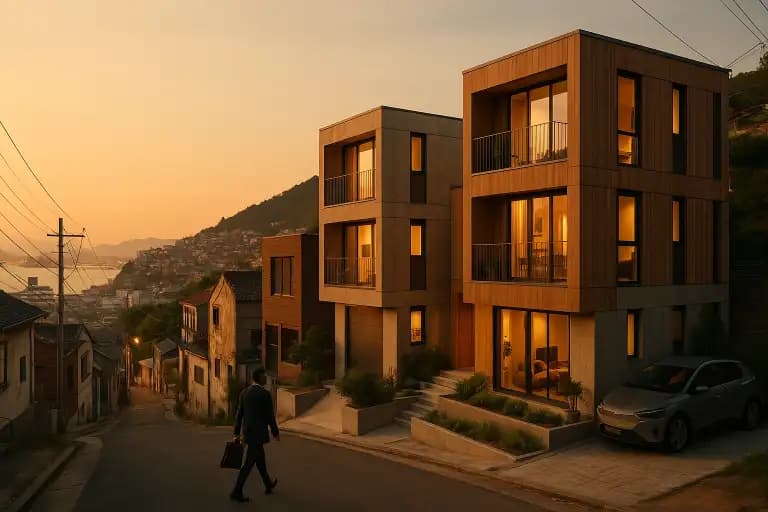
There is, however, a practical alternative to conventional development that has received little attention in current planning discourse. Modular housing—factory-produced, code-compliant units that can be installed on constrained urban land—offers a viable response to the unique spatial, economic, and temporal challenges of Busan’s historic core.
Unlike large apartment projects that require land clearance, years of permitting, and extensive capital, modular construction can be deployed quickly and incrementally. Units can be placed on vacant lots or sites cleared of derelict buildings. They can be scaled to fit narrow plots and even sloped terrain, which dominates much of the Dong-gu landscape.
Modern modular systems meet all necessary building code standards, including fire safety, structural integrity, and thermal performance. They are not stopgap shelters. With proper materials and design, they can provide durable, energy-efficient, and aesthetically flexible housing for long-term use.
Multi-story configurations are feasible, and site planning can accommodate parking, shared amenities, or mixed uses. Most importantly, the construction timeline is condensed: a project that might take 18 months through conventional methods can be completed in half that time using modular delivery.
From a policy and legal standpoint, there are no prohibitive barriers. South Korean law treats modular homes as standard buildings if they comply with existing codes. More relevant is the Vacant Houses and Small-Scale Housing Redevelopment Act, which enables municipalities to simplify procedures and provide regulatory flexibility when projects target abandoned sites or public-use housing.
Dong-gu qualifies on multiple fronts: it is an officially designated regeneration area, it meets national criteria for demographic decline, and it contains multiple clusters of vacant or obsolete homes within walking distance of key infrastructure.
Funding channels are already in place. The Ministry of Land, Infrastructure and Transport has allocated new resources for urban regeneration through modular construction, including demolition support and land preparation grants. LH Corporation, the national public housing agency, has implemented similar projects in cities like Jeonju.
There, modular homes were installed on cleared sites with public subsidies, providing affordable rental units and shared facilities in previously stagnant neighborhoods. Local programs in Busan have also supported home renovation and rent stabilization in exchange for fixed-term leases to priority residents, such as young workers or low-income households.
Internationally, other cities have followed similar paths. In Yokohama, Japan, municipal authorities partnered with civic groups to activate vacant homes through renovation incentives, some of which included modular retrofits or extensions. In the UK, the Oxley Woods project offered affordable, prefabricated eco-homes, though the initiative later suffered setbacks due to construction defects and inadequate oversight.
These examples highlight both the promise and pitfalls of modular development: it can deliver speed and quality when carefully managed, but it requires strict attention to detail, proper governance, and long-term operational planning.
What distinguishes Dong-gu is its alignment of conditions. It faces housing pressure from a defined, time-bound government relocation; it has a concentration of idle land unsuitable for traditional development; and it sits within a broader national conversation about equitable urban regeneration. These are the conditions under which modular strategies are not just appropriate, but necessary.
This is not a matter of architectural innovation. It is a question of policy execution. The national government has committed to institutional decentralization. If that commitment is to mean more than geographic relocation, it must include functional support systems—starting with housing.
Modular construction, applied strategically to Busan’s old city center, would demonstrate that decentralization can adapt to context rather than impose uniform urban forms on places that cannot support them.
At the same time, modular housing provides a defensive policy tool to counter early signs of speculation. Since the relocation announcement, local real estate listings have dropped by more than 7 percent, and prices for mid-size apartment units have surged by 500 million KRW in some cases.
These are not indicators of healthy market adjustment, but of speculative repositioning. A centralized rollout of modular housing, administered through public-sector leasing or co-op-based tenure, could temper price shocks and secure available stock for actual relocating workers. Residency conditions or income thresholds could be embedded directly into tenancy agreements to prioritize real demand over profit-driven transactions.
The physical form of the neighborhood also supports such an approach. Dong-gu is defined by its steep hillsides and maze-like alleys, where high-rise towers are both technically and socially disruptive. Modular housing can adapt to narrow sites, irregular lots, and elevation changes.
Rather than fighting the topography with excavation-heavy construction, modular builds can work with it—stacked along ridges, terraced on slopes, or built above parking decks that double as structural platforms. These design adaptations are already used in compact urban environments across East Asia.
There is also a broader symbolic value in choosing this approach. For decades, South Korea has equated high-density development with progress, and high-rise apartments with modern living.
But as urban conditions change—aging populations, shrinking households, and the environmental burden of large-scale construction—that model is increasingly out of step with what cities like Busan need.
High-quality, low-rise modular homes could offer a different narrative: one that values integration over scale, and precision over spectacle.
Finally, modular housing opens a practical path for linking residential policy with urban regeneration. By distributing housing units across multiple sites, public planners can layer in small-scale mobility investments, sidewalk extensions, or micro-hubs for social services. The result is not just housing, but stitched-infrastructure—urban repairs that can evolve with community needs.
The ministry’s relocation is a rare opportunity to align national intent with local potential. If used wisely, it can serve as the foundation for a new housing model: decentralized, adaptable, and grounded in the real constraints and capacities of the city.
If decentralization is to be more than symbolic, it must begin where people live—and be built in forms that match the places they come to inhabit.
Continue this reporting
Reporting on the same issue
Related coverage selected from the article's desk, topics and newsroom relationships.
 NewsSep 20, 2026
What It Takes for U.S. Navy Repair Work to Become a Busan Industry
HJ Shipbuilding has brought U.S. Navy maintenance work to Yeongdo. Whether it...
 NewsSep 17, 2026
Busan’s Finished Homes, Unfinished Projects
Busan’s unsold homes sit in one monthly total, but they belong to very differ...
 NewsSep 16, 2026
Busan’s Young-Adult Migration Turns Sharply at 25–29
Busan can still draw young adults into the city, but keeping them becomes far...
More from the author
More from this byline
Stay with the same line of reporting through more work from this byline.
- NewsSep 17, 2026
Busan’s Finished Homes, Unfinished Projects

Editorial Record
Corrections, sourcing notes and newsroom disclosures remain part of the published record. View Newsroom Notes →
Reader Signal
Community readWhat did this report leave you with?
Choose the signal that best reflects your reading. Select it again to remove it.
One response per article
No response selected
A moderated conversation about the reporting.
One-level replies and newsroom moderation keep the conversation anchored to this article.
Discussion Status
Open
Please sign in to join the discussion.
Newsletter
Weekly reporting and context from Busan and Korea.