Maritime Institutions Alone Won’t Secure Busan’s Future — University Reform Will
The relocation of the Ministry of Oceans and Fisheries and a proposed maritime court won’t make Busan a global maritime hub unless paired with structural integration of its fragmented national universities.

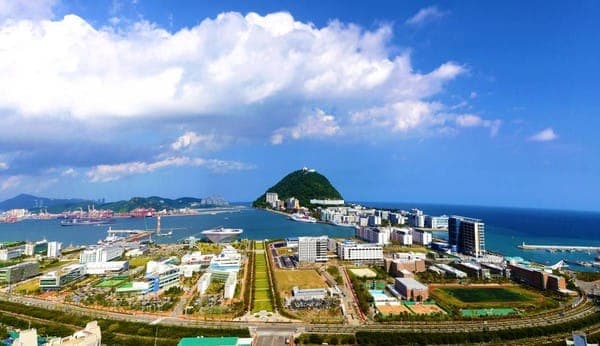
Busan, South Korea — In the lead-up to South Korea’s 21st presidential election, the city of Busan announced an expansive policy agenda to position itself as a global maritime capital. The blueprint includes more than 140 trillion KRW in proposed investments across 32 projects, ranging from a new airport expansion and logistics mega-hubs to initiatives in AI, mobility, and urban tourism. While the relocation of the Ministry of Oceans and Fisheries has appeared in national political platforms—particularly those of opposition parties—Busan’s official roadmap notably excludes any formal proposal for such a move. Instead, the city has focused on measures within its direct administrative reach, most prominently the establishment of a specialized maritime court, intended to anchor legal authority closer to coastal and port operations.
Yet strikingly absent from this ambitious vision is any serious investment in the intellectual infrastructure that would sustain it. Nowhere in the plan is there a roadmap for higher education reform, regional talent development, or the creation of world-class academic institutions aligned with maritime policy, law, or science. In a strategy that leans heavily on physical relocation and industrial infrastructure, education — the foundation of long-term leadership — remains a blind spot.
A maritime court without a supply of maritime lawyers, arbitrators, and scholars will struggle to assert national or international relevance. A ministry without proximity to researchers, graduate institutions, and cross-sectoral policy laboratories risks becoming an isolated administrative outpost. Institutions cannot function in isolation; their effectiveness is inseparable from the knowledge ecosystems that support them.
This is why Busan’s strategy must evolve beyond infrastructure and relocation. It must begin to address structural reform at the academic level — starting with the integration of its fragmented national university system. Pusan National University, Korea Maritime & Ocean University, and Pukyong National University each hold valuable expertise, but they operate in silos, duplicating efforts while diluting potential. A unified, functionally specialized national university structure — modeled on global standards — is essential not only for producing talent, but for embedding the city’s policy ambitions within an enduring intellectual framework.
True transformation lies not in where institutions are placed, but in how they are empowered to lead. Busan must not only host the offices of maritime governance; it must become their intellectual and strategic engine.
Why Talent and Education Cannot Be Afterthoughts
Busan’s current trajectory reflects a familiar pattern in regional development: the heavy emphasis on physical infrastructure, symbolic institutions, and political signaling. While such investments can be catalysts for growth, they rarely deliver sustainable leadership in complex, knowledge-based sectors — especially when not paired with reforms in education and human capital development.
In the case of maritime governance, these gaps become particularly pronounced. A specialized court cannot operate effectively without a pipeline of trained maritime legal professionals, including judges, arbitrators, insurance specialists, and academic experts. Likewise, a relocated ministry will be limited in its ability to formulate and execute cutting-edge ocean policy without proximity to maritime economists, marine engineers, environmental scientists, and interdisciplinary research centers. The infrastructure may be in place, but the intellectual machinery is missing.
Currently, Busan’s university ecosystem is underpowered to meet these demands. Pusan National University, Korea Maritime & Ocean University, and Pukyong National University each possess niche strengths — yet they remain divided, underfunded, and often in competition for limited resources. There is no single institution in the region capable of producing a comprehensive, integrated cohort of maritime professionals across law, policy, technology, and science.
This is not a matter of academic prestige alone. Without the necessary educational infrastructure, Busan cannot attract high-caliber foreign students or faculty. It cannot retain its own best and brightest. And it cannot claim to lead in maritime governance while outsourcing the production of maritime expertise to Seoul, London, or Singapore.
In short, without academic and talent infrastructure reform, Busan risks becoming a city that hosts maritime institutions — but does not lead them.
Reimagining Busan’s University System
If Busan is to transform from a host city into a true leader in maritime governance, it must begin by reconfiguring the intellectual infrastructure that underpins any such ambition. This means moving beyond fragmented institutional arrangements and establishing an integrated, functionally specialized national university system — one designed not for administrative convenience, but for strategic competitiveness.
Pusan National University, Korea Maritime & Ocean University, and Pukyong National University each contribute to different dimensions of maritime knowledge. However, they do so within isolated frameworks, duplicating programs and diluting resources that, if combined under a shared governance model, could form the core of East Asia’s most comprehensive maritime academic hub.
This integration need not take the form of a rigid administrative merger. Rather, it could adopt a federated or consortium model — one that preserves institutional identities while enabling joint degrees, shared research infrastructure, and coordinated international recruitment. A unified framework would allow each campus to specialize further: one focusing on maritime law and policy, another on ocean engineering and shipping logistics, and a third on fisheries, environmental science, and sustainability. Such a structure would not only optimize resources but also establish clear academic “value propositions” that resonate with both domestic and global stakeholders.
Precedents for such integration already exist. The University of California system, for example, coordinates globally ranked institutions like UC Berkeley, UCLA, and UC San Diego under a unified structure — each with distinct areas of academic leadership, but all operating under a single public mission and governance model. Japan’s national university reforms similarly empowered regional institutions like Tohoku University and Kyushu University through legal and administrative consolidation, creating powerful research ecosystems aligned with national strategic needs. Singapore, widely recognized for its academic competitiveness, has used targeted investment and strong institutional coordination to position the National University of Singapore (NUS) and Nanyang Technological University (NTU) as leading centers in maritime law, engineering, and technology.
These examples demonstrate that integration is not only feasible — it is transformative. For Busan, such a model could enable the establishment of Korea’s first specialized graduate schools in maritime law and international shipping policy, drive foreign faculty recruitment, and attract elite students seeking globally relevant programs in a strategically located city.
In essence, integration is not about university efficiency. It is about capability. It is about equipping Busan with the institutional weight and academic sophistication to not just support, but shape the future of maritime governance — both nationally and internationally.
To lead in maritime governance, Busan must invest not just in ports and policies — but in people, programs, and the universities that shape them.
Busan’s maritime vision is bold, ambitious, and grounded in the city’s history and geography. But ambition without infrastructure is rhetoric — and infrastructure without strategy is risk. The relocation of key institutions like the Ministry of Oceans and Fisheries and the establishment of a maritime court may capture headlines, but without deep structural reform in education and talent development, these efforts risk becoming symbolic rather than transformative.
The integration of Pusan National University, Korea Maritime & Ocean University, and Pukyong National University is more than an academic issue. It is the intellectual foundation upon which Busan’s entire maritime future depends. Only through a unified, specialized, and internationally competitive academic ecosystem can Busan provide the legal minds, policy innovators, engineers, and researchers who will give substance to its national leadership role.
This is not about building more buildings. It’s about building capacity. It’s not about moving ministries. It’s about empowering missions. As global cities compete for leadership in blue economy sectors, Busan must not simply aim to host maritime institutions — it must become indispensable to them.
Continue this reporting
Reporting on the same issue
Related coverage selected from the article's desk, topics and newsroom relationships.
 NewsOct 16, 2026
What Is Still Worth Going to See?
Busan’s biennale faces questions of artistic judgment and institutional care....
 NewsOct 14, 2026
What Became of Busan’s University Streets?
From 2015 to 2023, registered businesses grew near Pusan National University...
 NewsOct 12, 2026
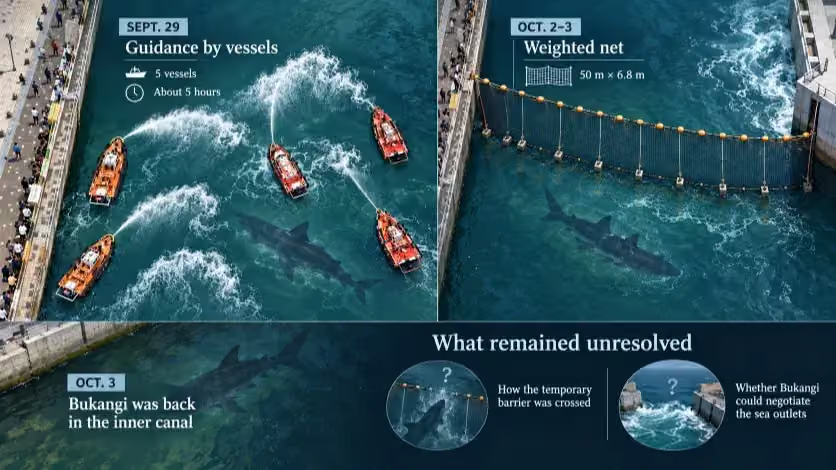
Bukangi, the Shark That Stayed in Busan’s North Port
A rescue net guided Bukangi toward the sea, but the dusky shark returned to B...
More from the author
More from this byline
Stay with the same line of reporting through more work from this byline.
 NewsOct 9, 2026
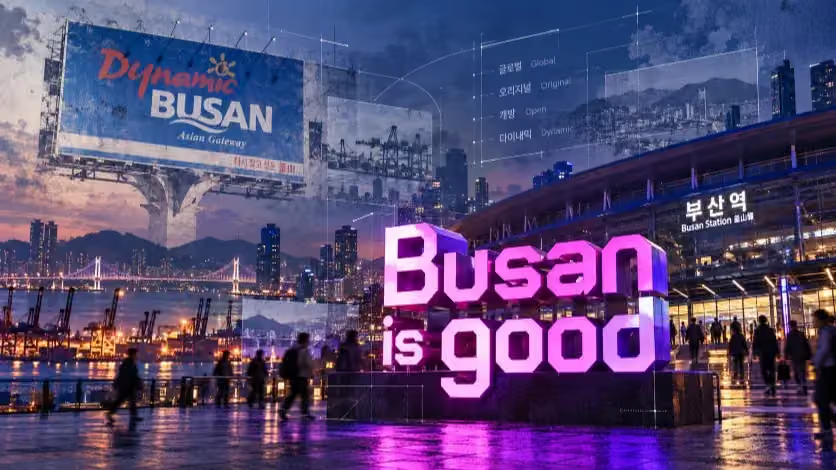
Why “Busan Is Good” Falls Short as a City Brand
 NewsSep 18, 2026
The Other AI Race Is for the Freedom to Change Course
Reader Signal
Community readWhat did this report leave you with?
Choose the signal that best reflects your reading. Select it again to remove it.
One response per article
No response selected
A moderated conversation about the reporting.
One-level replies and newsroom moderation keep the conversation anchored to this article.
Discussion Status
Open
Please sign in to join the discussion.
Newsletter
Weekly reporting and context from Busan and Korea.