Hydrogen BuTX Faces an Uncertain Future in Busan
Busan’s ₩4.8 trillion BuTX project promises a transport revolution, but untested hydrogen rail, fragile finances, and geology raise doubts.

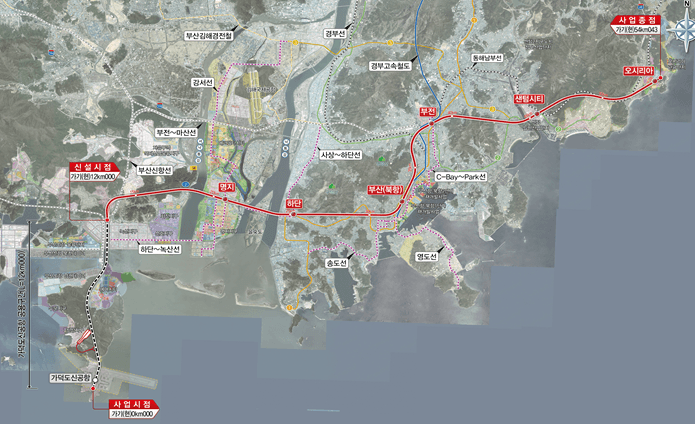
Busan, South Korea — Busan is preparing to launch one of the most ambitious infrastructure projects in its history: the Busan Next-Generation Express Railway, or BuTX. Designed as a high-speed underground line powered by hydrogen fuel, the project carries a price tag of nearly ₩4.8 trillion and a promise to cut the journey from Gadeok Island’s planned international airport to the city’s eastern districts to just 15 minutes.
For a city long constrained by geography, the appeal is obvious. Mountains and rivers divide Busan into separate corridors, limiting the reach of existing subway and road systems. City leaders have framed BuTX as a “transport revolution,” an artery that could overcome these natural barriers and reposition Busan as a hub for the broader southeastern region.
Yet the project’s ambition is matched by its uncertainty. Hydrogen trains have never been operated in the kind of high-frequency, deep-tunnel environment that BuTX requires. The financing model leans heavily on private capital and optimistic ridership projections, echoing past rail ventures that left local governments burdened with deficits. And beneath the city’s streets lies another obstacle: unstable marine clay that has delayed and derailed previous underground projects.
The political stakes are no less significant. The Korea Development Institute approved BuTX for private investment in October 2025, just months before local elections. For Mayor Park, the project is not only a transportation plan but also a centerpiece of his political legacy.
BuTX, then, stands at a crossroads between vision and feasibility. It is conceived as the line that will redefine mobility across Busan. But whether the city has the technical, financial, and institutional capacity to make that vision real remains an open question.
The Technology Gamble
The technological centerpiece of BuTX is also its greatest uncertainty: a fuel-cell–powered hydrogen railway, unprecedented for an entirely underground, high-frequency express network. While hydrogen multiple units like Alstom’s iLint entered service in 2018, those trains ran on surface-level regional lines at low frequency, not in deep tunnels with headways of just minutes. Transferring that experience underground represents a leap ahead of the regulatory frontier: European safety studies such as HyTunnel-CS have only issued pre-normative recommendations on hydrogen dispersion, ignition, and ventilation, meaning no binding standards yet exist for confined environments.
At the technical core is fuel-cell durability under metro conditions. Research shows that polymer electrolyte membrane (PEM) stacks degrade significantly faster under dynamic stop-and-go cycles, with start/stop stresses accelerating catalyst loss and voltage decay. What is a manageable duty cycle for regional trains becomes an accelerated wear environmentat metro frequencies, shortening replacement intervals and raising maintenance costs. These effects are not hypothetical; experimental and modeling studies confirm that load cycling and partial-load operation materially shorten stack life, undermining predictable operations.
The underground setting compounds safety and engineering risks. Hydrogen is the lightest and most volatile element; even a minor leak in a poorly ventilated tunnel can accumulate, raising the risk of ignition and overpressure. Studies highlight that ventilation geometry, purge logic, and sensor density are decisive for safety margins underground. Yet Busan would be operating ahead of codified design rules, where engineers must make high-stakes decisions with only provisional guidance.
Infrastructure requirements also extend beyond conventional rail practice. High-pressure storage tanks, dedicated refueling hubs, periodic stack replacements, and continuous mechanical ventilation must be integrated station by station. These needs compete for scarce underground volume, complicating design and inflating costs. Regulators in the U.S. and Europe have already noted gaps in existing railway safety frameworks when applied to hydrogen fuel cells, urging interim “best practices” rather than hard standards.
Even reported “proof points” need careful qualification. Trials of iLint units cite hydrogen consumption around 0.20–0.24 kg/km in open-air, low-frequency service. Such figures cannot be simply extrapolated to deep, high-frequency tunnel operation, where ventilation loads, gradients, and tight timetables materially alter energy use. Indeed, several European operators have since pivoted back to battery-electric systems, judging them more cost-efficient for comparable corridors.
For Busan, then, the gamble is not just hydrogen itself, but whether fuel-cell technology can withstand metro-scale duty in deep underground tunnels without prohibitive costs or risks. For city officials, hydrogen promises a green, high-tech image. For engineers, it presents a harsher test: to pioneer an operating model that even better-resourced systems have so far avoided.
The Fragile Economics of BuTX
If technology is the first gamble, the financing is no less precarious. Busan has structured BuTX under a Build-Transfer-Operate (BTO) model, inviting private investors to fund construction in exchange for long-term operating rights. On paper, this eases the burden on city coffers. In practice, Korea’s track record with such projects is mixed at best.
The Gimhae Light Rail remains a cautionary tale. Conceived under a similar framework, it quickly missed ridership forecasts and has relied on public subsidies ever since. Taxpayers, not private financiers, became the safety net. BuTX risks repeating this on a much larger scale: ₩4.77 trillion in initial construction costs, plus uncertain operating expenses tied to hydrogen storage and fuel cell maintenance.
Fare levels remain unsettled. Early reports floated a range of ₩2,500 to ₩5,000 for the longest trip—from the planned Gadeokdo International Airport to the resort area of Osiria. But those numbers are provisional, not binding. Final fares will hinge on multiple variables: ridership elasticity, operational costs, and whether government support is provided. If fares are set high, daily commuters may turn away; if kept low, the operator may struggle to recover costs. Both paths carry risk.
Compounding the uncertainty is the airport itself. Gadeokdo International has not yet begun construction, and its timeline remains unclear. Anchoring fare models and ridership forecasts to a facility that does not yet exist adds another layer of speculation to the project’s financial foundation.
The contrast with the capital’s GTX (Great Train Express) is telling. GTX-A, B, and C routes were also framed as public-private partnerships, but they rest on a vast and dependable suburban commuter base. Even then, costs have surged by 20–30 percent over initial estimates, and government intervention has been required to stabilize the model. BuTX, by comparison, lacks that same commuter density. Its demand projections lean heavily on airport traffic and tourism—flows inherently volatile and exposed to external shocks.
Even assuming healthy passenger numbers, operational economics remain uncertain. Unlike GTX, which runs on electricity from a mature grid, BuTX must finance and operate an entirely new hydrogen infrastructure. Fuel cell replacement cycles, continuous tunnel ventilation, and high-pressure refueling facilities add costs that BTO financial models have not yet fully absorbed.
For now, the project is sold as “private investment.” Yet if costs escalate or revenues disappoint, history suggests the city will face pressure to provide subsidies, shield investors from loss, or raise fares. In that event, the public may discover that the financial risk never truly left their shoulders.
The Ground Below – Geology and Infrastructure Risks
Beneath Busan lies another layer of uncertainty. The western districts, where much of the BuTX alignment is planned, sit on soft marine clay and unstable ground. These conditions have already challenged multiple infrastructure projects. The Hadan–Sasang line, for instance, suffered tunnel collapses and long delays, pushing costs far beyond projections. Contractors withdrew from bids on the Hadan–Noksan line, citing soil instability. BuTX proposes to carve a deeper and longer tunnel through the same geology, with higher speeds and stricter tolerances.
Tunnel construction in soft clay is notoriously fraught. Soil compression can trigger settlement, distorting tunnels and damaging surface structures. Subsidence is not only a construction hazard but a long-term maintenance liability: rails can shift, water can seep in, and costly reinforcements may be needed for decades. Engineers can mitigate risks with ground freezing, deep foundation methods, or grout injection—but such measures drive costs sharply upward.
Complicating matters further is Busan’s already crowded subsurface. The city has struggled with sinkholes, ruptured water mains, and gas leaks in recent years. Much of its underground utility network is aging and poorly mapped. Integrating a high-speed hydrogen rail beneath this patchwork risks conflicts with existing pipelines, drainage, and metro tunnels. Each new alignment decision raises the potential for disruption above ground and unforeseen engineering complications below it.
Unlike Seoul, which has developed layered underground transport and utility systems over decades, Busan’s subterranean management framework is less mature. BuTX would demand a level of geotechnical precision and urban coordination that the city has yet to demonstrate. The question is not only whether the tunnel can be built, but whether it can be built safely, on time, and within budget in an environment where past projects have already stumbled.
The Problem of Overstatement in BuTX’s Presentation
When the city of Busan announced that the BuTX rapid rail project had cleared the government’s investment feasibility review, the tone suggested a breakthrough achievement. Mayor Park Heong-joon spoke of a “transportation revolution” and promised a city transformed into a 15-minute living sphere. Travel times were presented as fixed outcomes—18 minutes from the new airport to North Port, 33 minutes to East Busan—while the integration of hydrogen-powered trains was framed as a world-first technological success.
Yet these claims rest on uncertain ground. Clearing a feasibility review is only an early procedural step, not a final guarantee of construction or operation. Environmental assessments, disaster impact reviews, land-use negotiations, and the securing of a private operator all remain unresolved. By presenting preliminary milestones as if they were definitive, the city risks misleading the public and eroding trust should the timeline slip or the project face setbacks.
The project’s positioning is also politically sensitive. With Busan having lost its bid to host the 2030 World Expo, the city’s leadership has been under pressure to deliver an alternative vision. The BuTX announcement, coming only months before a new election cycle, bears the hallmarks of a compensatory narrative: an ambitious infrastructure promise elevated into a symbol of resilience and renewal. This framing, however, veers toward exaggeration.
Even the technical and financial foundations are unsettled. The airport that BuTX is supposed to serve—Gadeokdo International—has yet to finalize its bidding and construction schedule. Without clarity on the airport’s opening, anchoring the rail line’s debut to its launch appears speculative. Fare levels, presented in some media as ranging between 2,500 and 5,000 won, are not fixed, and real-world travel times are subject to operational conditions. Hydrogen rail technology itself, particularly in deep underground alignment, remains largely untested in Korea.
In this light, the problem is not that Busan has a bold transport vision, but that the vision was announced as though it had already overcome its uncertainties. A balanced civic discourse would have stressed the contingencies, risks, and unresolved stages. Instead, the rhetoric of revolution and inevitability suggests a political performance more than an engineering or financial milestone.
The Unfinished Test of BuTX
At this stage, the railway represents neither revolution nor inevitability. It is a test—of Busan’s institutions, its political leadership, and its willingness to confront engineering and financial realities without illusion.
The uncertainties are plain. Hydrogen rail has yet to prove itself in the unforgiving environment of deep tunnels. The financing rests on a public–private model that, in Korea, too often ends with public bailouts. Beneath the city, unstable marine clay threatens delays and overruns, while an aging underground infrastructure leaves little margin for error. None of these issues are abstract; they are the very risks that undid previous projects, from light rail ventures that missed demand forecasts to metro lines that stalled in collapsing ground.
But the stakes are not only technical or financial. They are civic. BuTX will test whether the city can level honestly with its residents about risks and trade-offs. Every promise of “15 minutes” that later becomes 30, every fare estimate that doubles, every subsidy disguised as private capital will be measured not only in balance sheets but in the erosion of trust. And once that trust is lost, it is not easily rebuilt.
This is why the rhetoric of revolution is dangerous. A project still facing environmental reviews, unproven technology, and unsettled costs should not be framed as fait accompli. To do so risks locking the city into a path that tolerates no revision, even when evidence demands it. The wiser course is transparency: acknowledging what remains unresolved, what may need to change, and what the limits are.
If BuTX succeeds, it could place Busan at the frontier of urban transport, pioneering a model that other cities study and emulate. If it fails, the damage will extend far beyond sunk costs. It will weaken confidence in public institutions, deepen cynicism about political promises, and make future infrastructure projects even harder to pursue.
For now, BuTX remains an open trial. What Busan proves—or fails to prove—will reveal not only whether the city can build a railway, but whether it can balance ambition with responsibility. The test ahead is not just one of engineering, but of governance, candor, and the durability of civic trust. And if that trust collapses, the cost will not be measured in won alone, but in the credibility of the city itself.
Continue this reporting
Reporting on the same issue
Related coverage selected from the article's desk, topics and newsroom relationships.
 NewsSep 20, 2026
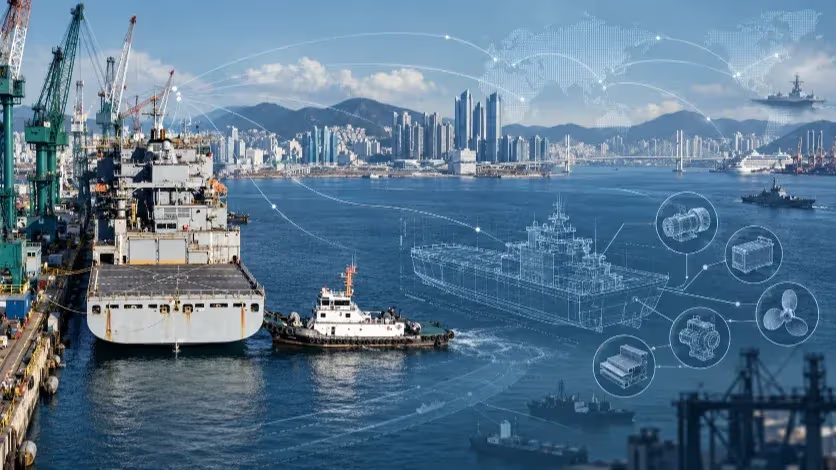
What It Takes for U.S. Navy Repair Work to Become a Busan Industry
HJ Shipbuilding has brought U.S. Navy maintenance work to Yeongdo. Whether it...
 NewsSep 17, 2026
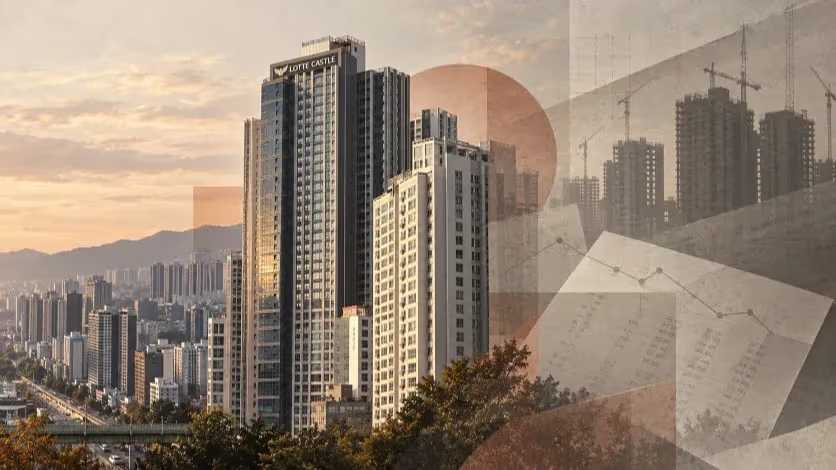
Busan’s Finished Homes, Unfinished Projects
Busan’s unsold homes sit in one monthly total, but they belong to very differ...
 NewsSep 16, 2026
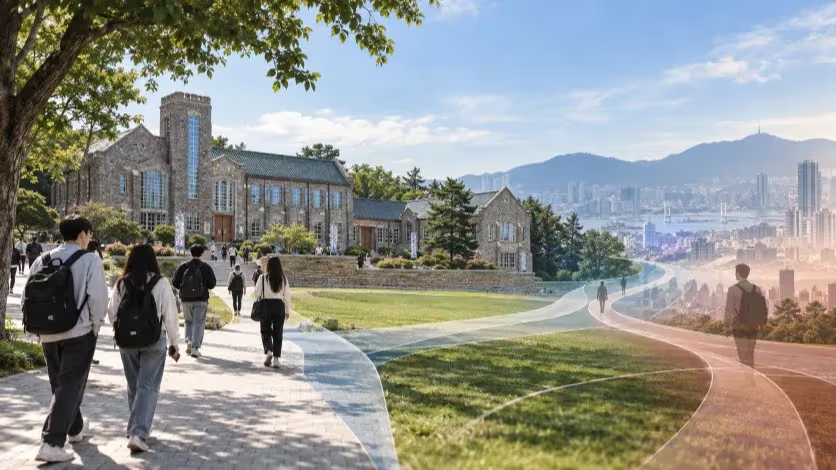
Busan’s Young-Adult Migration Turns Sharply at 25–29
Busan can still draw young adults into the city, but keeping them becomes far...
More from the author
More from this byline
Stay with the same line of reporting through more work from this byline.
- NewsSep 17, 2026
Busan’s Finished Homes, Unfinished Projects
Editorial Record
Corrections, sourcing notes and newsroom disclosures remain part of the published record. View Newsroom Notes →
Reader Signal
Community readWhat did this report leave you with?
Choose the signal that best reflects your reading. Select it again to remove it.
One response per article
No response selected
A moderated conversation about the reporting.
One-level replies and newsroom moderation keep the conversation anchored to this article.
Discussion Status
Open
Please sign in to join the discussion.
Newsletter
Weekly reporting and context from Busan and Korea.