How Busan’s Redevelopment Model Must Evolve
Busan is building higher, but not necessarily better. As the city doubles down on high-rise redevelopment, critics argue that infrastructure, affordability, and climate resilience are being left behind.

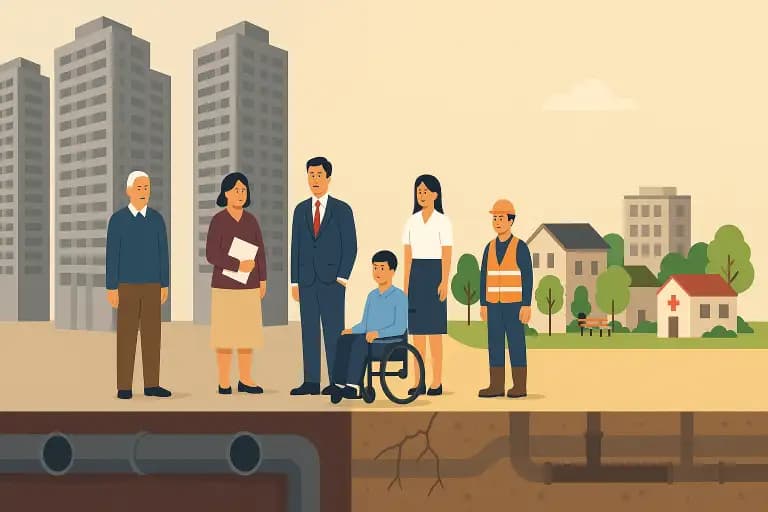
BUSAN, South Korea — On the ridges and alleys of Busan’s inner core, two eras of urban ambition are colliding. Gleaming apartment towers—some topping 40 storeys—rise swiftly across districts like Beomcheon and Choryang, promising “smart living” and skyline prestige. Yet below these towers, the ground tells a different story: fire trucks stalled in 4-meter alleys, stormwater bubbling out of 1970s-era pipes, and elderly residents sweeping monsoon floods from crumbling kitchens.
It is a dissonance no longer unique to Busan. Across the globe, the vertical model of redevelopment—build high, build fast, densify relentlessly—is coming under scrutiny. In 2024 alone, the global count of new high-rises over 200 meters fell by more than 30%, according to the Council on Tall Buildings and Urban Habitat. Rising carbon standards, shifting demographics, and infrastructure bottlenecks are forcing cities to confront a new question: not just how to grow up, but how to grow wisely.
Busan, however, remains wedded to the tower-led playbook. In its post-industrial core, dozens of mega-projects replicate the same typology: uniform 84㎡ units in slab-and-tower formations, stacked atop aging sewers and constrained roads. The physical consequences—flooding, heat islands, evacuation bottlenecks—are now accompanied by social and economic mismatch. Over 36% of households in Busan are single-person, yet few new homes reflect that scale. Local builders are sidelined, and skyline sameness erodes the coastal city’s famed view corridors.
Critics, including urban economists and infrastructure planners, warn that Busan is reaching an inflection point. Without a strategic shift—from building form-first to infrastructure-first, from height to hybrid, from speculation to sustainability—the city risks hardcoding future dysfunction into its built environment.
Yet a quiet alternative is beginning to take shape. A four-pillar redevelopment framework—emphasizing infrastructure-first investment, mixed-density urban morphology, diversified housing tenure, and transparent public return mechanisms—is gaining traction among urban economists and planners. Some experts argue that Korea’s aging cityscapes, marked by both redevelopment pressure and infrastructural fragility, are uniquely positioned to pilot such a shift.
Whether it will, or whether it simply builds higher on brittle ground, may define the face—and the fragility—of Korea’s second city for decades to come.
The Limits of Busan’s Tower-Led Urbanism
For over two decades, Busan’s formula for urban renewal has followed a predictable arc: demolish aging low-rise housing, consolidate parcels, and erect clusters of high-rise towers. It is a model that delivers visible transformation—density, elevation, capital flows—but beneath the glass façades and marketing slogans lies a widening infrastructural and social disconnect.
At the core of the strain is a temporal mismatch. Much of Busan’s inner-urban fabric was laid between the 1950s and 1980s, when neighborhoods like Yeongdo, Choryang, and Munhyeon were built atop 300-millimetre sewer lines, narrow two-lane roads, and patchwork electrical systems. In many cases, those same subsurface utilities remain untouched even as 30- and 40-storey towers now rise overhead. A 2024 audit by the Busan Metropolitan Government found that more than 42% of all redeveloped zones suffer from post-construction infrastructure deficits, including substandard drainage, fire-access obstructions, and transformer overloads.
The physical risks are escalating. During the 2023 monsoon season, over 70% of flood damage reports came from districts that had already undergone redevelopment. In one widely reported incident, emergency responders were delayed nearly 20 minutes navigating narrow access roads in a newly completed tower complex. “We are building vertical cities on horizontal systems that no longer function,” one city engineer told this paper. “The pipes don’t match the population.”
Demographics compound the imbalance. As of 2024, single-person households account for 36.4% of homes in Busan, and that number is projected to exceed 40% by 2030. Yet redevelopment continues to deliver a monoculture of 84 m², three-bedroom units—designed for the now-rare nuclear family. The mismatch has already begun to surface in market data: vacancy rates in large-unit towers are quietly rising, while mid-sized rentals and studio apartments remain in undersupply.
The economic logic behind this uniformity is simple: lenders and developers prefer scale and predictability. But the outcome is architectural sameness and market overhang. Analysts warn of a potential “reverse-jeonse” spiral, where unoccupied large units drive rents downward and hollow out investor returns—especially in towers that will soon require high-cost retrofits for elevators, HVAC, and exterior cladding.
The skyline itself is also under scrutiny. Critics point to the erosion of Busan’s iconic topography—its stepped hills, open sky corridors, and coastal vistas. Tower blocks, often oriented for maximal floor-area ratios, create visual walls that sever urban permeability and wind flow. In districts like Suyeong and Dongrae, once defined by sloped alleys and sea breeze, residents now report heat-island effects and shadowing that linger into evening.
Beneath all of this runs a more structural concern: market and governance concentration. Five major chaebol builders now capture close to 75% of all public redevelopment contracts in the city, according to a 2024 HUG report. Their design and construction models—while efficient—are optimized for repetition. Small- and mid-sized firms, often better equipped for mid-rise or mixed-use formats, are effectively excluded from the planning table.
And yet, change is slow. Zoning codes still reward height and floor-area maximization. Approval processes are streamlined for uniformity. And with infrastructure funding treated as an afterthought, few incentives exist for developers to build anything but what already fits the mold.
In the end, Busan’s skyline may be rising—but so are its service costs, vacancy risks, climate vulnerabilities, and resident disaffection. As the contradictions multiply, planners and policymakers face a narrowing window in which to recalibrate the system. What is needed is not more height, but a new hierarchy: systems before silhouettes.
Reframing the Model: A Ground-Up Contract for Urban Renewal
If Busan is to move beyond its current high-rise orthodoxy, the shift will not come from rejecting density outright—but from rethinking what density should be grounded upon. Increasingly, planners and urban economists are converging on a different starting point: not how high a building can rise, but what the ground beneath it can support—physically, socially, and ecologically.
This reversal in logic marks the beginning of a new urban contract. It reframes redevelopment not as a one-way delivery of towers, but as a negotiation among systems: infrastructure, household structure, and shared urban resources. From this reordering, four interlocking principles are emerging.
The first is sequencing: infrastructure must come first. Rather than laying pipes and cables after towers are built, this approach calls for cities to pre-invest in upgraded drainage, stormwater buffers, pedestrian access, and utility trenches before any vertical development begins. It’s a method not yet mainstream in Korea but gaining attention, particularly as floods and fire hazards continue to expose the fragility of overburdened networks. Aligning infrastructure delivery with redevelopment approvals could help restore public trust and reduce the costly retrofits now common in post-redevelopment zones.
Second is the principle of morphological diversity. Current redevelopment in Busan tends to replicate a narrow typology: 30- to 40-floor towers on podium parking. But cities thrive when built form responds to terrain, airflow, and human scale. A more balanced morphology—combining low-rise terraces, mid-rise blocks, and slender towers—can preserve view corridors, enhance walkability, and better reflect the range of housing needs. Design guidelines that limit any single typology to no more than half the district’s floor area may ensure such variety becomes the norm, not the exception.
Equally vital is the question of who lives in the city—and how. A diversified tenure model, already tested in parts of Seoul, introduces a mix of land-lease units, affordable rentals, cooperative housing, and market-rate homes within the same plan. This not only accommodates different income brackets but helps original residents remain in redeveloped areas—a challenge Busan has yet to overcome. Long-term affordability mechanisms, such as public land leases or resale caps, offer a path toward inclusive renewal without relying solely on state subsidies.
Finally, redevelopment must clarify who benefits—and how. Under current systems, the gains from increased density often accrue privately, while the costs of supporting infrastructure fall to the public. A more transparent value-capture model would tie each additional square metre of floor area to measurable public returns. Through tools like “amenity tokens,” the link between private profit and public good could be formalized: every bonus granted to a developer would translate into a direct investment in childcare facilities, green space, or flood mitigation within the neighborhood itself—tracked through open ledgers and enforced by policy, not discretion.
These principles are not radical in isolation. But applied together, they constitute a profound shift—from skyline-first urbanism to a ground-first strategy. In Busan, where the costs of the status quo are becomin
Global Winds Shift Against High-Rise Orthodoxy
As climate targets tighten and urban priorities evolve, the once-unchallenged reign of the residential tower is being reconsidered.
Across major cities, the residential high-rise—long hailed as a symbol of modernity, density, and architectural ambition—is undergoing a quiet but profound reappraisal. Verticality, once seen as a default route to urban efficiency, is now facing scrutiny on multiple fronts: ecological, social, spatial, and financial. From New York to Paris, from Seoul to Stockholm, the question is shifting—from how tall to why taller?
A primary driver of this shift is climate legislation. In New York, Local Law 97 has introduced binding carbon caps for buildings over 25,000 square feet—including residential towers. Developers must now assess not only operational energy use, but also the full lifecycle emissions of concrete-and-steel construction. Many are finding that the embodied carbon costs of tall buildings—in foundation work, structural cores, curtain walls, and HVAC systems—exceed their floor-area efficiencies. Across Europe, similar policies in the UK and France now mandate whole-life carbon assessments, prompting architects to reevaluate whether height aligns with net-zero commitments. Unless construction technologies advance significantly, most high-rise typologies remain at odds with mid-century climate goals.
Beyond emissions, spatial and environmental concerns are reshaping the skyline. Paris, long a model of low-rise coherence, has reaffirmed strict height controls following public resistance to experimental projects like the Tour Triangle. Vancouver and London have tightened design review processes for tall buildings, factoring in view corridor preservation, solar access, and wind microclimate. The underlying message is clear: cities are more than density engines—they are lived environments. And in such environments, porosity, human scale, and rhythm matter just as much as unit yield.
Economically, the logic behind high-rise residential has also come under review. In cities like Toronto and Melbourne, height bonuses are now contingent on affordable housing provision and public space contributions—eroding the profit margins of ultra-tall projects. When coupled with energy-efficiency mandates, inclusionary zoning, and open space quotas, the financial calculus often favors mid-rise formats. Developers are increasingly embracing hybrid forms: six to fifteen storey courtyard blocks, terraces, and slender towers—offering density with lower risk and higher adaptability.
Material science, too, is placing limits on height’s dominance. While timber-hybrid structures offer promise as a low-carbon alternative, current engineering best practice caps their feasibility at around 20–30 storeys. The result: a global shift toward “gentle density”—urban typologies that prioritize mix over monumentality, and systems coherence over skyline drama. Stockholm, Tokyo, and Barcelona are already modeling this transformation: diverse morphologies, locally anchored uses, and infrastructure synchronized from below.
In parallel, the policy logic is evolving. Where once planners pursued vertical growth as a proxy for value creation, height is increasingly treated as a conditional privilege—granted only when tangible public benefit is delivered. New development frameworks tie floor-area incentives to libraries, childcare, flood infrastructure, or on-site energy systems. In Korea as well, this principle is taking root. Yet its implementation remains uneven—highlighting a gap between intent and outcome.
For Busan, these global signals offer both caution and opportunity. The city continues to approve uniform 40-storey apartment clusters on legacy grids—many still resting atop 300mm sewer lines laid in the 1970s. This disconnect between vertical ambition and horizontal capacity is not just a technical problem. It is a reflection of an outdated paradigm: one that privileges repetition over resilience, and scale over suitability.
Cities around the world are now reversing that course—not abandoning density, but rethinking its delivery. For Busan, the lesson is urgent: the future of sustainable urbanism lies not in building taller, but in building smarter—through diversified form, infrastructure-led planning, and an architecture of shared benefit.
What Needs to Change
Even as Busan begins to reckon with the limitations of its high-rise-led redevelopment paradigm, the shift toward a more sustainable, infrastructure-first and socially inclusive model remains halting. Awareness may be growing, but meaningful change is still obstructed—not by a lack of ideas or intent, but by the deep structure of how the city plans, builds, and finances urban transformation.
At the core of the problem is a sequencing failure. In much of Busan’s redevelopment practice, vertical construction continues to precede horizontal preparedness. New residential towers rise first; sewer systems, storm drains, road capacity, and utility infrastructure are upgraded later—if at all. This reversal is not just a bureaucratic oversight. It reflects a systemic financing challenge. Under current Korean law, cities have no clear mechanism to capture future land value increases as a source of upfront capital. Without tools like municipal bonds or infrastructure impact levies, local governments struggle to fund essential groundwork before approving large-scale private development.
The governance structure itself compounds this inertia. Urban planning, utility management, housing supply, and climate adaptation remain housed in separate departments, each pursuing narrow mandates with limited coordination. Cross-sectoral alignment typically relies on informal negotiation rather than institutionalized processes. In such a fragmented environment, redevelopment models that combine mixed-use typologies, tenure diversity, and public-benefit frameworks often get diluted—if not derailed entirely—during implementation.
The financing ecosystem further reinforces the status quo. Korea’s project finance (PF) market is optimized for conventional, high-rise, for-sale apartment blocks that offer predictable, front-loaded returns. More complex models—such as those including leaseholds, social housing, or cooperative ownership—are often considered too risky or too unfamiliar for mainstream lenders. Without public guarantees or de-risking instruments from state-backed entities like the Housing and Urban Guarantee Corporation (HUG), these alternatives rarely move beyond the conceptual stage.
Cultural norms add another layer of resistance. In the Korean housing imagination, the high-rise apartment remains a potent symbol of modernity, affluence, and upward mobility. For many buyers—particularly older generations—mid-rise or low-rise housing is still perceived as second-tier, regardless of its environmental or architectural advantages. This cultural preference narrows consumer demand, making it harder for developers to justify more diverse or nuanced typologies.
Even where policy tools exist to promote smarter redevelopment—such as Busan’s Small-Scale Renewal Zones or floor-area bonuses tied to public amenities—they are often treated as optional, symbolic, or marginal to the main business of maximizing yield. Without binding standards, transparent value-capture mechanisms, and infrastructure-linked enforcement criteria, the incentive structure continues to favor expedient, tower-centric growth.
Yet despite these headwinds, signs of momentum are emerging. A small but growing network of academics, mid-sized developers, and community advocates are pushing for pilot projects that can test a new redevelopment paradigm—one grounded in mixed density, infrastructure-first planning, and social return. Planners are experimenting with “One Table” coordination models, in which housing, engineering, finance, and community stakeholders co-design from the outset. Emerging digital platforms aim to make public contributions and infrastructure readiness trackable in real time, bridging the trust gap between developers and residents.
Still, pilot projects are not policy. For this shift to scale, a more comprehensive reset is required. That means enacting legal frameworks for land-value financing. It means building unified permitting regimes that reward systemic integration, not just vertical ambition. It means creating financial guarantees for mixed-tenure developments—and launching public campaigns to reframe what high-quality urban living looks like in the 21st century.
Busan does not lack technical capacity. It lacks, as many cities do, a coherent mechanism to align economic incentives, public interest, and physical design. The question is no longer whether better models exist—they do. The real question is whether Busan can summon the political imagination and institutional will to implement them before the window for regenerative urbanism closes.
Rewriting the Urban Contract: From Expansion to Intention
Cities do not simply grow—they declare. In the way they shape skylines, sequence infrastructure, and allocate space, cities reveal what they value most. In Busan, the last generation of urban redevelopment has spoken in a singular vocabulary: height, repetition, acceleration. But as floodwaters rise, aging pipes fail, and social dislocation widens, that vocabulary no longer describes a sustainable urban future.
The costs of a tower-first model—environmental, social, and infrastructural—are no longer abstract. They are measurable in flood-prone alleys, displaced households, and oversaturated grids. These are not incidental failures, but symptoms of a development logic that equates form with function, scale with success, and private investment with public good. If Busan is to remain liveable, inclusive, and climate-resilient, it must negotiate a new kind of contract: one that reconnects the vertical with the horizontal, the financial with the communal, the built with the lived.
This contract must be enacted in policy, not just principle. It will require tangible tools: financial mechanisms like land-value bonds to fund groundwork before ground-breaking; urban codes that embed morphological diversity, not just FAR quotas; and planning frameworks that reward longevity over speed, and inclusion over uniformity. It will also require governance structures that enable cross-sector alignment—from utility agencies to housing departments—and digital systems that track public return in real time.
Perhaps most importantly, it will demand a recalibration of urban ambition itself. True progress may no longer lie in reaching higher, but in building smarter—around soils and systems, heritage and households. Cities around the world have already begun this recalibration. Some have learned to regenerate without erasing; others have learned to extract equity from density, not just capital. The lessons are there.
Busan does not need to reinvent the idea of the city. But it must reimagine what kind of city it wants to be—and how it will be built, not just upwards, but together.
Continue this reporting
Reporting on the same issue
Related coverage selected from the article's desk, topics and newsroom relationships.
 NewsOct 23, 2026
Busan’s Twelve-Year School Account Faces a Test Beyond Access
Busan’s PENZ promises one school account for 12 years, while BeAT brings AI t...
 NewsOct 22, 2026
Busan Port’s LNG and Methanol Plan: Who Pays to Keep Fuel Ready?
Busan already supplies ships with LNG and methanol, drawing on regional and i...
 NewsOct 16, 2026
What Is Still Worth Going to See?
Busan’s biennale faces questions of artistic judgment and institutional care....
More from the author
More from this byline
Stay with the same line of reporting through more work from this byline.
 NewsOct 21, 2026
What a Small Mackerel Is Worth

Reader Signal
Community readWhat did this report leave you with?
Choose the signal that best reflects your reading. Select it again to remove it.
One response per article
No response selected
A moderated conversation about the reporting.
One-level replies and newsroom moderation keep the conversation anchored to this article.
Discussion Status
Open
Please sign in to join the discussion.
Newsletter
Weekly reporting and context from Busan and Korea.