How Busan’s BRT Is Redesigning the City From the Ground Up
Busan’s expanding BRT network has improved travel times, but its most lasting achievement may be how it redefines the role of streets. As the city grows and ages, ground-level, pedestrian-friendly mobility is no longer optional — it’s foundational.

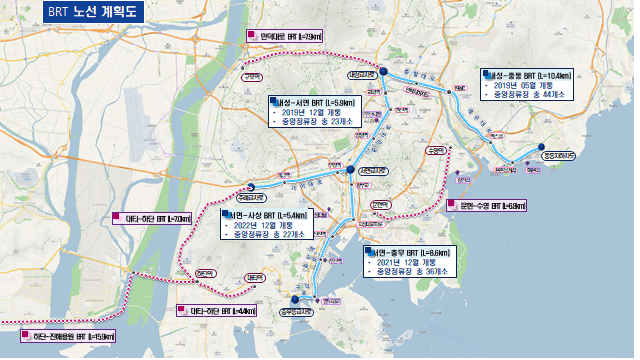
Busan, South Korea — Over the past decade, South Korea’s second-largest city has been quietly rewriting the role of the street. With the introduction of Bus Rapid Transit (BRT) corridors, Busan has done more than streamline its public transportation system — it has begun to reimagine its streets as shared, human-scale spaces. In a city long shaped by fast-moving cars and narrow sidewalks, BRT has offered a new logic: that streets should first serve the people who walk, wait, and live alongside them.
Dedicated bus lanes have not only improved travel times, but helped reduce the dominance of private vehicles in the public realm. Sidewalks have widened. Crosswalks have been reoriented toward new bus stations. Trees, lighting, and street furniture have made once-hostile roads more navigable. In many places, the BRT stop has become a small plaza — not just a point of transit, but a social node within the neighborhood.
What began as a transportation initiative has become a subtle urban design revolution — one that treats movement not as an engineering challenge, but as a daily, lived experience. And now, as Busan prepares to expand this model to new corridors, the challenge is no longer just moving people efficiently, but sustaining a city where walking, waiting, and riding can happen with dignity.
How BRT Changed Busan’s Streets
When Busan first began carving out space for Bus Rapid Transit lanes in 2016, it was met with familiar resistance: fears of increased traffic, reduced car lanes, and longer travel times for drivers. But over time, the project began to reshape not only the flow of vehicles, but the feel of the city itself.
The most visible change was spatial. Major roads like Haeundae-daero and Jungang-daero, once dominated by private cars and endless turning lanes, began to take on a more balanced structure. Bus-only lanes now cut cleanly through the center of these corridors, flanked by newly organized sidewalks and signalized crossings. Where once pedestrian access was fragmented and secondary, it became primary — with transit stations acting as new centers of gravity for street life.
Design played a quiet but powerful role. Elevated shelters provided shade and seating. Trees and lighting created visual continuity. Information panels and tactile paving signaled that these were not just functional spaces, but dignified ones. In many neighborhoods, residents report that the BRT stop is now easier to reach on foot than the nearest subway entrance — not only because of geography, but because of clarity, openness, and safety.
The psychological shift is equally important. Riders no longer wait uncertainly by the curb, hoping their bus will arrive on time. With dedicated lanes and improved scheduling, the system encourages confidence — not just in the vehicle, but in the public realm it inhabits. Streets once treated as conduits for speed are becoming spaces of pause and interaction. BRT has, in effect, redrawn parts of the city to be more human.
BRT as Urban Infrastructure
The early phases of Busan’s BRT system demonstrated that dedicated bus lanes could do more than move people—they could transform the way streets function and feel, particularly for those on foot. Now, the city is preparing to scale that vision.
As of 2024, Busan operates four primary BRT corridors totaling approximately 30.3 kilometers, running through major urban axes such as Haeundae-daero, Jungang-daero, and Saha-gu. Building on this foundation, the city plans to expand the system by an additional 27.1 kilometers across three new corridors, all incorporated into the national infrastructure plan. These include a 6.8-kilometer link from Munhyeon to Suyeong, a 4.4-kilometer extension from Daeti to Hadan, and a 15.9-kilometer route connecting Hadan to Jinhae—together forming a more continuous, cross-district network.
Upon completion, Busan’s BRT system will comprise seven corridors spanning 57.4 kilometers, connecting key commercial, residential, and transit zones through a reliable and accessible surface-level rapid transit service.
What makes these plans notable is not just their scale, but their intent: to deepen integration and accessibility. While city officials point to improvements in speed, ridership, and punctuality as drivers of expansion, the deeper logic lies in walkability, shorter transfer distances, and a more human-scaled experience—especially in neighborhoods with poor subway access or difficult walking environments.
This expansion reflects a broader urban philosophy: that transportation infrastructure is not only about movement, but about the quality of movement. Each new corridor offers a chance to rethink the public realm—to rebalance traffic flows, enhance pedestrian safety, and provide dignified, legible spaces for everyday life. In this sense, BRT is as much about urban equity as it is about efficiency.
As Busan continues to grow and age, the value of a street-level, universally accessible transit network will only increase. If designed with care, the next phase of BRT will not simply extend the map—it will extend the city's commitment to becoming a more walkable, inclusive, and livable place for all.
Focus on What Needs to Improve
Busan’s BRT system has redefined how public transit shapes the city — not just in how people move, but in how they interact with the street itself. It has improved reliability, rebalanced road space, and brought new energy to previously car-dominated corridors. For many, it has made daily life more walkable, more predictable, and more dignified.
But as the city moves to expand this model, it must also face the challenges that remain. Many neighborhoods — especially those on hillsides or cut off by industrial zones — still lack safe, convenient access to these corridors. BRT stations may be walkable to some, but for elderly residents or those with mobility limitations, the last 200 meters can still be a barrier. And while new lanes are planned, they risk repeating the original blueprint unless they are paired with more inclusive design and localized service.
The success of Busan’s BRT lies not only in how far it moves people, but in how well it brings the city together. Its next phase must extend that promise — through better integration, stronger walkability, and more equitable access for all.
Continue this reporting
Reporting on the same issue
Related coverage selected from the article's desk, topics and newsroom relationships.
 NewsOct 16, 2026
What Is Still Worth Going to See?
Busan’s biennale faces questions of artistic judgment and institutional care....
 NewsOct 14, 2026
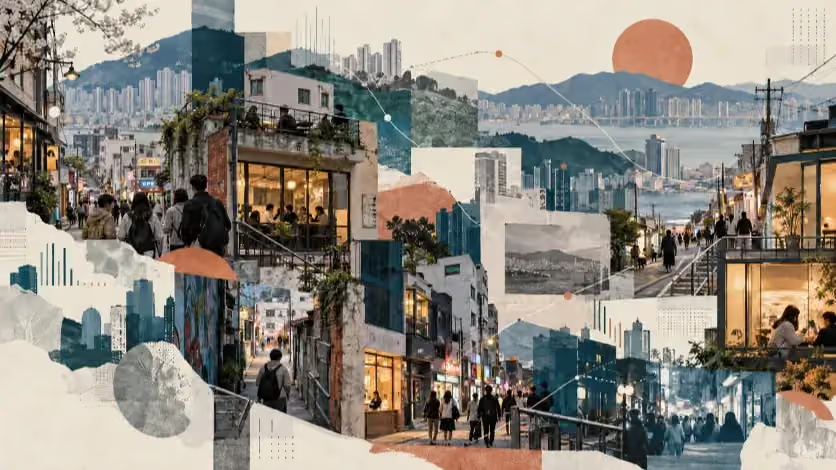
What Became of Busan’s University Streets?
From 2015 to 2023, registered businesses grew near Pusan National University...
 NewsOct 12, 2026
Bukangi, the Shark That Stayed in Busan’s North Port
A rescue net guided Bukangi toward the sea, but the dusky shark returned to B...
More from the author
More from this byline
Stay with the same line of reporting through more work from this byline.
 NewsOct 9, 2026
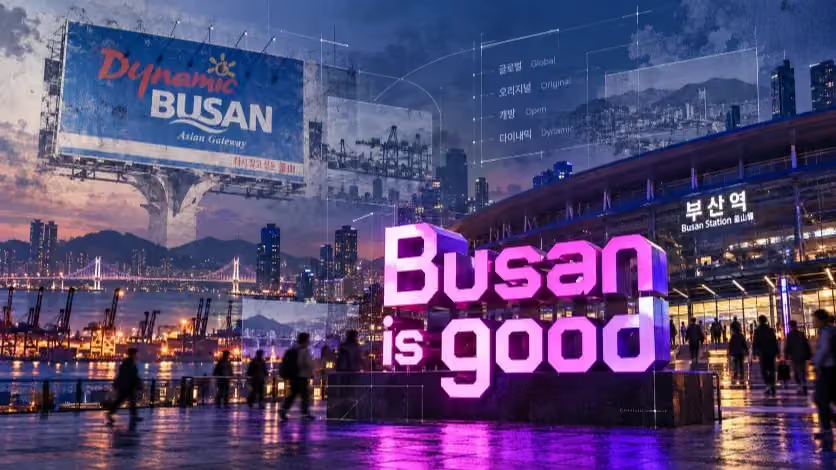
Why “Busan Is Good” Falls Short as a City Brand
 NewsSep 18, 2026
The Other AI Race Is for the Freedom to Change Course
Reader Signal
Community readWhat did this report leave you with?
Choose the signal that best reflects your reading. Select it again to remove it.
One response per article
No response selected
A moderated conversation about the reporting.
One-level replies and newsroom moderation keep the conversation anchored to this article.
Discussion Status
Open
Please sign in to join the discussion.
Newsletter
Weekly reporting and context from Busan and Korea.