Final Three Confirmed for World Expo 2030 Hosting: Busan, Rome, and Riyadh
The race to host the World Expo 2030 has been narrowed down to a three-way contest between Busan (South Korea), Rome (Italy), and Riyadh (Saudi Arabia). The Bureau International des Expositions (BIE), the governing body responsible for overseeing World Expos, officially confirmed the trio on the 20th. War-torn Odesa, Ukraine, has regrettably been withdrawn from the race. At the 172nd BIE General Assembly, the final three candidates were selected via member nation voting. The selection was based


The race to host the World Expo 2030 has been narrowed down to a three-way contest between Busan (South Korea), Rome (Italy), and Riyadh (Saudi Arabia). The Bureau International des Expositions (BIE), the governing body responsible for overseeing World Expos, officially confirmed the trio on the 20th. War-torn Odesa, Ukraine, has regrettably been withdrawn from the race.
At the 172nd BIE General Assembly, the final three candidates were selected via member nation voting. The selection was based on the realistic capability of these cities to host the Expo and their compliance with BIE regulations. Due to the ongoing war in Ukraine, the BIE executive committee concluded that it is virtually impossible for Odesa to prepare for the Expo, thus leading to its exclusion.
Over March and April, BIE examination teams visited Busan, Rome, and Riyadh for on-site evaluations. Due to the conflict in Ukraine, the assessment of Odesa was conducted via a video conference instead. The evaluation team scrutinized each candidate's submission, considering factors such as Expo motivation, theme appeal, post-Expo site use plan, national support level, and financial feasibility.
Busan presented the theme of "Transforming Our World, Navigating Toward a Better Future". Rome countered with "People and Territories: Urban Regeneration, Inclusion, and Innovation", and Riyadh proposed "Era of Change: Companionship for an Insightful Tomorrow".
The victorious city that will host the Expo 2030 will be decided in November at the BIE's 173rd General Assembly. The Assembly will hold a secret vote involving 179 member nations, operating on a one-nation, one-vote principle. To be selected as the final Expo host city, a candidate must garner the support of at least two-thirds of the attending member nations, given that at least two-thirds of all member nations are present.
If no city achieves this two-thirds majority, a re-vote will occur, excluding the city with the fewest votes. Once the race narrows down to the final two, the city with more votes will be chosen as the Expo host.
Known as "International Registered Exhibitions", these Expos are global events held every five years, continuing for up to six months with an expansive theme. Tens of millions of people from around the world visit the host city during the event period. The 1993 Daejeon Expo and the 2012 Yeosu Expo hosted by South Korea were not classified as "International Registered Exhibitions".
The most recent Expo, the "Expo 2020 Dubai", was held under the theme "Connecting Minds, Creating the Future", and attracted over 24 million visitors. The next Expo will take place in Osaka, Japan, from April 13 to October 13, 2025, under the theme of "Designing Future Society for Our Lives".
Continue this reporting
Reporting on the same issue
Related coverage selected from the article's desk, topics and newsroom relationships.
 NewsOct 16, 2026
What Is Still Worth Going to See?
Busan’s biennale faces questions of artistic judgment and institutional care....
 NewsOct 14, 2026
What Became of Busan’s University Streets?
From 2015 to 2023, registered businesses grew near Pusan National University...
 NewsOct 12, 2026
Bukangi, the Shark That Stayed in Busan’s North Port
A rescue net guided Bukangi toward the sea, but the dusky shark returned to B...
More from the author
More from this byline
Stay with the same line of reporting through more work from this byline.
 NewsOct 9, 2026
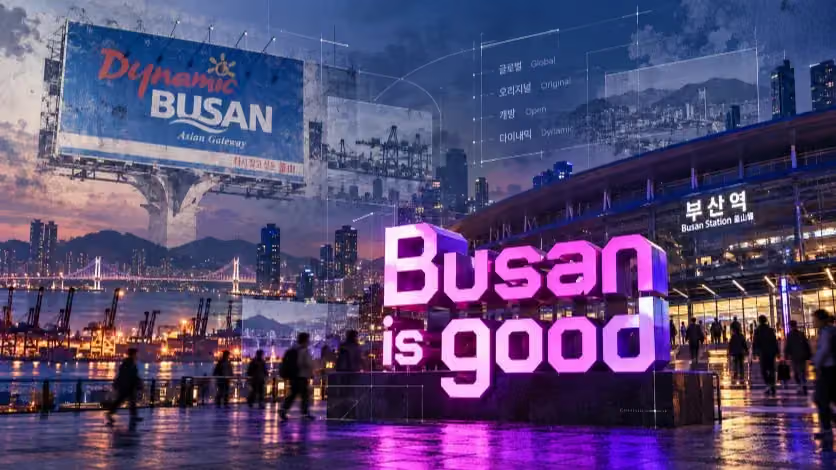
Why “Busan Is Good” Falls Short as a City Brand
 NewsSep 18, 2026
The Other AI Race Is for the Freedom to Change Course
Reader Signal
Community readWhat did this report leave you with?
Choose the signal that best reflects your reading. Select it again to remove it.
One response per article
No response selected
A moderated conversation about the reporting.
One-level replies and newsroom moderation keep the conversation anchored to this article.
Discussion Status
Open
Please sign in to join the discussion.
Newsletter
Weekly reporting and context from Busan and Korea.