Cyclists to Conquer Busan’s Bridges in First-Ever Seven Bridges Tour
On September 21, more than 3,000 riders will take part in the first Seven Bridges Tour: Riding in Busan—a non-competitive event.


Busan, South Korea — In a bold reimagining of urban space, the city of Busan will transform its iconic coastal infrastructure into a stage for large-scale public participation this fall.
On September 21, the metropolis will host the inaugural “Seven Bridges Tour: Riding in Busan,” a non-competitive cycling event designed to send thousands of riders over sea bridges, through tunnels, and across cityscapes in a 77-kilometer circuit that merges the built and natural features of the port city.
This marks the first time Busan’s network of vehicular bridges—typically reserved for motor traffic—will be opened exclusively to cyclists under full traffic control. The event’s route incorporates four of the city’s signature sea bridges, including the Gwangandaegyo (Gwangan Bridge), Busanhangdaegyo (Busan Port Bridge), Namhangdaegyo, and Eulsukdodaegyo Bridge.
In Korean, the word daegyo (대교) means “grand bridge,” a term commonly used to denote large-scale crossings that span rivers, ports, or coastal waters—names that reflect both their engineering scale and symbolic prominence in the urban landscape.
The course also includes two underground passages and one tunnel, forming a continuous loop that starts and finishes at BEXCO, the city’s major exhibition complex. The tour will proceed as a single-day ride between 7 a.m. and 11 a.m., during which time participating roadways will be fully closed to automobiles.
Organized by the Busan Metropolitan Government and its Festival Committee, the event is open to adults born before September 21, 2006, with eligibility limited to riders capable of maintaining an average speed of at least 25 kilometers per hour. E-bikes, motor-assisted bicycles, and bikes lacking brakes are excluded due to safety concerns.
Participants can choose between two course lengths: a 77-kilometer “Seven-Seven” route, which includes more technical segments such as the spiral ramp on Busan Port Bridge, and a shorter 33-kilometer “Three-Three” course with an earlier return point.
Ticket sales for the event will officially open on July 22 at 2 p.m. via the Yes24 Ticket platform. Standard registration is priced at 100,000 Korean won, approximately 75 U.S. dollars.
A group discount of 20 percent will be applied to teams of 30 or more, capped at 500 tickets. Demand for early entry has already proven intense, with an early-bird sale on July 16 selling out in under one minute. Each participant may purchase up to ten tickets.
Beyond the core cycling component, the tour will feature a variety of experiential attractions. The upper deck of Gwangan Bridge will be temporarily opened to pedestrians and non-racing cyclists for public events including a cycling parade and cultural showcases.
Additional programming will include bicycle safety education for children, live stunt demonstrations, mechanical support stations, and a curated food experience featuring Michelin-level chefs operating gourmet food trucks. The event also targets international visitors, with an estimated 1,500 foreign participants expected through regional sports tourism channels.
Public safety and traffic coordination have been a central focus of preparations. The city government has conducted operational planning meetings with the Busan Metropolitan Police, Fire Department, local universities, cycling organizations, and emergency services.
The event’s revenue will be partially reinvested into security staffing, traffic control, infrastructure upgrades, and participant amenities. Riders will receive official race kits including number plates, time chips, commemorative medals, and premium event merchandise.
The Seven Bridges Tour is the latest in a series of initiatives by Busan to position itself as a “global sports city,” integrating elements of recreation, tourism, and infrastructure branding.
The city has indicated plans to expand future editions of the tour, with discussions underway about adding new routes or bridge segments in coming years. While this year’s edition prioritizes experienced cyclists, future adaptations may allow broader public access and varying levels of difficulty.
With its fusion of coastline engineering and public participation, the Seven Bridges Tour offers a compelling model of how major urban infrastructure can be reinterpreted as a platform for civic engagement.
If successful, it could serve not only as a new annual fixture in Busan’s event calendar, but as a blueprint for other global cities seeking to activate their landscapes in similarly ambitious and participatory ways.
Continue this reporting
Reporting on the same issue
Related coverage selected from the article's desk, topics and newsroom relationships.
 NewsOct 23, 2026
Busan’s Twelve-Year School Account Faces a Test Beyond Access
Busan’s PENZ promises one school account for 12 years, while BeAT brings AI t...
 NewsOct 22, 2026
Busan Port’s LNG and Methanol Plan: Who Pays to Keep Fuel Ready?
Busan already supplies ships with LNG and methanol, drawing on regional and i...
 NewsOct 16, 2026
What Is Still Worth Going to See?
Busan’s biennale faces questions of artistic judgment and institutional care....
More from the author
More from this byline
Stay with the same line of reporting through more work from this byline.
 NewsApr 23, 2026
Gaza photo exhibition opens at Busan’s Arise Art Space
 NewsNov 10, 2025
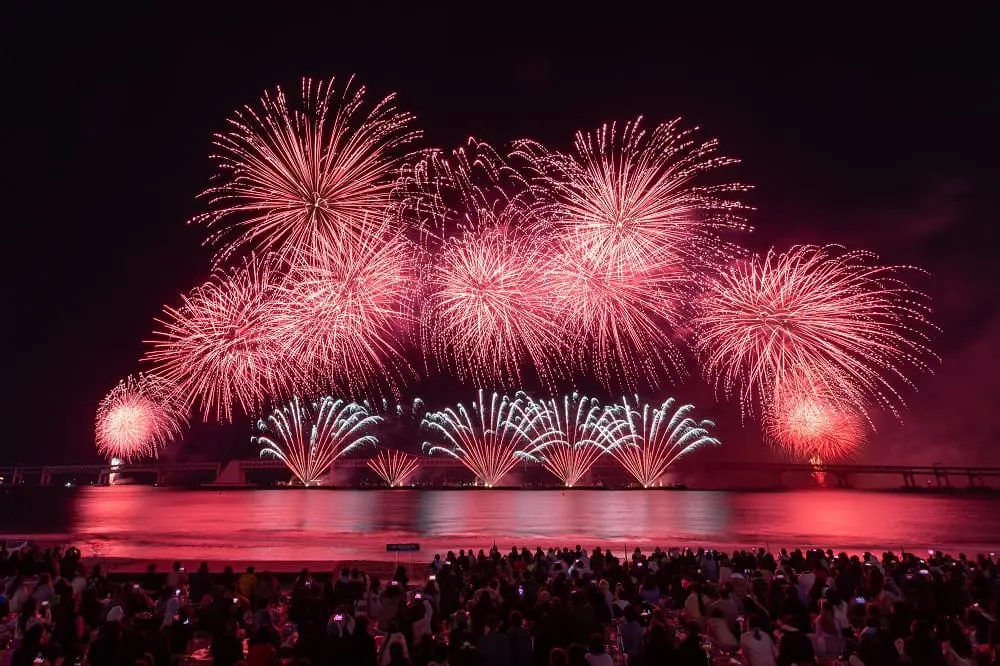
Busan Fireworks Festival Marks 20 Years With Expanded Show
Reader Signal
Community readWhat did this report leave you with?
Choose the signal that best reflects your reading. Select it again to remove it.
One response per article
No response selected
A moderated conversation about the reporting.
One-level replies and newsroom moderation keep the conversation anchored to this article.
Discussion Status
Open
Please sign in to join the discussion.
Newsletter
Weekly reporting and context from Busan and Korea.