Can Better Urban Design Solve South Korea’s Youth Loneliness Crisis?
In Busan and beyond, apartment towers rise—but so do youth suicide and isolation. What if the cure lies not in therapy, but in the street?


Busan, South Korea — In South Korea, suicide remains the leading cause of death among people in their teens and twenties. Despite national efforts to address mental health, youth isolation continues to grow. Experts increasingly point to structural issues that extend beyond the individual—specifically, the way cities are built and experienced.
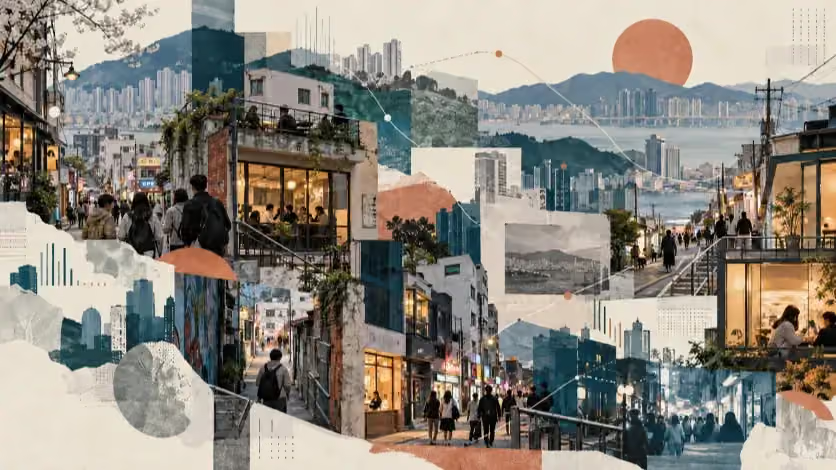
Nowhere is this more visible than in Busan, a city of striking geography and dense development. Towering apartment blocks rise between steep hills and coastal highways, yet opportunities for spontaneous human connection remain scarce. Public spaces are limited, pedestrian access fragmented, and the rhythms of daily life shaped more by efficiency than community.
As one of South Korea’s largest cities, Busan reflects a broader pattern: young people are living in urban environments that prioritize speed, privacy, and productivity, but fail to offer spaces for rest, gathering, or belonging. Urban design—long treated as a matter of function and form—is emerging as a critical, and often overlooked, dimension of the youth mental health crisis.
The Invisible Epidemic – Youth Loneliness in Korea
South Korea continues to record one of the highest youth suicide rates in the OECD, with suicide remaining the leading cause of death among people aged 10 to 29. According to data from Statistics Korea in early 2024, the overall suicide rate rose to 28.3 per 100,000 people, and rates among adolescents and young adults have shown an especially sharp increase.
Among teenagers, the suicide rate for middle school students rose from 3.19 to 4.61 per 100,000, while for high school students it increased from 5.50 to 8.39, reflecting heightened psychological distress in post-pandemic years. Meanwhile, the proportion of individuals in their twenties who died by suicide also rose by more than 5% compared to the previous year.
A growing body of national research suggests that these trends are not simply attributable to individual mental illness, but rather reflect deeper structural and environmental factors—among them, chronic social isolation, particularly in urban settings.
A 2023 report by the Ministry of Health and Welfare estimated that over 540,000 young people in South Korea (ages 19–34) experience serious social withdrawal, including nearly 244,000 who avoid any contact outside their home. Roughly 5.2% of all youth are considered at risk of long-term seclusion. In this group, three out of four report suicidal thoughts, and over half face declining mental health.
Experts increasingly describe this as a crisis of “structural loneliness.” As traditional community structures weaken and individual competition intensifies, many young people live alone in dense apartment towers, commute anonymously in crowded transit systems, and rarely experience informal social connection.
In Busan, the disconnect is especially visible. While the skyline grows more vertical, and neighborhoods more segmented, the everyday infrastructure for human interaction—shared courtyards, community spaces, pedestrian-friendly environments—remains limited or absent.
Cities Designed for Efficiency, Not Connection
For decades, South Korea’s urban development has been driven by a singular logic: efficiency. Cities have grown rapidly through large-scale apartment construction, high-speed transit systems, and commercial zoning designed to maximize movement, consumption, and housing density. While these policies addressed postwar housing shortages and fueled economic growth, they have produced an urban landscape that increasingly struggles to support community, rest, or social belonging.
In modern Korean cities, high-rise apartment blocks dominate residential zones, often enclosed and uniform. These complexes are efficient for land use, but socially inert. Shared courtyards or community rooms, if they exist, are typically underused or poorly maintained. Streets prioritize vehicular traffic over walkability. Public benches are rare. Libraries, parks, and social centers are disproportionately located in wealthier districts, making them inaccessible to many young residents in lower-income or peripheral neighborhoods.
Many cities, including Busan, follow a “functional zoning” model that separates housing from workplaces, schools, and recreation. As a result, everyday life becomes a cycle of commuting between sealed-off private and institutional spaces. This fragmentation minimizes chances for spontaneous interaction—no shared sidewalks, no casual gathering points, no real public living rooms.
Moreover, the rise of digital convenience has accelerated physical withdrawal. Food is delivered, meetings are virtual, shopping is online. Without public spaces that invite presence over transaction, young people increasingly conduct life indoors, alone.
In a dense yet disconnected urban fabric, the very infrastructure that sustains the city also reinforces loneliness. Housing is available, but homes lack neighborhood. Parks exist, but not within reach. Movement is fast, but destinations are isolating. The result is a city that works—logistically—but fails emotionally.
A City of Natural Beauty, Structural Isolation
Busan stretches between steep mountains and a sweeping coastline. Known for its beaches, ports, and cultural festivals, it has long marketed itself as a livable, picturesque city. But beneath its scenic surface, Busan reflects many of the spatial contradictions of modern Korean urbanism—and the emotional disconnection it can produce.
The city’s terrain is fragmented by geography: mountains divide neighborhoods, while sprawling road networks disconnect communities rather than bind them. Many older hillside areas—such as Gamcheon-dong, Yeongdo, and parts of Dong-gu—are composed of aging housing stock, narrow stairways, and irregular infrastructure. These neighborhoods are often cut off from reliable transit, green space, and shared facilities, deepening the sense of isolation among residents, particularly elderly people and low-income youth.
Meanwhile, newer developments in areas like Centum City, Haeundae, and Gijang follow a pattern of high-density residential towers surrounded by highways and commercial complexes. These spaces prioritize access and profit over human-scale interaction. Wide roads discourage walking. Public plazas are polished but empty. Shared housing is rare, and third places—informal gathering spaces like local cafés, libraries, or common rooms—are inconsistently distributed across the city.
For young people, Busan can be both overstimulating and profoundly lonely. Many live in one-room apartments with little access to community infrastructure. The university districts, such as those near Pusan National University or Kyungsung University, lack sufficient public facilities for social support. Post-graduation, many young residents leave the city altogether, citing limited career opportunities and a lack of social cohesion.
Despite Busan’s natural environment—mountains, rivers, and coastlines—urban design has largely failed to integrate nature into everyday life.
Green spaces are either tourist destinations or located on the city’s outskirts. For many residents, daily routines unfold in concrete corridors, with nature viewed from windows, not engaged on foot. In this way, Busan becomes a case study in contradiction: a city with the conditions for wellbeing, but without the connective tissue to make it real. A city full of people, yet not built for presence.
From Apartments to Belonging
The challenges facing young people in cities like Busan are not inevitable. They are the result of planning decisions—choices about what kind of housing is built, how public space is distributed, and which forms of mobility are prioritized. Addressing youth isolation requires more than mental health services. It requires a shift in how the city itself is conceived and constructed.
South Korea’s current model of urban development centers on high-rise apartments, private space, and infrastructural efficiency. These forms prioritize shelter over sociability, and access over encounter. Yet international models suggest a different path—one that centers belonging, interaction, and proximity.
In Denmark, the Superkilen park in Copenhagen was designed as a multicultural public space that encourages co-use across generations and backgrounds. In Tokyo, co-living housing models combine affordable private rooms with shared kitchens, lounges, and rooftop gardens—designed not just for space-saving, but for intentional community-building.
For Busan, the first step may be far more local: rethink the role of neighborhood. In hillside districts, small-scale interventions like public terraces, stairway gardens, and shared laundries could convert isolating topography into connective space. In apartment-heavy new towns, integrating community rooms, resident-run cafés, or rooftop commons into development requirements could transform vertical living into shared experience.
The emphasis must move from maximizing units to cultivating relationships. That means designing for chance encounters—benches on walking paths, seating at bus stops, flexible use libraries, modular parks. It means valuing walkability, visibility, and shared ownership. And it means treating urban space not as a backdrop, but as a social infrastructure.
Toward Emotional Infrastructure
In recent years, the “15-minute city” has gained traction as a planning ideal. The concept proposes that all essential services—work, food, healthcare, education, leisure—should be accessible within a 15-minute walk or bike ride from one’s home. Cities like Paris, Melbourne, and Seoul have begun to incorporate its language into urban policies, citing environmental sustainability, convenience, and reduced car dependence.
But for young people in South Korea’s cities, the problem is rarely how far things are. It is how disconnected they feel once they get there.
The “15-minute city” solves proximity. It does not guarantee presence. A convenience store or clinic down the block may tick a box on a planning chart, but if there are no public benches nearby, no trees for shade, no people to talk to—does it really count as access? Without designing for human emotion—comfort, visibility, interaction—the 15-minute city risks becoming a spatial checklist rather than a lived reality.
In Busan, where terrain, zoning, and vertical construction complicate walkability, the model faces even greater limits. A café may be within range, but separated by a six-lane road or 60-meter incline. More importantly, the surrounding spaces may offer no reason to linger, speak, or share.
What Korean cities need is not just proximity, but emotional infrastructure: physical environments intentionally designed to foster ease, recognition, and relationship. That includes not just roads and parks, but third places—spaces that are neither home nor work, where people can simply be with others.
It means designing for informality and fluidity: spaces where a stranger might become a neighbor, or where solitude doesn’t equal isolation.
A bench under a tree. A stairway landing turned into a storytelling platform. A public square that invites sitting without ordering. These details may seem small, but they offer what many young people crave: a reason to go outside, to stay a little longer, to maybe say hello.
Cities Must Design for Connection, Not Just Convenience
In the face of rising youth suicide, prolonged isolation, and a quiet epidemic of loneliness, South Korea’s cities can no longer afford to treat urban planning as a technical exercise. The layout of streets, the placement of benches, the design of housing—all of these shape how people relate to one another, whether they feel seen, and whether they feel they belong.
Busan, with its natural beauty and spatial complexity, holds a unique opportunity. It can become a testing ground for a new kind of urbanism—one that doesn’t just count units and roads, but counts relationships. A city where hillside stairways become meeting points, not barriers. Where public space is not an afterthought, but a foundation. Where young people are not left to disappear quietly behind apartment walls.
The question is no longer whether the city works. The question is whether people can live well in it—with others, not just around them. Urban design must evolve from engineering efficiency to cultivating empathy. From maximizing throughput to making space for presence.
In Busan, and across South Korea, the next phase of city-making must begin with a simple truth: connection is infrastructure too. Without it, cities may thrive on paper. But on the ground, people are quietly vanishing.
Continue this reporting
Reporting on the same issue
Related coverage selected from the article's desk, topics and newsroom relationships.
 NewsOct 16, 2026
What Is Still Worth Going to See?
Busan’s biennale faces questions of artistic judgment and institutional care....
 NewsOct 14, 2026
What Became of Busan’s University Streets?
From 2015 to 2023, registered businesses grew near Pusan National University...
 NewsOct 12, 2026
Bukangi, the Shark That Stayed in Busan’s North Port
A rescue net guided Bukangi toward the sea, but the dusky shark returned to B...
More from the author
More from this byline
Stay with the same line of reporting through more work from this byline.
- NewsOct 14, 2026
What Became of Busan’s University Streets?
 NewsSep 28, 2026
Why Some Commercial Space in Busan Is Hard to Reuse
Reader Signal
Community readWhat did this report leave you with?
Choose the signal that best reflects your reading. Select it again to remove it.
One response per article
No response selected
A moderated conversation about the reporting.
One-level replies and newsroom moderation keep the conversation anchored to this article.
Discussion Status
Open
Please sign in to join the discussion.
Newsletter
Weekly reporting and context from Busan and Korea.