Busan’s Real Estate Faith and the Hollowing of Industry
From ministry relocations to design-city branding, Busan keeps rebuilding its skyline without rebuilding its base. The city’s revival remains rhetorical—a choreography of anticipation where belief replaces productivity and motion stands in for progress.

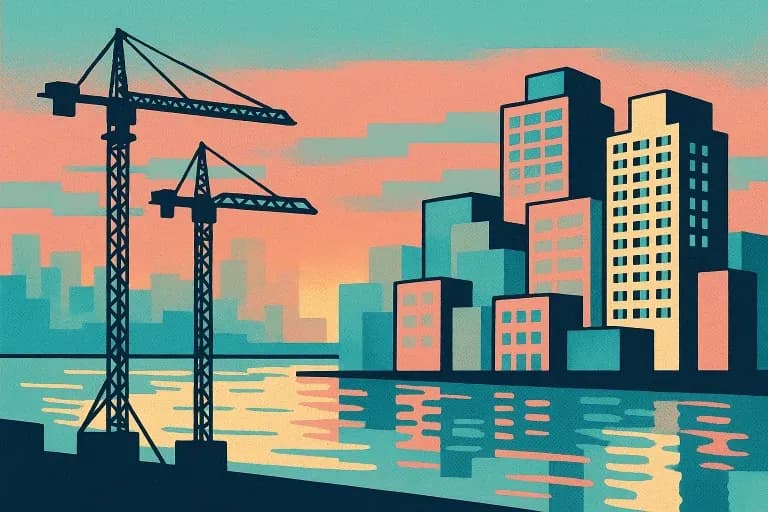
Busan, South Korea — When, in July 2025, South Korea’s Ministry of Oceans and Fisheries announced its relocation to Busan’s Dong-gu—designating the IM Building as its new base and Hyupseong Tower as an annex—the city’s property market reacted with familiar excitement. Banners offering “relocation specials” hung along the narrow harbor streets, and brokers spoke of “turning points” with the confidence of déjà vu. Yet the data that followed told a quieter story: transactions declined, listings multiplied, and prices rose only in conversation. What moved was not the market itself, but its mythology.
South Korea’s experiment in relocating government ministries has so far produced housing booms, not economies. Sejong, once the emblem of “balanced development,” now faces youth flight, retail stagnation, and an inwardly contracting market—its success measured in apartment prices rather than productivity. Yet Busan, the nation’s second city, appears to be tracing the same path: relying on bureaucratic migration, design branding, and speculative confidence to substitute for industrial renewal. The risk is not merely duplication of policy, but replication of failure.
According to the Korea Real Estate Board, Dong-gu saw no meaningful uptick in housing sales after the announcement. The district government, wary of speculative contagion, inspected thirty-two brokerages in Sujeong-dong and found minor infractions: expired listings left online to simulate activity, unauthorized assistants, and one firm fined ₩1.25 million for advertising a completed sale. The violations were technical, yet revealing—signs of a market where performance substitutes for progress.
Beneath that surface optimism, the numbers reveal an economy under demographic gravity. Busan’s population has slipped to 3.33 million, down more than 400,000 from its 1995 peak—a loss roughly equal to the entire population of Sejong, the nation’s administrative capital. What South Korea built anew in Sejong, it has quietly lost in Busan. Nearly a third of Dong-gu’s residents are now over sixty-five, and more than 114,000 homes across the city—about one in ten—stand vacant. The fertility rate, 0.66, is among the lowest in the country. Against this arithmetic, every redevelopment plan functions less as an economic strategy than as collective reassurance.
The city’s industrial foundation has eroded. Manufacturing—once anchored by shipbuilding, machinery, and component industries—now accounts for barely 12 percent of Busan’s gross regional product. Services dominate, but productivity lags, reflecting the same national pattern in which low-margin tertiary work employs most Koreans yet contributes modestly to growth. The port remains visually kinetic, but its energy is externalized: over 55 percent of Busan Port’s container throughput consists of transshipment cargo, freight that touches the city without entering its economy. The cranes still move; the factories do not.
Recent port data sharpen this paradox. In the second quarter of 2025, Busan handled 6.43 million TEUs, a 3.1 percentincrease year on year—a record volume—but almost all of that rise came from transshipment traffic. Nationwide, total cargo tonnage fell 2.2 percent, underscoring weak domestic demand and export softness. Busan’s logistics boom, in other words, conceals a hollow core: throughput without absorption, movement without metabolism.
Construction, long treated as a substitute for production, shows similar fatigue. Nationally, construction investment fell 1.5 percent quarter-on-quarter in Q2, while unsold housing in Busan reached 7,146 units by August—the highest level recorded. Developers have delayed waterfront projects as financing tightens and household formation slows. The North Port redevelopment—nearly two million square meters of planned hotels, offices, and residences—has become a landscape of renderings and cranes, a choreography of anticipation rather than habitation.
Busan’s embrace of “design-led revitalization” deepens the irony. The city has been named World Design Capital 2028, and its municipal campaigns now promote architecture, waterfront aesthetics, and lifestyle branding as economic strategy. Yet UNESCO recognizes Busan as a City of Film, not of Design; the title is civic marketing, not institutional endorsement. The underlying logic—that visual modernity can compensate for industrial decline—mirrors the speculative psychology of its property market. The skyline grows sleeker even as its employment base erodes.
The relocation of the Ministry of Oceans and Fisheries is therefore less an economic catalyst than a political symbol. A staff survey found 86 percent of employees opposed to the move, with only 32.5 percent expressing even conditional acceptance. Most plan to commute or maintain dual residences, limiting any demographic spillover. For local businesses, the immediate effects will be temporary—busier cafés, higher rents, fuller roads. Symbolically, however, the move reinforces Busan’s dependence on expectation: the belief that presence itself equals progress.
That belief has precedent. Two hundred kilometers inland, Sejong once embodied the same logic—the promise that administrative migration could animate a city. For a decade, it did. Sejong’s population tripled from 124,000 in 2013 to nearly 390,000 in 2022, buoyed by new ministries, public agencies, and a surge of apartment construction. Then the momentum stalled. As of mid-2025, Sejong’s population hovers just below 400,000, having declined for two consecutive months for the first time since its founding. The supply of new housing has slowed sharply: 135,000 units are occupied, only 65,000 remain to be built by 2030. Prices have tripled since 2010, while youth outmigration has accelerated—61 percent of those leaving are in their twenties, most bound for Seoul.
The result is a city of movement without motion. By day, offices fill with civil servants; by night, streets empty into silence. Retail sales lag, cafés shutter, and new construction has given way to vacancy. The city that was meant to embody balance now mirrors imbalance: a concentration of administration without accumulation.
Sejong’s trajectory exposes the flaw at the heart of Korea’s decentralization model. Relocation moves buildings, not economies. It redistributes presence without creating production. Public-sector migration, unaccompanied by private-sector formation, produces an illusion of growth—a geography of offices, not of opportunity.
Busan risks inheriting that illusion. Its pursuit of symbolic renewal—ministries, design titles, megaprojects—evokes the same logic that hollowed Sejong’s promise. Without industrial renewal and high-value employment, the arrival of a government ministry may bring motion but not metabolism.
If Busan’s predicament has a deeper resonance, it lies in what urban economists now call the expectation economy—a cycle in which cities substitute belief for growth. Each announcement revives momentum; each pause reveals the void beneath. Both Busan and Sejong embody that pattern: cities animated by confidence rather than creation, by hope that infrastructure alone can manufacture destiny.
Korea’s national development language remains bound to construction—to the conviction that revitalization means rebuilding. Yet the cranes that mark renewal now rise over aging populations, vacant homes, and stagnant industries. The North Port’s gleaming renderings promise a “global maritime hub,” but without the firms, talent, or technology to sustain it, the future risks being cosmetic.
Busan’s challenge is not whether property prices rise when the ministry arrives, but whether anything else does. What Sejong revealed, Busan now repeats: administrative relocation without industrial transformation produces movement without meaning. In both cities, the skyline shines while the foundation drifts.
Hope alone cannot power an economy; belief cannot replace work. Busan’s future will depend not on the arrival of officials, but on whether it can reimagine the value of creation itself.
Continue this reporting
Reporting on the same issue
Related coverage selected from the article's desk, topics and newsroom relationships.
 NewsOct 16, 2026
What Is Still Worth Going to See?
Busan’s biennale faces questions of artistic judgment and institutional care....
 NewsOct 14, 2026
What Became of Busan’s University Streets?
From 2015 to 2023, registered businesses grew near Pusan National University...
 NewsOct 12, 2026
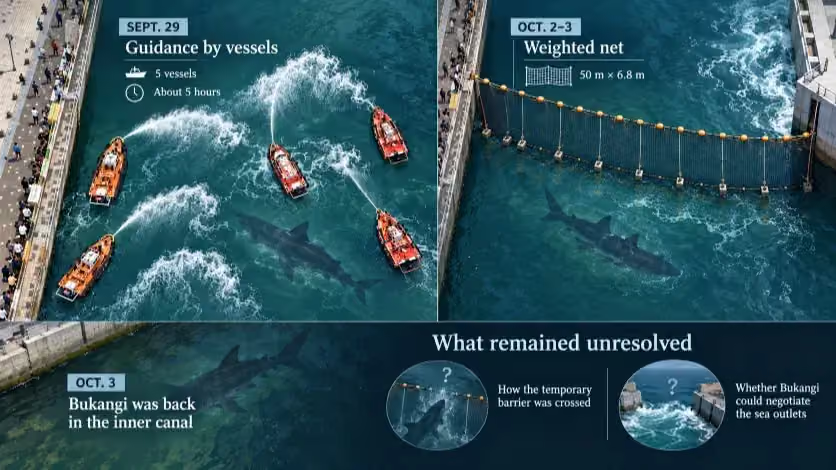
Bukangi, the Shark That Stayed in Busan’s North Port
A rescue net guided Bukangi toward the sea, but the dusky shark returned to B...
More from the author
More from this byline
Stay with the same line of reporting through more work from this byline.
- NewsOct 14, 2026
What Became of Busan’s University Streets?
 NewsSep 28, 2026
Why Some Commercial Space in Busan Is Hard to Reuse
Reader Signal
Community readWhat did this report leave you with?
Choose the signal that best reflects your reading. Select it again to remove it.
One response per article
No response selected
A moderated conversation about the reporting.
One-level replies and newsroom moderation keep the conversation anchored to this article.
Discussion Status
Open
Please sign in to join the discussion.
Newsletter
Weekly reporting and context from Busan and Korea.