Busan’s new Seobusan Medical Center brings care access and heavy obligations
Busan has secured construction of a long delayed hospital through private financing. While residents will gain emergency and infectious disease services the 20 year lease deal commits Busan to rising payments regardless of demand or performance.

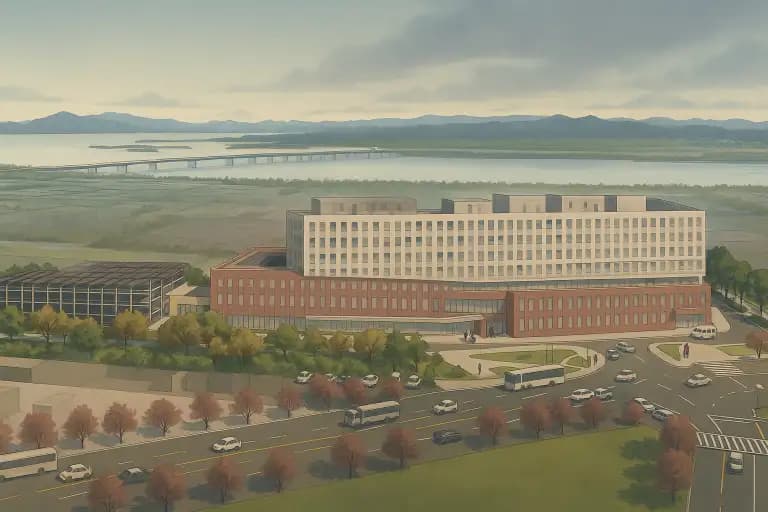
Busan, South Korea — Busan has signed an implementation agreement with a private consortium led by Taeyoung Construction to build the long-delayed Seobusan Medical Center. The project, scheduled to break ground in 2026 and open in 2028, will create a 300-bed public hospital in the city’s underserved western districts.
The agreement commits the city to a Build-Transfer-Lease (BTL) arrangement: once construction is completed, ownership will transfer immediately to the municipality, while the consortium retains a 20-year operating right in exchange for fixed annual lease payments. Those payments, projected at about 81 billion won per year, will add up to more than twice the initial capital cost of 858 billion won over two decades.

This financing structure sets Seobusan apart from other municipal hospitals. Unlike Ulsan, which has repeatedly failed to pass central government feasibility tests for a public hospital, Busan was able to move forward by shifting fiscal risk into long-term lease obligations. The strategy has ensured progress on a project that has been in discussion since 2015, but it also locks the city into high fixed expenditures at a time when its existing public hospital is already operating at a loss.
The central question now is whether the new facility will strengthen the region’s fragile public health system, or whether it will deepen the city’s structural deficits in health care finance.
The Seobusan Medical Center will be built under a Build-Transfer-Lease model, a framework that allows local governments to reduce the visible upfront cost of major infrastructure. The official project budget is set at 858 billion won, calculated on a 2021 base price. The figure covers design and construction but excludes long-term expenses such as equipment replacement and operating deficits.
Once construction is complete, the facility will transfer immediately to the city. In return, Busan is obligated to pay the private operator, a consortium led by Taeyoung Construction, fixed annual lease fees. These payments are projected at 81.3 billion won per year, indexed to inflation, over a 20-year contract period. In addition, the city will provide an annual operating subsidy of about 9.6 billion won. Together, these commitments amount to more than 1.8 trillion won by the end of the contract, more than twice the official capital cost.
This arrangement differs sharply from the financing of Busan Medical Center, the city’s existing public hospital. Built as a conventional fiscal project, that facility does not carry lease obligations. Its deficits are covered directly from the city budget. Seobusan, by contrast, will add a layer of fixed payments that cannot be reduced even if patient volumes fall short or operating losses increase.
City officials argue that spreading costs over two decades makes the project feasible within current budget limits. But the structure also limits fiscal flexibility. Unlike discretionary subsidies, the lease obligations are contractual and cannot be cut without penalty.
Why the Reported Cost Appears Lower
At first glance, the Seobusan Medical Center looks relatively inexpensive. Its stated capital cost of 858 billion won is far below Ulsan’s projected 2.6 trillion won and even below Yeongwol’s 1.4 trillion won plan for a similar 300-bed facility. The discrepancy, however, reflects differences in accounting and scope rather than efficiency.
The Busan figure is expressed in 2021 constant prices. In practice, the rising costs of labor and materials will be absorbed through adjustments in the lease payments over the 20-year contract period. What looks like a lean budget today will translate into higher obligations tomorrow.
The project scope is also narrower. Seobusan will provide core inpatient and outpatient functions, along with an emergency center, a unit for infectious disease isolation, and a specialized dental service for patients with disabilities. By contrast, Ulsan’s plan included broader research and training facilities, as well as community health programs, all of which drove up the cost per bed.
Land costs are another factor. Busan secured the site in Saha District in 2024 before finalizing the implementation agreement, meaning land acquisition expenses are excluded from the official project budget. In Ulsan and Yeongwol, new site purchases and infrastructure work are part of the project cost.
Taken together, these factors create the impression of a low-cost project. In reality, Busan’s financial commitment over the life of the contract will exceed the headline capital figure by a wide margin.
Seobusan Medical Center faces promise and fiscal strain
Recruiting and retaining staff may prove harder than constructing the Seobusan Medical Center itself. Public hospitals across South Korea struggle to attract physicians, particularly in fields that are essential but less lucrative.
Busan Medical Center has already seen gaps in core departments such as hematology-oncology and pediatrics, forcing units to scale back services. Nationwide, many local hospitals report persistent shortages in emergency medicine, anesthesiology, and intensive care, all of which are vital for an emergency-capable hospital like Seobusan.
Nursing shortages are no less severe. Private hospitals in the city offer better pay and conditions, making it difficult for municipal facilities to compete. Without incentives such as housing support or professional development, staff turnover is likely to remain high.
Government efforts to expand the pool of doctors through a public medical school and regional quotas are years away from producing results, leaving Seobusan dependent on ad hoc recruitment strategies that may delay the opening of key departments or force the hospital to operate below planned capacity.
These operational difficulties are embedded within a strict legal and financial framework. The hospital’s establishment is defined by the Local Medical Center Act, which obliges facilities to provide essential services that private hospitals avoid.
Profitability is not the measure of success. At the same time, the financing is bound by the Private Investment in Infrastructure Act, which compels the city to pay lease fees to the private consortium regardless of performance. Oversight is divided between the Ministry of Health and Welfare, which approves new hospitals, and the Ministry of Economy and Finance, which reviews the fiscal soundness of BTL projects.
Busan’s city government must implement the project and secure council approval for long-term commitments. This dual structure means the city is legally obligated both to uphold the hospital’s public health role and to honor its lease payments, even if those obligations come into conflict.
Against this backdrop, the hospital’s future could follow different trajectories. If it secures enough specialists to run its emergency and infectious disease units at full capacity, occupancy could rise toward sustainable levels and subsidies might keep annual deficits politically manageable.
A slower path, marked by persistent recruitment gaps and occupancy stabilizing at two-thirds of capacity, would leave the hospital functional but under financial strain, with fixed lease payments compounding the deficit. The greatest risk is that staffing shortages and weak demand coincide, leaving much of the facility underused.
If occupancy falls below half of capacity, escalating lease fees would fund a hospital unable to fulfill its mission, and political debate over whether Busan can sustain both Seobusan and its existing medical center would intensify.
The outcome will determine whether the hospital becomes a cornerstone of public health or a case study in fiscal miscalculation. For residents in the western districts, Seobusan promises long-awaited access to emergency and essential services.
Yet the method chosen to deliver that promise carries lasting risks. The Build-Transfer-Lease contract ensures construction but locks the city into two decades of fixed payments that far exceed the capital cost. Combined with the fragile record of existing municipal hospitals, the decision shifts the question from whether Busan can build a hospital to whether it can sustain one.
If Seobusan establishes itself as a trusted public institution, the expenditure may be justified as the price of equity in health care. If it fails to overcome deficits and staffing shortages, the lease obligations could stand as a symbol of structural error.
In either case, the project will test how far the city is prepared to balance its public health responsibilities against the weight of long-term fiscal commitments.
Continue this reporting
Reporting on the same issue
Related coverage selected from the article's desk, topics and newsroom relationships.
 NewsOct 16, 2026
What Is Still Worth Going to See?
Busan’s biennale faces questions of artistic judgment and institutional care....
 NewsOct 14, 2026
What Became of Busan’s University Streets?
From 2015 to 2023, registered businesses grew near Pusan National University...
 NewsOct 12, 2026
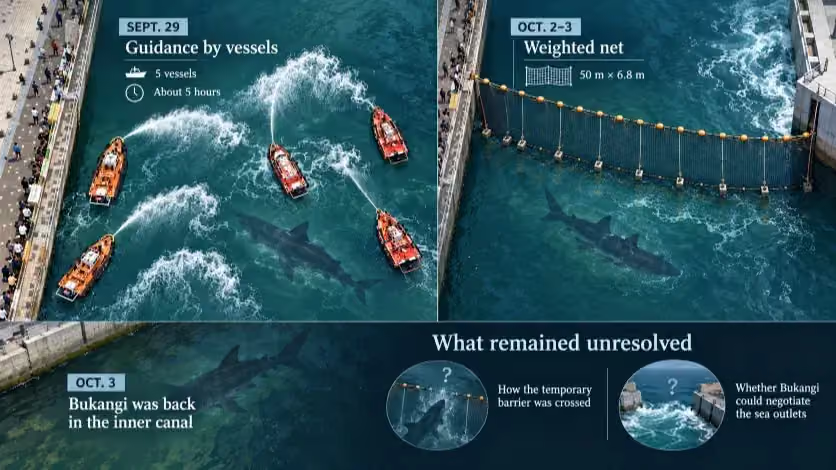
Bukangi, the Shark That Stayed in Busan’s North Port
A rescue net guided Bukangi toward the sea, but the dusky shark returned to B...
More from the author
More from this byline
Stay with the same line of reporting through more work from this byline.
- NewsOct 14, 2026
What Became of Busan’s University Streets?
 NewsSep 28, 2026
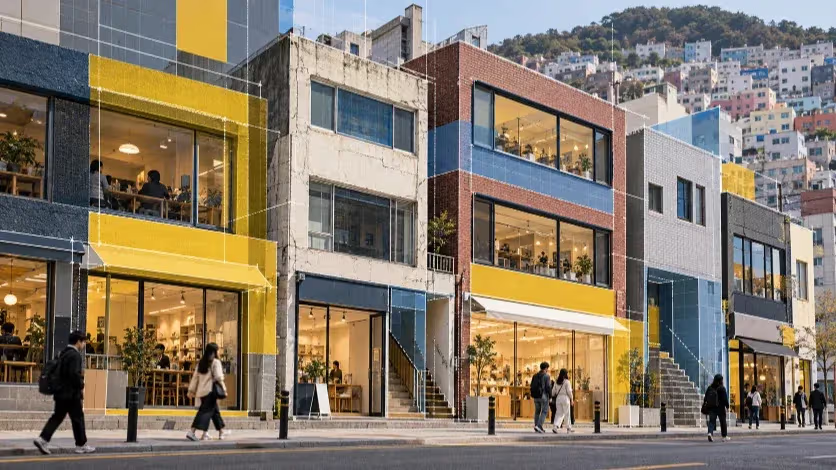
Why Some Commercial Space in Busan Is Hard to Reuse
Reader Signal
Community readWhat did this report leave you with?
Choose the signal that best reflects your reading. Select it again to remove it.
One response per article
No response selected
A moderated conversation about the reporting.
One-level replies and newsroom moderation keep the conversation anchored to this article.
Discussion Status
Open
Please sign in to join the discussion.
Newsletter
Weekly reporting and context from Busan and Korea.