Busan’s Marine Data Platform Falls Short of Expectations
Despite a budget of 3.7 billion KRW, the Smart Ocean Village project in Busan has struggled with low citizen engagement and technological limitations, leading to concerns over its effectiveness in addressing marine pollution.


Busan, South Korea – The Busan Smart Ocean Village Project, initially launched with a budget of 3.7 billion KRW, was designed to tackle marine environmental challenges through an integrated, data-driven platform. The project’s primary objectives include real-time monitoring of marine waste, providing air quality updates, and analyzing the status of the marine industry. The overarching aim is to engage the citizens of Busan in marine conservation efforts while creating a sustainable management model for the region.
However, despite the substantial financial backing, the project's implementation has faced significant challenges, raising doubts about its ability to deliver on its ambitious promises. While the project includes advanced tools such as CCTV, satellite, and drone data for marine waste monitoring, these technologies have yet to provide the intended impact. The data presented through the platform is often outdated or too generalized, offering little practical value to users. Moreover, the platform’s reliance on external sources for key data has raised questions about its uniqueness and effectiveness.
A central feature of the project is its citizen participation component, which allows local residents to engage in marine waste cleanup activities. Unfortunately, this initiative has failed to attract widespread interest, with participation rates remaining exceedingly low. During its pilot phase in 2024, only four cleanup activities were registered, underscoring the platform's failure to engage the public. Despite the platform’s potential to allow citizens to upload data and track their cleanup efforts, its limited reach and lack of engagement point to serious flaws in both its promotional strategy and user experience design.
The platform’s failure to generate meaningful insights further exacerbates its shortcomings. Much of the data used by the platform is simply aggregated from already available public sources, such as air quality data from the government-run Air Korea system and marine environmental information from the Marine Environment Information System (MEIS). Critics argue that the platform does not provide new or innovative information but merely consolidates publicly available data. What could have been a transformative tool for marine environmental management has instead become a basic data aggregation platform, unable to offer the kind of deep, actionable insights necessary for meaningful change.
Moreover, the data visualization features of the platform have been found wanting. While it offers basic charts and maps, there is a distinct lack of advanced analytical tools that could provide deeper understanding of the data. For instance, the marine waste monitoring feature only estimates the volume of debris detected by CCTV cameras, without analyzing the types of waste or identifying its source. Similarly, the fine dust data presented on the platform merely reconfigures already published statistics, failing to add any new dimensions to the conversation. The platform's current visualizations are largely static and offer little in the way of predictive capabilities or advanced insights.
Equally concerning is the sustainability of the project in the long term. While the initial budget was allocated for platform development and infrastructure, concerns have been raised about future funding. The majority of the budget was spent in the first year, while subsequent years have seen significantly lower financial support. This raises serious doubts about the platform's ability to maintain and upgrade its features in the future. Without additional funding and resources for updates, the platform risks becoming obsolete after the project period ends in 2026. Furthermore, no clear plan for the operational transition or continued funding has been outlined, leaving its future uncertain.
The overall design and functionality of the platform have also come under scrutiny. Despite claims that it utilizes AI and advanced technology to track marine waste, the platform has failed to integrate these technologies in a way that provides real value. The platform’s reliance on external data sources, without adding significant analytical value or offering new insights, has led to criticisms that it merely consolidates information without advancing the conversation on marine environmental management.
While the Busan Smart Ocean Village Project was launched with good intentions, it has fallen short of delivering the promised results. The project’s inability to engage the public, the limited scope of its data analysis, and its dependence on pre-existing data sources all undermine its effectiveness. If the platform is to fulfill its original goals of improving marine environmental management, it will require significant improvements in user engagement, data analysis capabilities, and long-term sustainability planning.
Without these changes, the project risks becoming a costly failure, with little to show for the significant investment made. Moving forward, it will be crucial for the platform’s stakeholders to reevaluate their approach, ensuring that future iterations of the project prioritize user needs, advanced data analytics, and sustainable funding mechanisms. Only then can the Smart Ocean Village Project truly serve as a model for marine conservation and environmental management in the region.
Continue this reporting
Reporting on the same issue
Related coverage selected from the article's desk, topics and newsroom relationships.
 NewsOct 16, 2026
What Is Still Worth Going to See?
Busan’s biennale faces questions of artistic judgment and institutional care....
 NewsOct 14, 2026
What Became of Busan’s University Streets?
From 2015 to 2023, registered businesses grew near Pusan National University...
 NewsOct 12, 2026
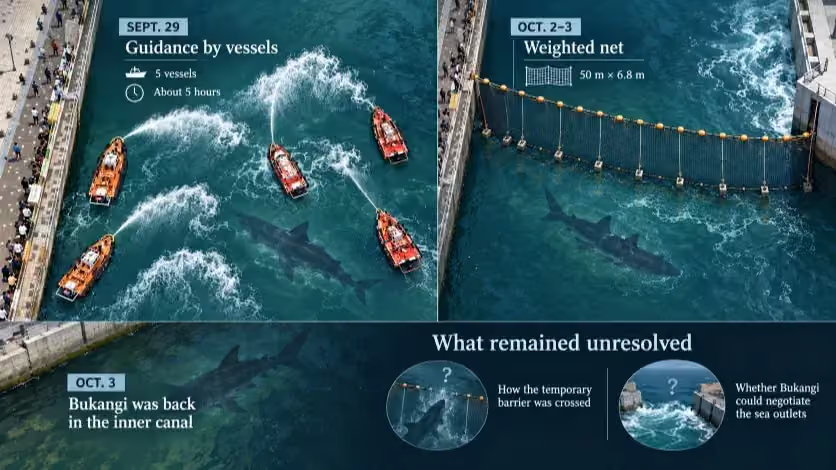
Bukangi, the Shark That Stayed in Busan’s North Port
A rescue net guided Bukangi toward the sea, but the dusky shark returned to B...
More from the author
More from this byline
Stay with the same line of reporting through more work from this byline.
- NewsOct 14, 2026
What Became of Busan’s University Streets?
 NewsSep 28, 2026
Why Some Commercial Space in Busan Is Hard to Reuse
Reader Signal
Community readWhat did this report leave you with?
Choose the signal that best reflects your reading. Select it again to remove it.
One response per article
No response selected
A moderated conversation about the reporting.
One-level replies and newsroom moderation keep the conversation anchored to this article.
Discussion Status
Open
Please sign in to join the discussion.
Newsletter
Weekly reporting and context from Busan and Korea.