Busan’s Global City Ranking Sparks Debate: Success or Oversight?
Busan, South Korea’s dynamic port city, has been ranked 67th in the 2024 World’s Best Cities report by Resonance Consultancy, marking its debut on this prestigious global list. While the ranking has been celebrated by city officials as a significant achievement, it has also sparked debate over whether it truly reflects Busan's current state and future potential. The ranking, seen by some as a major milestone, is viewed by others as an overstatement that may obscure the city’s underlying challeng

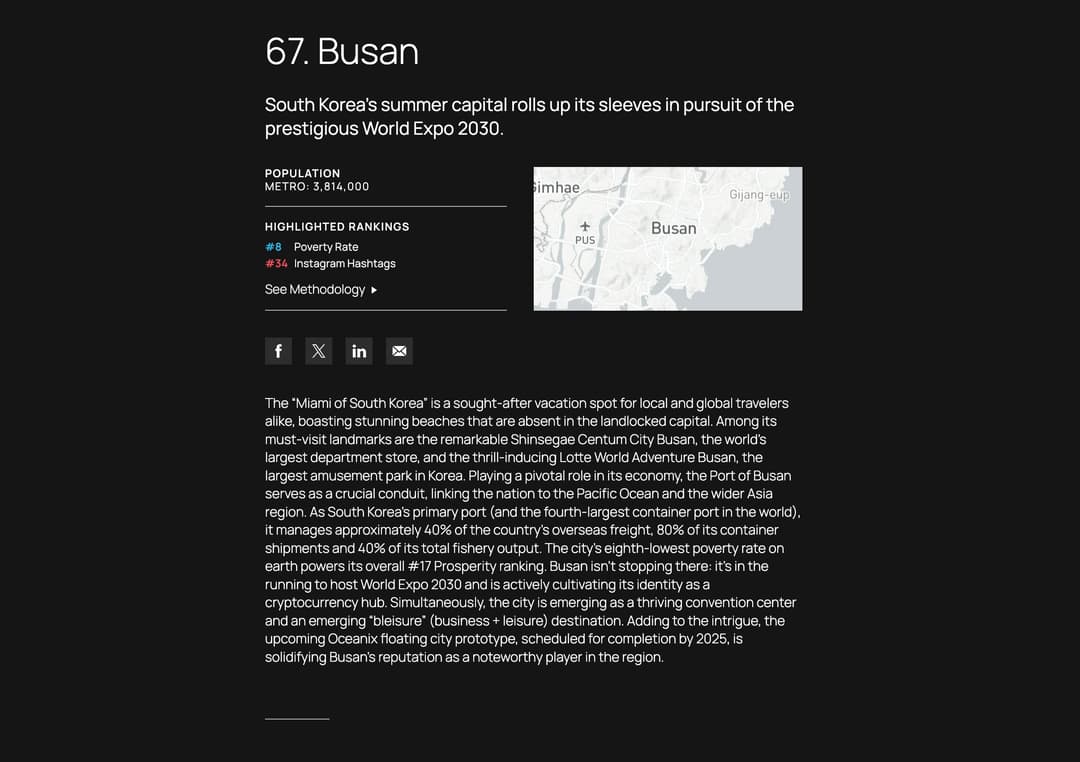
Busan, South Korea’s dynamic port city, has been ranked 67th in the 2024 World’s Best Cities report by Resonance Consultancy, marking its debut on this prestigious global list. While the ranking has been celebrated by city officials as a significant achievement, it has also sparked debate over whether it truly reflects Busan's current state and future potential. The ranking, seen by some as a major milestone, is viewed by others as an overstatement that may obscure the city’s underlying challenges.
The 2024 World’s Best Cities report, which evaluates over 270 global cities based on criteria such as livability, economic vitality, and cultural vibrancy, highlighted several factors that contributed to Busan’s inclusion in the top 100. The report praised Busan for its blend of natural beauty and modern infrastructure, noting the city's low poverty rate and its emerging status as a "bleisure" destination—a place where business and leisure coexist harmoniously.
Busan’s role as a major container port and its growing reputation as a hub for international events and cultural activities were also emphasized. The report described Busan as "South Korea’s summer capital" and likened it to Miami, underscoring its appeal to both domestic and international travelers. Additionally, the city’s forward-thinking initiatives, such as the ‘Oceanics Busan’ project—the world’s first maritime smart city—were cited as examples of its innovative approach to urban development.
Busan Mayor Park Heong-joon expressed pride in the city’s ranking, stating, “This recognition brings immense joy, and we are committed to sustaining our efforts to keep Busan in the global spotlight and continue its development.” The city’s leadership has positioned the ranking as a validation of Busan’s growing global profile and a testament to its efforts to attract more tourists and investors.
Criticism and Concerns
Despite the celebratory tone from city officials, the ranking has not been without its critics. Some argue that while the ranking is a positive indicator, it may not fully capture the complexities of Busan’s current situation. The comparison to Miami, for instance, has been met with skepticism. While both cities share a coastal identity and are known for their tourism sectors, critics argue that this comparison oversimplifies Busan’s broader economic and cultural significance. Unlike Miami, Busan is a vital industrial and economic hub with a rich history and a central role in South Korea's economy. The comparison may fail to recognize the city's full potential and its distinct identity beyond being a tourist destination.
Moreover, the gap between Busan and Seoul’s rankings—Seoul being ranked 10th—has raised questions about Busan’s competitive positioning within South Korea and the broader Asian region. Seoul’s strong showing underscores its global influence and dynamic urban environment, while Busan’s lower ranking suggests there is significant room for improvement. Critics have pointed out that, despite the city’s strengths, Busan continues to struggle with issues such as income inequality and a lower overall income level compared to other major South Korean cities. This discrepancy raises concerns about whether the ranking truly reflects the lived realities of Busan’s residents.
Furthermore, some local voices have expressed doubts about whether the ranking accurately reflects the city’s long-term prospects. While the report highlights Busan’s low poverty rate as a key factor in its ranking, there is a concern that it may overlook deeper socio-economic challenges. Critics argue that the city government should focus on addressing these underlying issues, such as economic diversification and improving infrastructure, rather than merely celebrating the ranking.
Implications for Busan’s Future
The 2024 World’s Best Cities ranking should serve as both a recognition of Busan’s achievements and a call to action for its future development. While the ranking provides a platform for promoting Busan on the global stage, it also underscores the need for the city to critically assess its current strategies and address areas where it still lags behind its regional and global peers.
For Busan to climb higher in future rankings, it will be essential for city leaders to focus on sustainable growth, enhancing the quality of life for residents, and boosting the city’s economic diversity. This includes addressing income disparities, improving public services, and ensuring that the city’s infrastructure can support its growing population and attract more international businesses.
In conclusion, while Busan’s inclusion in the 2024 World’s Best Cities report is a noteworthy accomplishment, it also highlights the challenges that lie ahead. As Busan continues to grow and evolve, city leaders will need to balance celebrating the city’s successes with a clear-eyed assessment of its challenges. Only by addressing these issues head-on can Busan truly secure its place among the world’s best cities in the years to come.
Continue this reporting
Reporting on the same issue
Related coverage selected from the article's desk, topics and newsroom relationships.
 NewsOct 16, 2026
What Is Still Worth Going to See?
Busan’s biennale faces questions of artistic judgment and institutional care....
 NewsOct 14, 2026
What Became of Busan’s University Streets?
From 2015 to 2023, registered businesses grew near Pusan National University...
 NewsOct 12, 2026
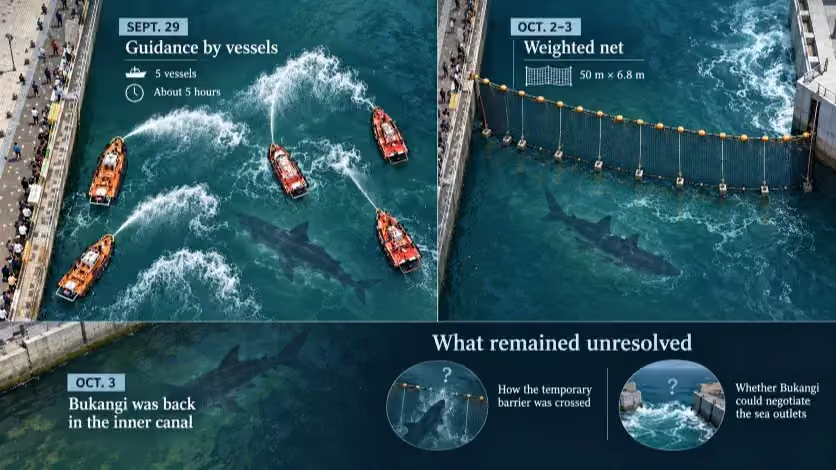
Bukangi, the Shark That Stayed in Busan’s North Port
A rescue net guided Bukangi toward the sea, but the dusky shark returned to B...
More from the author
More from this byline
Stay with the same line of reporting through more work from this byline.
 NewsOct 9, 2026
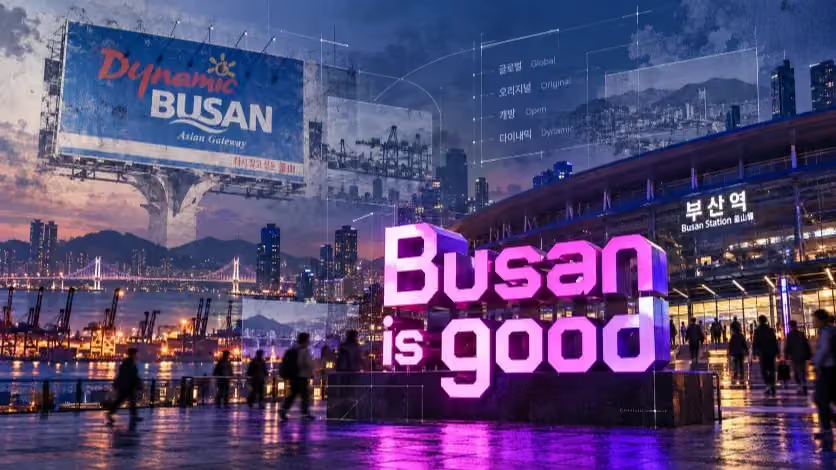
Why “Busan Is Good” Falls Short as a City Brand
 NewsSep 18, 2026
The Other AI Race Is for the Freedom to Change Course
Reader Signal
Community readWhat did this report leave you with?
Choose the signal that best reflects your reading. Select it again to remove it.
One response per article
No response selected
A moderated conversation about the reporting.
One-level replies and newsroom moderation keep the conversation anchored to this article.
Discussion Status
Open
Please sign in to join the discussion.
Newsletter
Weekly reporting and context from Busan and Korea.