Busan Unveils 10-Year Urban Rail Plan Featuring Hydrogen Trams and BuTX Express
Busan's 2026–2035 plan outlines 10 core routes with a focus on clean energy transit and regional connectivity, including the flagship BuTX line.

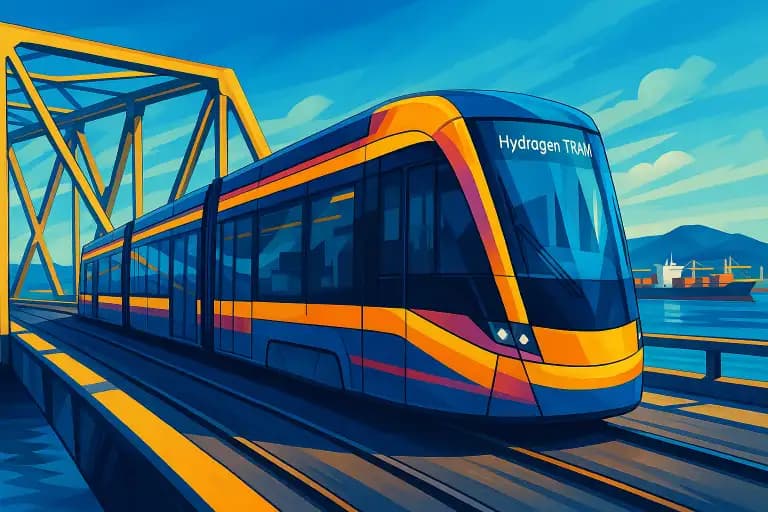
Busan, South Korea — On May 7, 2025, the Busan Metropolitan Government released its Second Urban Rail Network Plan, outlining the city’s strategic transport development goals from 2026 through 2035. Mandated under Article 5 of the Urban Rail Act, which requires local rail network planning every ten years, this initiative aims to redefine public transit access across the region with a vision of providing urban rail service to all residents, regardless of location.
The newly proposed plan includes ten priority rail lines and four additional candidate routes, amounting to a total projected length of 179.48 kilometers. The city has emphasized four core objectives for the expansion: to establish Busan as a globally connected hub city, to enhance green and sustainable transportation infrastructure, to increase the rail share of public transit by 10 percent, and to foster balanced regional development. To support these objectives, eight strategic approaches have been proposed, including fast inter-district connectivity, improved multimodal transfers, and extending service to currently underserved areas.
Among the proposed lines, the centerpiece of the plan is the Busan Train eXpress (BuTX), a 54.04-kilometer hydrogen-powered express railway that will link major urban and economic centers including Gadeokdo New Airport, Myeongji New Town, Busan Station, Bujeon, Centum, and the Osiria Tourism Complex. The BuTX is set to become Korea’s first hydrogen train and is expected to play a central role in strengthening Busan’s east-west transit connectivity while improving airport access and reducing travel time between key nodes.
Another significant component of the plan is the Busan Port Line, a 24.21-kilometer hydrogen tram designed to connect Taejongdae in Yeongdo District with Central Station, the North Port redevelopment area, Gamman-dong, and the Kyungsung University area. This route is intended to support revitalization efforts in the old downtown and waterfront redevelopment zones by improving public transit access. Meanwhile, the Yeonsan–Centum2 Line, using automated rubber-tired light rail vehicles, will serve as a vital link between the planned Centum2 industrial zone and existing metro lines at Yeonsan, Seokdae, and Wondong Stations, filling a service gap in the city’s northeast corridor.
Other confirmed routes include the Jeonggwan Line, Songdo Line, Gangseo Line, and Gijang Line, as well as express service upgrades to Metro Lines 1 and 2. Each was selected based on economic feasibility thresholds, specifically a benefit-cost ratio of 0.7 or greater, or an Analytic Hierarchy Process (AHP) score of at least 0.5. Collectively, the ten priority lines total 145.66 kilometers, with each aligned to complement ongoing urban development efforts and optimize connectivity across neighborhoods.
In addition to the confirmed projects, the city has designated four routes as candidate lines to be considered for phased development depending on future demand and financial viability. These include the Oryukdo Line, the Jure–Busan Station connector, the East Busan Line, and the Deokcheon–Choeup–Seomyeon corridor. Though not immediately actionable, these routes will be subject to further feasibility studies and planning integration as regional development progresses.
| No. | Line Name | Route | Length (km) | System Type (Detailed) |
|---|---|---|---|---|
| 1 | BuTX | Gadeokdo Airport – Osiria (via Busan Station, Centum) | 54.04 | Hydrogen-Powered Express Train (Heavy Rail) |
| 2 | Busan Port Line | Taejongdae – Kyungsung Univ. | 24.21 | Hydrogen-Powered Street Tram |
| 3 | Jeonggwan Line | Wolpyeong – Jwacheon | 12.80 | Street Tram |
| 4 | Songdo Line | Jagalchi – Jangnim | 7.05 | Street Tram |
| 5 | Gangseo Line | Myeongji – Daejeo | 21.10 | Street Tram |
| 6 | Gijang Line | Anpyeong – Ilgwang | 7.10 | Korean Automated Guideway Transit (Rubber-Tyred Light Metro) |
| 7 | Yeonsan–Centum2 Line | Yeonsan – Centum2 | 8.03 | Korean Automated Guideway Transit (Rubber-Tyred Light Metro) |
| 8 | Osiria Line | Jangsan – Osiria | 4.13 | Medium-Capacity Light Metro |
| 9 | Line 2 Express | Yangsan – Jangsan | 45.20 | Heavy Rail (Express Retrofit) |
| 10 | Line 1 Express | Nopo – Dadaepo | 39.90 | Heavy Rail (Express Retrofit) |
The city has already completed preliminary consultations with the Ministry of Land, Infrastructure and Transport, as well as received input from the Busan Metropolitan Council. A public hearing is scheduled for May 8 at 2 p.m. at Busan City Hall, where transport experts, academics, and civil society groups will be invited to review and comment on the plan. Citizens may also submit opinions via email or fax until May 14. The city intends to reflect public feedback before submitting the finalized proposal for ministerial approval by the end of May.
Speaking on the announcement, Busan Mayor Park Heong-joon described the plan as a “decisive blueprint for revolutionizing the city’s public transport system over the next decade.” He highlighted the Busan Port Line as the city’s highest implementation priority and pledged to advance other projects based on surrounding development conditions and financial viability.
The Second Urban Rail Network Plan marks a significant step forward in Busan’s broader strategy to become a globally competitive city. Through the integration of advanced technologies, including hydrogen-powered rail and automated transit systems, and by addressing longstanding transport imbalances, the city aims to deliver a more accessible, efficient, and sustainable public transit network for all.
The Yeonsan–Centum2 Line will utilize K-AGT[1] vehicles for seamless integration with the existing light metro network. AGT systems[2] are commonly used for short-distance urban transit in elevated or underground settings.
- K-AGT (Korean Automated Guideway Transit) is a domestically developed variant of AGT tailored for South Korea’s urban environments. Developed by the Korea Railroad Research Institute (KRRI), K-AGT utilizes rubber-tired, fully automated vehicles and is optimized for cost-effective implementation in mid-sized cities or high-density corridors. It offers seamless integration with existing metro systems and reduces noise, vibration, and maintenance costs. While AGT is a broader global standard, K-AGT represents a localized adaptation focused on technological self-reliance, modular design, and high automation, and has been deployed in systems such as Busan Metro Line 4, Uijeongbu Light Rail, and Yongin EverLine. ↩︎
- AGT (Automated Guideway Transit) refers to a type of fully automated, driverless rail system typically used for urban short-distance or shuttle services. AGT systems are characterized by their use of dedicated guideways, rubber or steel tires, and computer-based control, allowing for safe, frequent, and quiet operation—often in elevated or tunnel configurations. ↩︎
Continue this reporting
Reporting on the same issue
Related coverage selected from the article's desk, topics and newsroom relationships.
 NewsSep 20, 2026
What It Takes for U.S. Navy Repair Work to Become a Busan Industry
HJ Shipbuilding has brought U.S. Navy maintenance work to Yeongdo. Whether it...
 NewsSep 17, 2026
Busan’s Finished Homes, Unfinished Projects
Busan’s unsold homes sit in one monthly total, but they belong to very differ...
 NewsSep 16, 2026
Busan’s Young-Adult Migration Turns Sharply at 25–29
Busan can still draw young adults into the city, but keeping them becomes far...
More from the author
More from this byline
Stay with the same line of reporting through more work from this byline.
 NewsSep 18, 2026
The Other AI Race Is for the Freedom to Change Course
 NewsSep 5, 2026
How a Political Appointment Becomes a Judgment of Character
Editorial Record
Corrections, sourcing notes and newsroom disclosures remain part of the published record. View Newsroom Notes →
Reader Signal
Community readWhat did this report leave you with?
Choose the signal that best reflects your reading. Select it again to remove it.
One response per article
No response selected
A moderated conversation about the reporting.
One-level replies and newsroom moderation keep the conversation anchored to this article.
Discussion Status
Open
Please sign in to join the discussion.
Newsletter
Weekly reporting and context from Busan and Korea.