Busan Stakes Its Claim on the Northern Sea Route Future
As the Arctic warms, Busan positions itself as a key Northern Sea Route hub with port upgrades, legal infrastructure, and targeted investment plans.

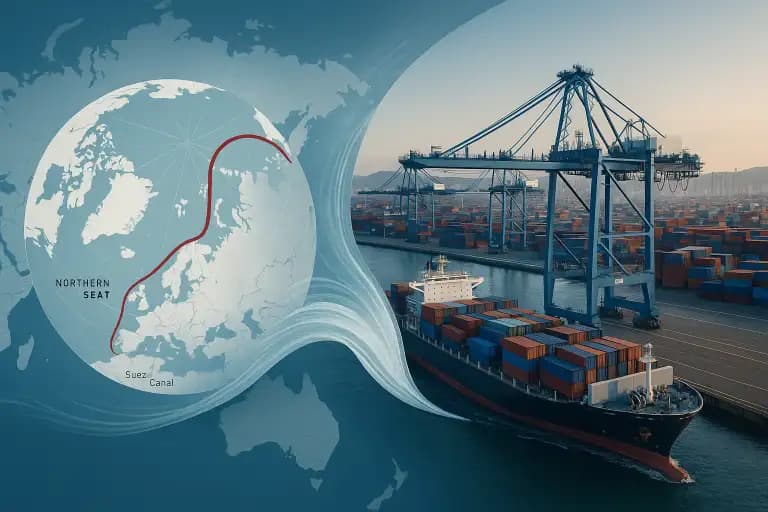
Busan, South Korea — The Northern Sea Route, once an ice-locked stretch of ocean known only to polar researchers and Russian icebreakers, is edging closer to regular commercial use. In Busan’s port district, the talk has shifted from if to when. City officials see the timetable narrowing — perhaps a decade before summer sailings through the Arctic become routine, cutting the Busan–Rotterdam run by nearly 10 days.
Against that backdrop, the central government’s decision to move the Ministry of Oceans and Fisheries from Sejong to Busan by year’s end is being treated here as more than a bureaucratic shuffle. In interviews last week, ministry planners described the relocation as “a starting gate” for a broader push: anchoring government, industry, and maritime law in one place before the Arctic corridor changes global shipping patterns. The challenge, as several port executives told us, is that the window to prepare is shorter than the political cycle — and the competition has already started investing.
The Northern Sea Route Countdown
From Murmansk to Shanghai, governments and shipping lines are recalculating their maps. In Russia, the Ministry for the Development of the Far East is quietly pushing for a near-doubling of Arctic cargo volumes by 2035. That target rests on an aggressive shipbuilding program: new nuclear icebreakers under construction at Baltic Shipyard, LNG carriers purpose-built for the Yamal and Arctic LNG 2 projects, and a chain of upgraded ports along the Siberian coast.
China’s involvement is no longer tentative. Through COSCO and state-linked energy companies, Beijing has taken equity in Arctic LNG projects, commissioned its own ice-strengthened vessels, and even trialed regular container services through the route during ice-light months. At Dalian, shipyard managers confirmed to us that at least two new ice-class hulls are already earmarked for NSR service in the next three years.
Japan’s approach has been quieter, centered on feasibility studies and joint ventures with Russian energy partners. A senior official in Tokyo told us the government’s priority is securing LNG deliveries while staying aligned with environmental commitments. That caution reflects the broader split in Europe, where several of the world’s largest carriers — including CMA CGM and Hapag-Lloyd — have publicly sworn off the Arctic route over ecological risks.
For Busan, these moves are more than a geopolitical footnote. Each new port dredged in the Russian Arctic or icebreaker launched on the Yangtze is a signal that the starting line is shifting north. “Once a carrier commits capacity to the NSR, it changes transshipment patterns in East Asia,” one shipping analyst in Seoul explained. “If Busan isn’t integrated into that network early, it risks being bypassed.”
Strengths Tested in a Shifting Maritime Order
On the quayside at New Port, cranes move in a slow, deliberate rhythm, stacking boxes from Asia-bound mega-vessels. By volume, Busan remains in the global top tier — more than 23 million TEUs last year, with over half of that moving on to other destinations. That transshipment ratio, second only to Singapore, has long been the city’s claim to maritime fame.
Yet rankings tell another story. A decade ago, Busan held sixth place worldwide; now it sits seventh, edged down by the rise of Chinese ports like Qingdao and Guangzhou. Shipping schedules reveal the shift: some services that once called in Busan now link directly between Chinese hubs and overseas markets, bypassing the Korean stop.
Port planners here point to the assets they can build on: deepwater berths, proximity to Japan and the Russian Far East, and the ability to handle the largest container ships afloat. But the Arctic era will demand more. Ice-class capable berths, smart terminal automation that can turn vessels around faster, and seamless integration with the new airport and rail links are all on the table.
Terminal operators say the challenge is timing. “Infrastructure takes years, sometimes decades, to plan and finance,” one senior manager at the port authority noted. “If the NSR accelerates faster than expected, we could be playing catch-up.” In the meantime, competition from both the north and the south — Shanghai’s industrial gravity and Singapore’s unrivaled efficiency — is not slowing down.
Anchoring Law and Capital in the Port City
For Busan’s ambitions to outlast shipping trends, the city needs more than cranes and quay walls. It needs institutions that keep decision-making — and money — within its waterfront skyline. Two projects are shaping that vision: a dedicated maritime court and the proposed Southeast Investment Corporation.
The maritime court plan has been discussed in shipping circles for years, but now carries a price tag and a political timetable. Research commissioned by the city estimates an economic ripple of roughly ₩5 trillion, driven by the clustering of legal services, insurers, and arbitration specialists. The idea is simple in outline: if disputes over vessels, cargoes, or marine insurance can be resolved here, then the lawyers, surveyors, and financiers will base themselves here too. London and Shanghai offer precedents; both turned legal infrastructure into a magnet for high-value maritime business.
Alongside the legal push, the Southeast Investment Corporation is pitched as a regional capital engine. The initial ₩3 trillion in government and municipal seed money would be leveraged — officials talk about a fifteen-fold multiplier — into targeted investments across shipbuilding, offshore energy, and port-linked logistics. Advocates say it would give the region a financial instrument designed for its own industries, rather than relying solely on Seoul-based lenders.
Critics note that similar schemes have faltered when politics shifted or when mandates overlapped with national banks. Supporters counter that without a localized source of capital, Busan’s port economy will remain dependent on external decision-makers. “You can’t call yourself a maritime capital if your financing is still decided three hundred kilometers away,” one senior figure in the local shipowners’ association told us.
For both projects, the window for alignment is narrow. Legislative approval for the court and corporate structuring for the investment body would need to move in parallel with physical port upgrades. Miss that alignment, and the Arctic era may arrive before Busan has the institutional weight to shape it.
Holding on to Talent Before the Tide Turns
In a city built on trade, the most worrying departures are not cargoes but people. Over the past decade, Busan has recorded the steepest decline in youth population among Korea’s major cities. Government migration data show a consistent net outflow of residents in their twenties and thirties, with many heading to Seoul for jobs in tech, finance, and research.
Employers here are candid about the imbalance. Headquarters for large shipping lines and shipyards may be in Busan, but high-value corporate roles — strategy, design, advanced R&D — often sit in the capital. The pay gap between regional and Seoul-based positions compounds the pull. “We lose graduates before we even get a chance to hire them,” admitted the HR director of a mid-sized logistics firm near Gamman Port.
To counter the trend, the city has expanded targeted incentives. Since 2023, municipal housing subsidies have been offered to young professionals in port-related industries, and more than 1,200 recipients have applied under the scheme. Industry-linked degree programs, such as the maritime logistics track at Pukyong National University, guarantee job interviews with partner companies and have placed over 80% of graduates locally in the past two years.
Public agencies relocated to Busan under the national decentralization policy are now subject to a 35% local hiring quota, giving recent graduates more entry points into stable public-sector jobs. Yet even with these measures, retention depends on a steady supply of high-quality positions tied to the maritime economy’s future growth areas — from Arctic-ready vessel design to digital port operations. Without that pipeline, the city’s best-trained engineers, analysts, and managers will continue to look north to the capital.
The Narrow Channel Ahead
The relocation of the Ministry of Oceans and Fisheries to Busan will be complete in months, but the forces reshaping global shipping will play out over decades. The Northern Sea Route is no longer an abstract line on polar charts; it is a developing corridor with icebreakers under construction, LNG terminals rising on Arctic shores, and shipping alliances deciding how to deploy capacity.
Busan enters this race with enviable assets — a deepwater port, high transshipment efficiency, and proximity to key Northeast Asian trade lanes. But those advantages will erode if they are not matched with forward-looking infrastructure, legal and financial institutions that anchor decision-making locally, and a labor market able to hold on to its brightest graduates.
Other ports are not waiting. Russia and China are laying steel and pouring concrete. Singapore is refining its role as a transshipment superhub, and Chinese coastal cities are pulling more services directly into their own terminals. In this environment, delay carries a cost that may only become visible once the Arctic route is fully open — and by then, the patterns will be hard to change.
For Busan, the task is to act as if the NSR will be commercially viable sooner than the most cautious forecasts suggest. That means aligning political commitments with capital projects, synchronizing legislative work on the maritime court and investment corporation with physical port upgrades, and delivering tangible opportunities to keep skilled workers in the city.
Shipping lanes are set by more than geography; they are drawn by economics, policy, and capacity. Whether Busan becomes a fixture on the Arctic map or a port passed by on the horizon will depend on choices made well before the first season of ice-free summer sailing arrives.
Continue this reporting
Reporting on the same issue
Related coverage selected from the article's desk, topics and newsroom relationships.
 NewsSep 20, 2026
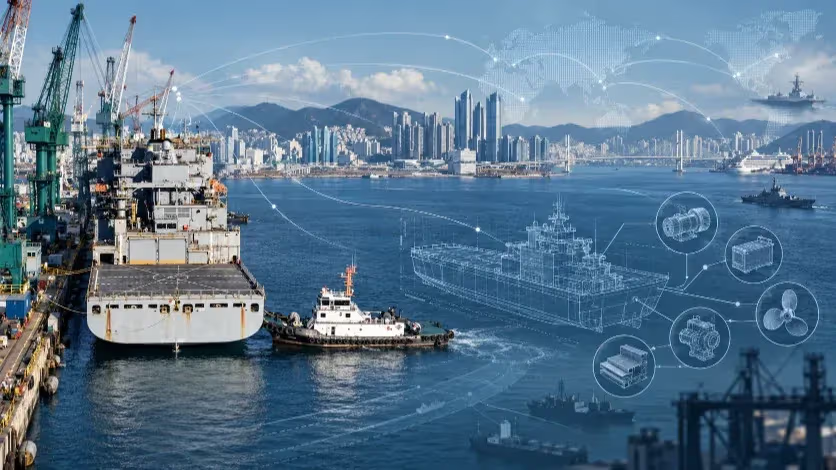
What It Takes for U.S. Navy Repair Work to Become a Busan Industry
HJ Shipbuilding has brought U.S. Navy maintenance work to Yeongdo. Whether it...
 NewsSep 17, 2026
Busan’s Finished Homes, Unfinished Projects
Busan’s unsold homes sit in one monthly total, but they belong to very differ...
 NewsSep 16, 2026
Busan’s Young-Adult Migration Turns Sharply at 25–29
Busan can still draw young adults into the city, but keeping them becomes far...
More from the author
More from this byline
Stay with the same line of reporting through more work from this byline.
- NewsSep 17, 2026
Busan’s Finished Homes, Unfinished Projects
Editorial Record
Corrections, sourcing notes and newsroom disclosures remain part of the published record. View Newsroom Notes →
Reader Signal
Community readWhat did this report leave you with?
Choose the signal that best reflects your reading. Select it again to remove it.
One response per article
No response selected
A moderated conversation about the reporting.
One-level replies and newsroom moderation keep the conversation anchored to this article.
Discussion Status
Open
Please sign in to join the discussion.
Newsletter
Weekly reporting and context from Busan and Korea.