Busan Scales Up Green Urban Forests to Combat Heat and Pollution
Busan’s ambitious “garden-type urban forest” expansion signals a growing shift in urban policy, using nature-based solutions to fight fine dust, heat islands, and public health disparities. Yet questions remain about whether neglected and industrial districts are being left behind.

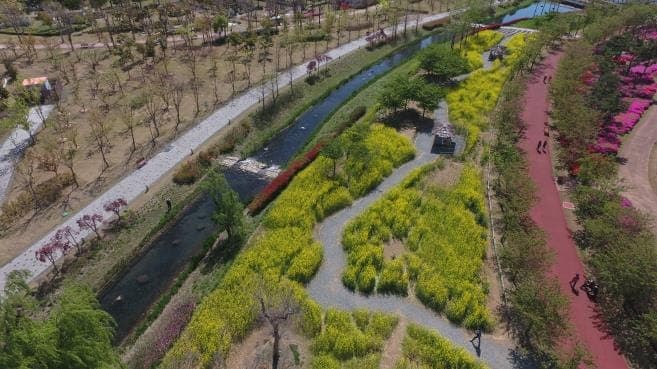
Busan, South Korea — As cities worldwide face intensifying climate pressures, Busan is scaling up its green infrastructure with a major expansion of its urban forestry initiative. Branded as “garden-type urban forests,” the initiative aims to weave green spaces into daily life—reducing fine dust, cooling the city, and enhancing well-being.
This spring, the city unveiled plans to develop six new green zones: three climate-responsive forests, two wind-path forests, and one child-safety greenbelt near a school. Complementing these larger interventions, the city will also install community mini-gardens at 12 additional Bus Rapid Transit (BRT) stations along Gaya-daero, building on a pilot project launched in 2024.
Busan’s urban forest strategy reflects a broader global shift toward sustainable, livable cities. In Seoul, “cooling forests” and vertical greenery are being integrated into high-density areas, while Singapore has long pursued its “City in a Garden” agenda, embedding green into rooftops, transit, and urban form. Internationally, cities like Melbourne, Toronto, and Copenhagen have advanced urban forest masterplans to enhance biodiversity, reduce urban runoff, and combat the urban heat island effect.
Scientific data reinforces the urgency. Korea’s National Institute of Forest Science has shown that tree cover significantly reduces ultrafine particulate matter—particles as small as 0.4 micrometers—by accelerating deposition. Forested zones also buffer temperature spikes, contributing to energy savings and respiratory health. Urban forestry, once seen as aesthetic, is now viewed as a public health imperative.
However, beneath these successes lies a critical equity challenge. While central areas such as Seomyeon, Gaya-daero, and major transit hubs are seeing green upgrades, many of Busan’s older or industrially burdened neighborhoods remain underserved. For example, while the new plan includes green interventions in Sinpyeong-Jangnim Industrial Complex and Ilgwang Recreation Area, these zones are limited to just 1 hectare each—modest, given their pollution load and population exposure.
Residents in areas like Danggam-dong, or Gamcheon—often older, lower-income, or surrounded by concrete infrastructure—continue to experience limited green cover, greater exposure to heat stress, and elevated particulate matter. Without targeted policies to address these regional disparities, the benefits of Busan’s greening effort risk being concentrated in already privileged districts.
Experts argue for a data-driven approach to greening, guided by urban heat maps and environmental risk profiles. "Urban forest planning must prioritize zones with the greatest environmental need, not just those with visual potential," notes a 2023 policy paper by the Korea Environment Institute. Micro-forests, green buffers along industrial roads, and rooftop gardens on public housing can deliver outsized benefits in these under-served zones.
Busan’s strategy does include promising elements of decentralization—such as nature-integrated school zones and mini-parks at transit stops—but these must be scaled more deliberately. Moreover, for the project to succeed long-term, maintenance and community engagement will be key. As seen in cities like Toronto and Melbourne, green infrastructure works best when embedded in broader resilience frameworks that link transportation, housing, public health, and land use.
The vision is ambitious: to transform a coastal industrial metropolis into a “breathing” city. As Busan prepares to welcome international visitors for events, its symbolic green corridors will be on display. But the true test will be whether every neighborhood—not just downtown or the city’s gateways—feels the shade, breathes the air, and shares the benefits of this green transformation.
Continue this reporting
Reporting on the same issue
Related coverage selected from the article's desk, topics and newsroom relationships.
 NewsOct 16, 2026
What Is Still Worth Going to See?
Busan’s biennale faces questions of artistic judgment and institutional care....
 NewsOct 14, 2026
What Became of Busan’s University Streets?
From 2015 to 2023, registered businesses grew near Pusan National University...
 NewsOct 12, 2026
Bukangi, the Shark That Stayed in Busan’s North Port
A rescue net guided Bukangi toward the sea, but the dusky shark returned to B...
More from the author
More from this byline
Stay with the same line of reporting through more work from this byline.
 NewsOct 9, 2026
Why “Busan Is Good” Falls Short as a City Brand
 NewsSep 18, 2026
The Other AI Race Is for the Freedom to Change Course
Reader Signal
Community readWhat did this report leave you with?
Choose the signal that best reflects your reading. Select it again to remove it.
One response per article
No response selected
A moderated conversation about the reporting.
One-level replies and newsroom moderation keep the conversation anchored to this article.
Discussion Status
Open
Please sign in to join the discussion.
Newsletter
Weekly reporting and context from Busan and Korea.