Busan Opera House Faces Governance Void, Cost Overruns
The Busan Opera House was meant to anchor a waterfront cultural revival. Now, it stands half-built and over-budget, exposing the gap between vision and governance.

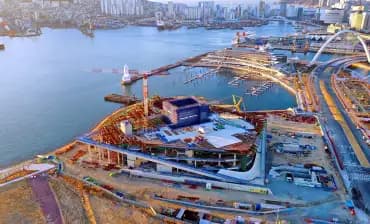
BUSAN, South Korea — On a stretch of reclaimed waterfront in Busan’s old North Port, a sweeping white structure is taking form — its silhouette twisting above the cranes and container yards like a maritime sculpture turned inward on itself. From a distance, it looks like it belongs on a postcard: part seashell, part modern temple, poised to signal a cultural renaissance for South Korea’s second city.
But up close, the story is less serene. The Busan Opera House, once pitched as a beacon of architectural ambition and regional transformation, has become a lightning rod for public frustration. Delayed by years, its costs have soared past ₩3.9 trillion, nearly 60 percent above initial projections. Funding shortfalls, design controversies, and bureaucratic stalemates have stalled construction and strained city finances. No one seems able — or willing — to answer the most basic questions: who will finish paying for it, who will operate it, and what, exactly, it will become once the doors open.
This was supposed to be Korea’s answer to Sydney or Oslo — a world-class waterfront venue that would turn a post-industrial harbor into a new civic stage. Instead, it risks becoming a case study in how vision can outpace governance, and how a city’s hopes can buckle under the weight of unresolved ownership.
With two years remaining before its planned completion in 2026, the Busan Opera House stands not just as a cultural project, but as a referendum on intergovernmental coordination — and a test of whether landmark architecture can deliver on its promise when the scaffolding of policy and politics begins to fray.
The Financial Anatomy of an Overrun
When construction officially began in 2018, the Busan Opera House was expected to cost ₩2.5 trillion. That estimate already accounted for a generous ₩1 trillion donation from Lotte Group — a symbolic gesture from one of South Korea’s most powerful conglomerates, and a major reason the project finally cleared political hurdles after years of deferral. The remaining funds were to be split between the city government, the Busan Port Authority (BPA), and possibly, if things went well, some measure of central government support.
They did not go well.
By 2021, the official project cost had risen to over ₩3.1 trillion — an increase rationalized by inflation in material prices, post-pandemic supply disruptions, and a series of design upgrades. Internally, the city blamed global conditions and technical refinements. But that only told part of the story. At least ₩800 billion of the new budget stemmed from one underlying reality: no one had clearly agreed, at the outset, who would carry the financial burden when costs began to drift.
The breakdown became public when the BPA quietly revised its pledged contribution. What had begun as a verbal commitment to support the project with up to ₩800 billion — reflecting the Opera House’s location inside the North Port redevelopment zone — was later reduced to ₩500 billion during internal deliberations. Then, in 2019, the Ministry of Economy and Finance intervened and flatly rejected the notion that BPA, a state-run port corporation, should finance what it described as a “municipal cultural facility.” Without a formalized agreement, and with the finance ministry drawing a hard jurisdictional line, the BPA pulled back entirely. No money ever arrived. The Opera House remained on their maps, but not in their ledgers.
This reversal left Busan City exposed — and furious. Officials argued that the Opera House sat on national land, inside a government-approved redevelopment district, and would revert to state ownership after 40 years. That, they said, made it a national project in everything but name. The finance ministry didn’t budge. The result: a capital gap of over ₩1.6 trillion, with the final ₩800 billion installment due by 2026 and no clear plan for how to secure it.
Privately, officials admit they had overestimated both the speed and sincerity of intergovernmental cooperation. “The land is national, the building is local, and the budget is nobody’s,” one former city planning director remarked wryly. Meanwhile, city council members have begun sounding the alarm — warning that the project could crowd out other urban investments and expose the city to long-term financial liabilities.
The more immediate concern is whether the opera house can be completed without further fiscal damage. With construction costs still climbing — and with global interest rates limiting new bond options — Busan’s ability to close the gap without emergency state support is narrowing. The city continues to lobby ministries in Seoul, hoping to revive some version of the BPA agreement or extract support via adjacent port redevelopment subsidies. But with two years left and no deal in hand, the Opera House may soon become not just Busan’s cultural centerpiece, but its most expensive administrative orphan.
The Façade Fiasco: Beauty and the Build
From the beginning, the building’s outer shell was never just a shell. Snøhetta’s design — two sweeping, interlocking curves inspired by the image of a sea clam cradling a pearl — was selected not for its feasibility but for its symbolism. The city wanted a landmark, something that could stand shoulder to shoulder with Oslo or Sydney and declare Busan’s arrival on the global cultural stage. It got one. What it didn’t get, at least not right away, was a way to actually build it.
The signature twist of the opera house façade — a seamless, continuously warped form without a single flat surface — presented an engineering problem that few in Korea had ever attempted. The steel frame had to be fabricated not just in curved sections but in individually twisted components, most of them unique in shape and dimension. Thousands of glass and concrete panels had to be modeled in 3D and tested in full-scale mockups, each with tolerances thinner than a thumb’s width. In the language of structural engineers, this wasn’t complexity — it was controlled chaos.
At first, no one said no. But behind the scenes, contractors were already searching for ways to compromise. In 2018, Hanjin Heavy Industries, the project’s lead builder, proposed replacing the “twist” design with a simpler “folding” method: instead of smoothly warped curves, the façade would be formed by connecting angled segments that mimicked curvature without requiring new fabrication methods. From a distance, it might look similar. But for the designers, the proposal was a dealbreaker. Snøhetta objected immediately, warning the change would alter not just the visual character of the building, but its architectural integrity.
What followed was less a negotiation than a stand-off. A second alternative — the so-called “smart-node” method — was floated as a compromise, allowing straight panels to be rotated at critical junctions to simulate curvature. The city, anxious to proceed, greenlit the idea. For a while, it seemed workable. But in 2020, construction ground to a halt. The new method was slower than expected, incompatible with existing structural tolerances, and — most damningly — aesthetically inconsistent. Photographs of mockup sections revealed visible joints and unnatural lines. The opera house, once imagined as fluid and organic, was beginning to look pieced together.
By 2023, the city did what few projects of this scale ever do: it stopped completely. For 16 months, the structure sat idle on the waterfront, half-skinned and unclaimed. Engineers, consultants, and city officials returned to square one, commissioning new simulations, physical tests, and external reviews. In the end, the conclusion was the same one Snøhetta had offered years earlier: if the building was to be built properly, it had to be built as designed.
When Busan formally re-adopted the twist method in late 2023, it came at considerable cost. The reengineering effort alone was estimated at over ₩100 billion. The lead contractor agreed to absorb part of the overrun — a concession that helped avoid lawsuits but left lingering bitterness. Internally, city auditors identified a dozen failures of oversight and documentation. Contracts had been amended without adequate review. Decision-making had been delegated to low-level project teams with neither the authority nor the expertise to manage a façade of this complexity. One internal report dryly noted: “The project failed to distinguish between visual ambition and structural process.”
By early 2025, work had resumed. The twisted steel ribs were being hoisted into place one by one, each a bespoke component in a 3,000-piece puzzle. Site engineers say the most difficult phase is now behind them. But the memory of the standstill lingers — and with it, a cautionary tale. In chasing visual symbolism, the project temporarily lost control of its own structure. It’s a paradox not lost on those involved: the building designed to redefine Busan’s identity nearly collapsed under the weight of its own metaphor.
A Landmark Without a Plan: Governance Void
As the opera house rises steel beam by steel beam along Busan’s waterfront, there is one thing conspicuously missing: an operator.
For all its scale and symbolic weight, the Busan Opera House still has no legal entity charged with running it. No foundation. No endowment. No binding governance model. The city has yet to formally establish even a managing corporation, despite having spent the better part of a decade — and now nearly ₩4 trillion — bringing the building to life.
This vacuum is not just procedural. It goes to the heart of the project’s viability. A 2019 internal feasibility study projected annual operating costs of roughly ₩15.1 billion. Of that, more than 59 percent — nearly ₩9 billion — would need to come from public subsidies. The rest might be earned through ticket sales, sponsorships, rentals, and tours. But there is no real business plan to back those numbers, and little indication of where, or from whom, the funding will come.
City officials have floated ideas. One proposal would place the opera house under the wing of a newly created municipal foundation, possibly modeled after Daegu’s opera house, which has been run successfully by an independent cultural corporation since 2003. Another option is to expand the existing Busan Cultural Foundation’s mandate to include opera-specific programming. A more recent stopgap plan — informally dubbed “Classic Busan” — seeks to combine the future opera house with the new Busan International Art Center under a single administrative bureau. For now, that bureau is more concept than institution: it has no legal status, no board, and no capacity to hire permanent artistic staff.
In the absence of a designated organization, the city has begun building content from scratch. Since 2022, a temporary ensemble called the “Busan Opera House Orchestra” has staged seasonal concerts in smaller venues, under the artistic guidance of renowned conductor Chung Myung-whun. Outreach programs and vocal workshops are underway. But without a real institution behind them, these efforts resemble scaffolding — useful in transition, insufficient in permanence.
The risks of inaction are well understood. Cultural policy experts warn that without early staffing, programming, and institutional leadership, major venues can struggle to attract content and audiences once the fanfare fades. Busan’s own recent history offers a cautionary tale. The Busan Cinema Center, another landmark cultural facility opened with fanfare in 2011, suffered years of underutilization due to ambiguous management roles and lack of content planning. City officials concede the parallel, but insist they won’t repeat the mistake.
And yet the timeline is tightening. The building is expected to be structurally complete by late 2026. A venue of this complexity — with a 1,800-seat main hall, full-stage machinery, and back-of-house systems — requires at least 18 to 24 months of soft-launch preparation. That includes hiring technicians, training crews, establishing repertoire pipelines, and securing long-term performance partnerships. None of this can happen without a legally constituted operator. None of it has begun.
The silence around this question is becoming harder to justify. At recent city council hearings, opposition lawmakers questioned why Busan had pushed ahead with one of the country’s most expensive cultural projects without first determining who would run it. One council member likened it to “building a ship without a captain, or even a crew.”
There is still time to course-correct. But the challenge now is less architectural than institutional. Without a governance structure in place — and without clear funding lines to support it — the Busan Opera House risks opening not as a triumph of culture, but as a hollow monument to indecision.
Maritime Dreams and Urban Realities
When Busan first unveiled its plans to transform the aging North Port into a new global waterfront district, the ambition was nothing short of sweeping. The cranes and shipping containers that had long defined the harbor’s edge would give way to cultural venues, green space, high-rise towers, and luxury marinas. It would be, in the city’s own words, “where industry yields to imagination.”
At the heart of this vision stood the Busan Opera House — not just a building, but a declaration. The site chosen for it was no accident: a finger of reclaimed land extending into the sea, precisely at the interface where the city’s industrial past meets its aspirational future. The opera house would be the anchor of the Marine Culture District, a keystone in the port’s first-phase redevelopment plan. If successful, it would help turn the North Port from a logistics zone into a civic landmark.
But the transformation proved harder to orchestrate than the renderings suggested. Much of Phase One — spanning over 1.5 million square meters — has remained stalled for years, with empty parcels, withdrawn investors, and shifting timelines. The government’s original ₩2.8 trillion investment plan has delivered patchy results. High-profile projects like a planned international convention center, a maritime museum, and a global business hub have either been delayed or downscaled. Even Las Vegas Sands, once floated as a partner for a mega-resort complex, pulled out when Korea declined to approve casino licenses.
In this context, the opera house took on outsize significance — not merely as an arts venue, but as proof that something tangible was rising from the port’s ruins. It became, quite literally, the only vertical symbol of progress in a sea of paper plans. As one urban planning scholar put it: “It’s not just a cultural building. It’s the credibility of the whole project on stilts.”
Still, its symbolic weight has not guaranteed alignment. Although the opera house sits on land administered by the Ministry of Oceans and Fisheries, and although the Busan Port Authority remains the official executor of the wider redevelopment, the cultural facility was never formally written into the central government’s investment framework. That omission has had consequences. When the city later sought support from the BPA to share construction costs, the Finance Ministry pushed back, arguing that the opera house — though physically in the redevelopment zone — was outside the scope of port infrastructure. In other words, the building belonged to the map, but not to the budget.
Busan has pushed to reverse this distinction. Officials point out that the opera house, under current agreements, will revert to state ownership after a 40-year lease expires. It is not a municipal vanity project, they argue, but a future national asset built with local funds. Yet to date, that logic has failed to unlock any material support from Seoul. The city continues to bear the weight alone.
And yet the broader plan rolls on. In 2024, Busan announced new foreign investment for an 88-story “Landmark Tower” to rise near the opera house, housing a hotel, a K-culture performance arena, and a tech-based medical hub. These developments are meant to complement the opera house, framing it as the cultural crown of the new district. The Ministry of Oceans and Fisheries has also begun revising its masterplan to integrate the opera house plaza and waterfront walkways into the broader public space network.
But physical proximity does not always translate to strategic alignment. The opera house is advancing under the cultural bureau. The tower is under urban planning. The marina, under maritime affairs. And while the city brands itself as Korea’s “Marine Cultural Capital,” its own departments often operate in silos. Without a unified delivery authority — or a coordinating body to manage the sequencing of infrastructure, programming, and activation — the risk remains that each of these projects will stand as impressive but disconnected nodes.
It’s a paradox familiar in many waterfront redevelopments: the map promises a cohesive vision, but the politics underneath fragment the execution. The Busan Opera House may still fulfill its role as a cultural beacon — but whether it catalyzes the urban renewal it was meant to anchor depends on a far more complex choreography.
Political Crosscurrents
No matter how refined the renderings or how ambitious the masterplan, public projects of this scale ultimately rise — or stall — on the fault lines of political responsibility. In the case of the Busan Opera House, those lines have shifted repeatedly, blurring the answer to what should have been a basic question: who owns this project?
The bureaucratic chart would suggest it’s a shared endeavor. The opera house sits on land controlled by the Ministry of Oceans and Fisheries. The surrounding redevelopment is administered by the Busan Port Authority, a national-level public corporation. The construction and design contracts are managed by Busan City. And the long-term cultural programming is — in theory — the responsibility of an operator yet to be formed. But the funding? That’s where the consensus ends.
When the Busan Port Authority (BPA) first offered verbal support for the project in 2018, it was under a different mayor, a different minister, and a different political climate. At the time, BPA pledged up to ₩800 billion to support construction — a gesture that reflected the opera house’s status as a flagship facility within the North Port redevelopment zone. The agreement, however, was never formalized in writing.
By 2019, the landscape had changed. Korea’s Ministry of Economy and Finance reviewed the arrangement and rejected it, citing statutory limits on BPA’s spending authority. Under existing regulations, the ministry argued, a port operator could not allocate funds to what it deemed a “non-port, non-logistical” facility. The verdict was clear: if Busan wanted to build an opera house, it would have to do so alone.
The fallout was swift. BPA walked back its pledge, reducing its notional contribution to ₩500 billion, then eventually abandoning the idea altogether. City officials accused Seoul of bureaucratic sabotage — first encouraging the plan, then pulling support at the eleventh hour. Behind closed doors, central government officials defended the decision as legal conservatism, not political malice. But for Busan, the damage was done.
The rift deepened under Mayor Park Heong-joon, who inherited the project amid construction delays and budget overruns. A political conservative with ambitions for national office, Park initially expressed skepticism about the ballooning cost. But he soon repositioned himself as the opera house’s protector — branding it a keystone in Busan’s bid for global recognition, and a litmus test for equitable development outside the capital. “If Seoul had built this, it would have been a national project from day one,” one city aide remarked.
Yet even with a mayor and central government aligned along partisan lines, the funding bottleneck remains unresolved. Ministries cite legal constraints. The city cites symbolic equity. Meanwhile, no compromise — or cash — has emerged.
The political standoff has also played out locally. In city council hearings, opposition lawmakers have grilled the administration over the lack of binding agreements and the absence of fiscal risk planning. Civic groups have called for audits. A 2022 municipal inspection found at least a dozen instances of procedural missteps, including undocumented changes to façade engineering plans and weak inter-agency oversight. Calls for formal accountability have followed, but no disciplinary actions have been made public.
Beneath these layers lies a familiar story in Korean infrastructure: a project caught between levels of government, shaped by fluctuating administrations, and forced to navigate a regulatory framework that lacks mechanisms for joint ownership. Without a single coordinating entity, even well-intentioned stakeholders operate at cross-purposes.
Today, the city continues to petition for last-minute support. There is talk of classifying parts of the opera house as “tourism infrastructure” to tap culture ministry subsidies. Others have suggested BPA fund the public plaza or pedestrian bridge as a workaround. These are tactical fixes — not structural solutions.
The irony is that everyone, in theory, wants the opera house to succeed. But in the absence of a shared ledger and a common mandate, success is defined differently by each player. For Busan, it’s a regional emblem. For Seoul, it’s a local ambition. And for the public? Increasingly, it’s a question of trust.
A Rising Shell, a Lingering Question
By the end of 2026, if schedules hold, the Busan Opera House will stand completed. Its sweeping white curves will reflect the harbor’s shifting light; its rooftop plaza will open to the sea; its doors — finally — will be ready to welcome the public. The concrete and steel will be in place.
But the questions that have trailed the project from its inception will not disappear with the scaffolding.
Who will run this house? Who will fund its seasons, its staff, its empty seats on a quiet weekday night? Who, in the years to come, will take ownership of not just the building, but the responsibility of making it live?
Busan has built a landmark. That much is undeniable. It has overcome delays, redesigns, and intergovernmental friction to erect one of the most technically ambitious public buildings in the country’s history. But a building is not a policy. It is not a budget plan, or a governance framework, or a cultural strategy. It is an instrument — and like all instruments, it requires players.
There is still time. The project is more than halfway complete, and the city has begun laying the groundwork for operations, programming, and public engagement. Civic energy remains. So does political will — at least for now.
But there is also fatigue. Years of administrative drift and financial strain have chipped away at public patience. For some residents, the opera house has already become a symbol of misaligned ambition — a beautiful object built without a plan for use.
Whether that perception changes will depend not on design, or even performance, but on administration: will Busan and the central government find a shared structure, a shared story, that lets the opera house become more than the sum of its setbacks?
In the end, the building stands for more than culture. It stands for how a society allocates vision. And how — or whether — it finishes what it dares to begin.
Continue this reporting
Reporting on the same issue
Related coverage selected from the article's desk, topics and newsroom relationships.
 NewsSep 20, 2026
What It Takes for U.S. Navy Repair Work to Become a Busan Industry
HJ Shipbuilding has brought U.S. Navy maintenance work to Yeongdo. Whether it...
 NewsSep 17, 2026
Busan’s Finished Homes, Unfinished Projects
Busan’s unsold homes sit in one monthly total, but they belong to very differ...
 NewsSep 16, 2026
Busan’s Young-Adult Migration Turns Sharply at 25–29
Busan can still draw young adults into the city, but keeping them becomes far...
More from the author
More from this byline
Stay with the same line of reporting through more work from this byline.
 NewsSep 24, 2026
Taiwan’s AI Boom Is Surging, but Wealth Follows a Different Map

Editorial Record
Corrections, sourcing notes and newsroom disclosures remain part of the published record. View Newsroom Notes →
Reader Signal
Community readWhat did this report leave you with?
Choose the signal that best reflects your reading. Select it again to remove it.
One response per article
No response selected
A moderated conversation about the reporting.
One-level replies and newsroom moderation keep the conversation anchored to this article.
Discussion Status
Open
Please sign in to join the discussion.
Newsletter
Weekly reporting and context from Busan and Korea.