Busan Needs to Retire the 15-Minute City Slogan and Rebuild Around Reality
As tolls rise and districts drift apart, Korea’s coastal metropolis faces the limits of an imported idea. Real progress will begin when planning speaks the city’s language.

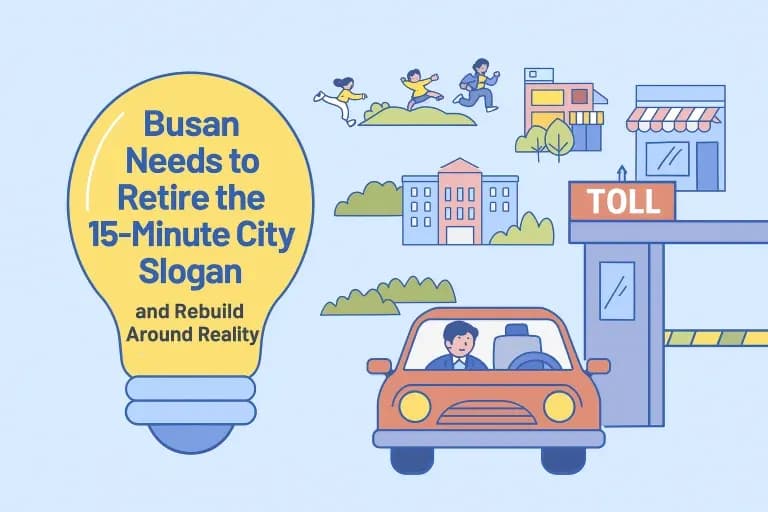
Busan, South Korea — Busan City Hall began the final week of October with a familiar phrase. In back-to-back press releases, the city reaffirmed its identity as a “15-Minute City.” One announced a cultural talk under the slogan “15-Minute City, Connected by Arts,”scheduled for late October at a new civic venue. The next revealed a partnership with Daangn Market, Korea’s largest neighborhood-based platform, to “build warmer communities.” Together, they were meant to show a metropolis made intimate: a place where work, leisure, and daily life unfold within walking distance. The timing was deliberate—just ahead of a series of autumn events designed to showcase Busan’s cultural vitality. The message was that the city had succeeded in making proximity its new measure of progress.
But Busan has never been a city of short distances. Its identity has always been defined by movement—through tunnels, over bridges, across slopes, and under tollgates. To live here is to calculate time not by minutes on foot but by traffic through bottlenecks. The slogan of “fifteen minutes” may sound modern, but it fits poorly onto the city’s map. For most residents, proximity remains something that must be paid for.
The 15-Minute City was first imagined in Paris, where Mayor Anne Hidalgo promoted it in 2020 as a remedy to pandemic-era isolation and car dependency. Every essential service—work, school, healthcare, recreation—should lie within a quarter-hour walk or bike ride. In the French capital, the idea seemed intuitive: a dense, flat metropolis long accustomed to transit-rich, mixed-use neighborhoods. The plan gave new language to an old geography. When Busan imported the model in 2021, it did so not as a transportation reform but as a brand of optimism. The city’s leadership declared the 15-Minute City the core of its “Happiness Strategy,” promising to make urban convenience the foundation of well-being. Officials described it as Korea’s first municipal “happiness policy,” an achievement that placed Busan alongside Paris and Melbourne in the global urban conversation.
Yet what was circular in Paris became linear on Korea’s southeastern coast. Busan stretches forty-five kilometers from west to east, hemmed between mountains and sea. It is a city that builds along corridors rather than across plains, a collection of narrow basins connected by civil engineering. To move between them is to traverse bridges, viaducts, and tunnels that turn proximity into a commodity. The municipal map may show compact neighborhoods, but the lived geography remains a chain of elongated districts: Haeundae, Suyeong, Seomyeon, Sasang, and Gangseo—each distinct, each separated by topography that resists the notion of a fifteen-minute life.
When Busan embraced the concept, global planners had already begun to interrogate it. A 2024 Taylor & Francis review described the 15-Minute City as “a metaphor in search of a metric.” The London School of Economics argued that it had become a post-political device, simplifying urban governance into a moral slogan that sidestepped questions of class and participation. A comparative study in MDPI traced its success to compact European cores where high density and public investment already ensured walkability. The same logic faltered in car-dependent, topographically complex cities. Meanwhile, scholars at Resilience.org and Iris Publishers warned that the pursuit of proximity risked producing “environmental gentrification”—raising property values in walkable districts and displacing low-income residents under the guise of sustainability. A team using Finnish mobility data added a behavioral twist: even when services sit nearby, people often travel farther out of habit, preference, or social connection. The research converged on a simple truth: distance cannot be legislated away.
Busan’s own geography makes that conclusion visible. The city counts seven major toll routes—Gwangan Bridge, Busanhang Bridge, Eulsukdo Bridge, the Cheonma and Sanseong tunnels, Sujeongsan Tunnel, and the Geoga Bridge to Geoje—each an engineering triumph, each a fiscal barrier. Together they carry more than 400,000 vehicles a day and generate hundreds of billions of won in annual toll revenue. They are, in effect, the arteries of a city where connection has a price tag. A resident traveling from Gangseo to Centum City may cross two toll points and spend half an hour in traffic; the “fifteen-minute” promise becomes an abstraction measured in fees rather than time.
The official map treats Busan as a continuous organism, but the lived reality resembles an archipelago of dense districts tethered by concrete causeways. Where Paris builds inward, Busan moves outward and along. Its population density—around 4,200 per square kilometer—is high by global standards but distributed unevenly: compact on the coast, sparse inland. Much of the western and northern periphery consists of steep residential hillsides and industrial corridors with limited public transit. To live in these zones is to occupy the blind spots of the 15-Minute narrative.
Inside City Hall, however, the language of proximity has become a universal solvent. The phrase appears in cultural campaigns, tourism brochures, and economic reports alike. In municipal presentations, every project—whether a tram extension, a waterfront redevelopment, or an arts festival—is framed as evidence of the 15-Minute City taking shape. Yet the budgets tell a different story. Between 2022 and 2024, Busan allocated more than ₩1.3 trillion to road expansion and toll maintenance, compared with less than a tenth of that amount for neighborhood-level accessibility programs. The city even introduced toll discounts to improve “inclusive mobility,” a paradoxical gesture that confirmed how dependent the urban system remains on car travel. Officials speak of shortening distances while investing in speed.
Urban policy analysts describe this phenomenon as goal drift: the gradual substitution of messaging for metrics. The administration’s communications emphasize “livability” and “cultural access,” but its data rarely measure either. There is no publicly released index of walking times to essential services, no map of service gaps between districts. Instead, proximity functions as a metaphor for civic identity—a promise broad enough to fit every department’s agenda. The result is a city perpetually announcing success without quantifying it. The more Busan repeats its 15-minute ideal, the more it reveals how far it remains from reality.
The gap is most visible across the city’s social geography. Amenities cluster where investment already flows: along the waterfront in Haeundae and Centum City, in the retail corridors of Seomyeon, around university zones in Nam-gu. Western and inland districts such as Sasang and Gangseo, by contrast, rely on long commutes for both work and culture. A 2024 municipal audit found that the average walking distance to a convenience facility in the eastern districts was 480 meters; in the west, 1.2 kilometers. Public libraries per capita are twice as concentrated on the coast as in the hills. Even the pilot “15-Minute Cultural Zone” programs launched last year were all sited within established entertainment areas. Proximity, in practice, reinforces prior privilege.
For those without private cars, the inequity compounds. Busan’s subway network, while extensive, runs primarily along the coastal spine. Bus service coverage declines sharply in hillside neighborhoods, where routes are steep, narrow, and unprofitable. Elderly residents in these areas often depend on municipal shuttles that operate only during daylight hours. For them, the “15-minute” life exists mostly in slogans. “Our fifteen minutes start after the tunnel,” a resident in Sasang quipped on a local online forum—a line that has since become a meme.
Digital inclusion programs mirror the same divide. The Daangn Market partnership aims to foster local community through app-based interactions, but assumes smartphone literacy and broadband access that many older citizens lack. The city’s attempt to replicate neighborhood cohesion online may therefore deepen rather than bridge social distance. What results is a paradoxical version of proximity: people connected by notifications but separated by topography.
Urban experts suggest that Busan’s predicament is not unique but exemplary. “The 15-Minute City was designed for Paris, not for peninsulas,” says Lee Jong-hwan, an urban planning professor at Kyungpook National University. “It’s elegant on paper but collapses when geography and income inequality overlap.” He and other scholars advocate for a “Multi-Core 30-Minute City” model better suited to coastal linear metropolises. Rather than measuring radius, they propose measuring reliability—door-to-door travel time between key hubs such as Haeundae, Seomyeon, and Gangseo. “Busan already has the infrastructure,” Lee says. “The challenge is to turn it from a toll network into a public connector.”
Such a shift would demand more than new metrics. It would require dismantling the institutional silos that separate transportation, culture, and welfare policy. Inside the municipal government, the “15-Minute” label has allowed each department to claim alignment without coordination: culture builds festivals, transit expands lanes, and planning drafts slogans. A senior city official, speaking anonymously, acknowledged the problem: “It’s easier to communicate success than to measure it. The slogan keeps everyone talking about the same goal, even if they are moving in different directions.”
To replace rhetoric with measurement, planners argue, Busan would need to publish a proximity dashboard tracking actual accessibility indicators—walking distance to essential services, transit reliability, toll cost per household, modal share, and injury rates. Equity targets could focus on the city’s lowest-access decile rather than averages that conceal inequality. “Accessibility has to become a line item,” says civic researcher Park Jin-ah. “Right now, it’s treated as a mood.”
At the core of the challenge lies the economics of connection. Busan’s toll infrastructure, mostly built through public-private partnerships in the 2000s, ties the city to decades-long concession contracts. These agreements guarantee investors steady returns from user fees, limiting the municipality’s ability to make crossings free or low-cost. Yet without toll reform, the 15-Minute City remains a contradiction in terms. Experts suggest phased equity measures—off-peak waivers for low-income drivers, integrated transfer discounts, and transparent toll-revenue audits—to gradually convert the system from a revenue stream into a public good. Such steps would cost money but buy credibility.
Cultural policy could follow a similar path. Busan’s global reputation as a creative city—home of the International Film Festival and UNESCO City of Film status—depends on events that attract visitors, not necessarily residents. The “15-Minute City, Connected by Arts” talk concert, for instance, will feature a pop singer, a composer, and the mayor himself discussing community through culture. For many citizens, the spectacle is less about access than about branding. Critics argue that real cultural proximity would mean permanent rehearsal rooms, local libraries, and youth studios—spaces built for daily use, not for press photography. In that sense, the cultural wing of the 15-Minute policy mirrors its physical side: glamorous, performative, and thinly distributed.
The broader political logic is familiar. Busan’s administration measures success partly through international attention. Since 2021, the city has featured in multiple OECD and EIU livability rankings, and its 15-Minute policy was cited in a 2025 OECD report as a “model for community engagement.” Such recognition reinforces the incentive to sustain the brand, even when domestic outcomes lag. Municipal planners quietly acknowledge that the slogan functions as a form of policy signaling: proof to national ministries and investors that Busan aligns with global sustainability narratives. In that sense, the city’s 15-Minute project has achieved its goal—just not the one its citizens experience.
Across Asia, similar stories unfold. Manila’s “20-Minute Community” initiative and Bangkok’s “Compact Living Districts” both struggle with car dependence and urban sprawl. Singapore, despite its flat terrain and strong transit, has extended its target to a “45-Minute City.” The lesson, urban theorists say, is not that proximity is wrong but that it cannot be universalized. Each city must translate it into its own language of terrain, economy, and social structure. For Busan, that translation has yet to occur.
And yet the city’s history shows resilience in adaptation. Its very existence—rebuilt after war, reshaped by trade, carved into cliffs—demonstrates an ability to reconcile constraint with ambition. The bridges and tunnels that now complicate its planning were once symbols of modernity. They turned isolation into connection, anchoring the port economy that made Busan Korea’s gateway to the world. To demand a “fifteen-minute life” within such a geography is to mistake mobility for failure. The city’s genius has always been movement.
That movement now needs recalibration, not slogans. The next stage of Busan’s evolution could be measured in verified minutes rather than metaphors: 30-minute cross-city travel times at peak, six-minute headways on trunk bus lines, 600-meter average walking distance to a clinic for 90 percent of seniors. These are numbers that mean something in lived terms. They would turn “livability” from a press release into a public contract.
For Busan, retiring the 15-Minute slogan would not signal retreat from global modernity. It would mark maturity—the point at which policy aligns with geography, and aspiration with arithmetic. The city that once built tunnels through mountains can certainly build honesty into its planning. The bridges and tollways that now separate districts can also become instruments of equity if the will matches the rhetoric. True accessibility will come not from imagining circles but from managing corridors.
Every city eventually chooses between the story it tells and the system it runs. Busan’s story has been eloquent; its system remains expensive. Letting go of the slogan may be the most progressive act available to it—a quiet correction that acknowledges both its terrain and its people. The 15-Minute City will remain a powerful metaphor for flat metropolises elsewhere. Here, on the coast where every connection costs a toll, progress will be measured not in slogans but in seconds saved, fares reduced, and corridors crossed freely—the real minutes of an honest city.
Continue this reporting
Reporting on the same issue
Related coverage selected from the article's desk, topics and newsroom relationships.
 NewsOct 16, 2026
What Is Still Worth Going to See?
Busan’s biennale faces questions of artistic judgment and institutional care....
 NewsOct 14, 2026
What Became of Busan’s University Streets?
From 2015 to 2023, registered businesses grew near Pusan National University...
 NewsOct 12, 2026
Bukangi, the Shark That Stayed in Busan’s North Port
A rescue net guided Bukangi toward the sea, but the dusky shark returned to B...
More from the author
More from this byline
Stay with the same line of reporting through more work from this byline.
- NewsOct 14, 2026
What Became of Busan’s University Streets?
 NewsSep 28, 2026
Why Some Commercial Space in Busan Is Hard to Reuse
Reader Signal
Community readWhat did this report leave you with?
Choose the signal that best reflects your reading. Select it again to remove it.
One response per article
No response selected
A moderated conversation about the reporting.
One-level replies and newsroom moderation keep the conversation anchored to this article.
Discussion Status
Open
Please sign in to join the discussion.
Newsletter
Weekly reporting and context from Busan and Korea.