Busan Metro Crisis Shows Why the $1.1B Hadan–Noksan Line Stalled
Busan’s $1.1B Hadan–Noksan metro project has stalled after two failed tenders, exposing deep flaws in procurement laws, engineering risk management, and urban mobility planning.

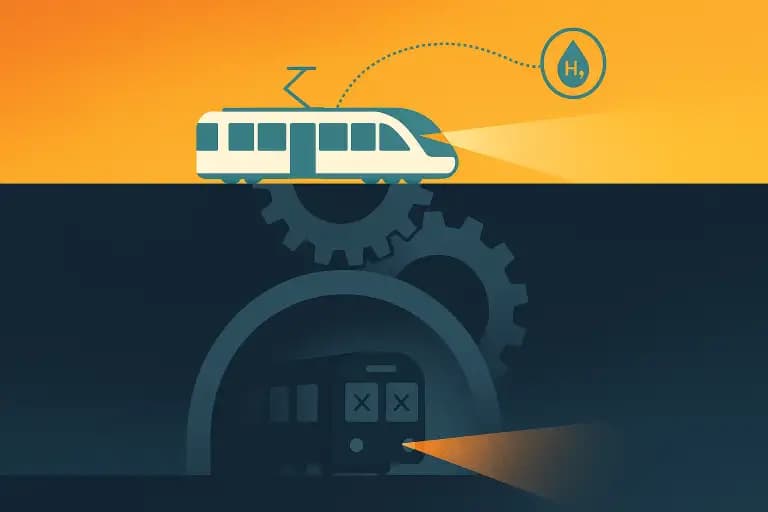
In September 2025, the Busan Transportation Corporation confirmed what many in the construction and infrastructure sector had already feared: the second consecutive bidding round for the Hadan–Noksan urban rail project had closed without a single contractor stepping forward. This was no minor scheme. At an estimated cost of ₩1.48 trillion (around $1.1 billion) and stretching more than thirteen kilometers across the rapidly expanding southwestern corridor of Busan, the line had been billed as essential to easing congestion, integrating new residential zones, and shaping the city’s future transit backbone. Yet the tender period ended in silence, just as it had months earlier, despite the authorities’ attempt to entice bidders by lowering the bridge construction experience requirement from 8.3 kilometers to 5.8 kilometers.
On the surface, the reasons seemed straightforward. The project’s technical demands were formidable: a 2.3-kilometer underground section slicing through the soft alluvial soils of the Nakdong River delta, a corridor already plagued by fifteen sinkhole incidents on the adjacent Sasang–Hadan Line since 2023, and a construction market rattled by volatile material and labor costs. Contractors, industry insiders noted, were understandably reluctant to shoulder such risks under Korea’s one-lot turnkey contracting regime, where price escalation clauses under the Enforcement Decree of the National Contract Act allow cost adjustments only on a ninety-day cycle. Any surge in steel, concrete, or labor costs before that window closed would fall squarely on the builder’s balance sheet. It was hardly surprising that no firm saw a path to a commercially viable bid.
Station HVAC & pumping add lifecycle cost; deep stations increase vertical access time.
Grid-electric; decarbonizes as the grid does. Level access improves user time.
Requires certified low-carbon H₂ to beat BEV lifecycle GHG; infra adders apply.
Yet focusing solely on geotechnical hazards or market conditions risks missing the deeper story. Beneath the headlines lies a structural rigidity in South Korea’s infrastructure governance that makes adapting projects midstream extraordinarily difficult. Once an Urban Rail Basic Plan is approved under the Urban Railroad Act and its Enforcement Decrees, any significant deviation—be it switching from underground to surface construction, adopting alternative technologies such as light rail or hydrogen trams, or even breaking a project into multiple contract packages—triggers a cascade of procedural requirements. These include fresh feasibility studies, central government re-approvals, underground safety impact assessments, and sometimes a full review of the project’s total cost plan if budget changes exceed twenty percent. Each layer brings months or years of delay, pushing project sponsors toward a kind of institutional inertia: it becomes easier to push through flawed designs than to reopen the bureaucratic Pandora’s box of approvals, studies, and negotiations.
This rigidity contrasts sharply with practices in other advanced transit markets. Paris, Freiburg, and Tokyo have increasingly shifted toward surface trams, Bus Rapid Transit systems, and even hydrogen-powered light rail, embracing phased delivery models, segmented contracting, and risk-sharing procurement frameworks such as Progressive Design-Build and Guaranteed Maximum Price agreements. These approaches allow projects to evolve when soil conditions, urban constraints, or technology landscapes change mid-course. South Korea, by contrast, remains tethered to mid-twentieth-century paradigms: heavy underground metros delivered under one-lot turnkey contracts, justified by benefit–cost ratios that give little weight to environmental sustainability, accessibility, or climate resilience.
The Hadan–Noksan debacle thus exposes a triple bind at the heart of the country’s infrastructure regime: engineering risk concentrated in difficult geologies, procurement systems that leave contractors carrying disproportionate financial exposure, and institutional frameworks that render plan adaptation procedurally prohibitive. With cities worldwide embracing low-carbon mobility solutions and with domestic initiatives such as Ulsan’s hydrogen city program and Daejeon’s Line 2 hydrogen tram project pointing to alternative futures, South Korea faces a critical question. Can it reform its laws, procurement practices, and planning doctrines to deliver adaptive, climate-conscious, and user-centered transit systems, or will projects like Hadan–Noksan remain locked into outdated models until costs, delays, and risks force a reckoning?
Engineering Risks and Market Reluctance Leave Contractors on the Sidelines
The engineering heart of the Hadan–Noksan project lies in the 2.3-kilometer stretch beneath Myeongji International City, a zone resting on the fragile alluvial soils of the Nakdong River delta. These sediments, deposited over centuries, are notoriously soft, water-saturated, and prone to settlement, presenting conditions that civil engineers describe as among the most challenging for urban rail tunneling. The records speak plainly: since 2023, fifteen sinkhole incidentshave been documented along the nearby Sasang–Hadan Line, with three occurring in the first year, eight in 2024, and four more before the close of the second quarter of 2025. Each collapse drew intense public scrutiny, triggering investigations into construction practices, supervision regimes, and ground stability measures. Even if the precise geotechnical causes varied, the effect on bidder psychology was unmistakable. When a corridor becomes associated with ground failure risks, contractors begin to model worst-case scenarios into their cost assumptions—or decline to bid altogether if those risks cannot be contractually shared.
In underground construction, risk translates directly into price, but only if the contract allows bidders to price it. Here, the project’s procurement structure became its own worst enemy. Korea’s one-lot turnkey system, widely used for rail projects, requires a single contractor or consortium to absorb design, construction, geotechnical uncertainty, and cost escalation risk within a single fixed-price envelope. Yet critical pieces of information—particularly late-stage geotechnical investigations—often arrive after prices are locked in. For a complex soft-ground tunnel, this means bidders must either inflate contingencies to astronomical levels, rendering their proposals politically indefensible, or refuse to bid altogether. In Busan, they chose the latter.
Compounding the problem were Korea’s price adjustment rules under the Enforcement Decree of the National Contract Act. These regulations permit cost escalation clauses but only on a ninety-day cadence from contract signing or the last adjustment date. In stable markets, such intervals may appear reasonable. But when steel prices spike or labor agreements lift wages mid-quarter—as has repeatedly occurred in recent years—contractors face carrying the entire risk until the next adjustment window opens. Internationally, mechanisms like escalation indices linked to commodities or cost-plus incentive fees are used to smooth such shocks, ensuring contractors neither profit unfairly from volatility nor collapse under its weight. Busan’s turnkey model offered no such balance.
Even the decision to package the entire line into a single construction lot proved a strategic misstep. Industry veterans note that complex urban rail projects often benefit from segmented contracting, where underground sections, elevated viaducts, and systems installations are bid separately or under progressive design-build (PDB) arrangements. Such structures allow high-risk segments—like Myeongji’s soft ground—to undergo additional geotechnical validationbefore price fixing, while lower-risk segments proceed under conventional contracts. By insisting on a one-package turnkey bid, Busan concentrated all risks onto a single bidder’s balance sheet, shrinking the pool of willing participants to zero.
The result was a predictable equilibrium: with engineering uncertainty high, procurement terms rigid, and price volatility left unbuffered, rational contractors chose to stay away. Busan now faces the prospect of rewriting its tender documents, possibly splitting packages or shifting to risk-sharing models. Yet such changes collide headlong with institutional constraints in Korea’s infrastructure governance—a rigidity that has become the next, and perhaps most formidable, barrier to salvaging the project.
Korean Infrastructure Laws Keep Projects Frozen in Outdated Plans
The engineering and procurement risks surrounding the Hadan–Noksan Line might, in another system, have prompted a fundamental rethink of the project’s scope or methods. City planners facing multiple bidding failures could have ordered fresh studies on whether the 2.3-kilometer underground section should be converted to surface light rail, whether the line should be broken into smaller packages to attract specialized contractors, or whether procurement terms should shift toward risk-sharing models. Yet in South Korea’s infrastructure governance, such mid-course corrections run headlong into a thicket of legal requirements, budgetary rules, and procedural constraints that make plan changes costly, slow, and politically fraught.
At the heart of this rigidity lies the Urban Railroad Act and its Enforcement Decrees, which structure every urban rail project into a tightly sequenced hierarchy of approvals. First comes the Metropolitan Network Plan, setting the broad strategic vision. Then the Basic Plan for each line fixes the alignment, technology choice, cost envelope, and key design parameters. Only after these stages can implementation proceed, unlocking land acquisition, safety assessments, environmental reviews, and procurement. In theory, this structure ensures discipline, transparency, and consistency across multiple agencies. In practice, it creates what experts call a “freezing effect”: once a Basic Plan is approved, any deviation risks unraveling the entire chain of subsequent clearances.
Korean law does permit “minor changes” to plans without restarting the process, but the definition of “minor” is exceedingly narrow. Realignments beyond a small percentage, changes in vertical profile from underground to surface, or shifts in system technology—from automated guideway transit to light rail or tram—almost always fall outside the exemption. These are treated as “material” changes, triggering a fresh round of feasibility studies, central-government reviews, and sometimes even parliamentary budget approvals if costs rise beyond the twenty percent threshold set by the Total Project Cost Management Guidelines. For local governments already struggling with tight election calendars and fiscal constraints, the prospect of a multi-year delay often proves politically unacceptable. As a result, officials default to the status quo even when technical conditions on the ground have changed dramatically.
Safety regulations add another layer of procedural gravity. The Underground Safety Impact Assessment Act requires any project involving tunneling or deep excavation to undergo a comprehensive review of settlement risks, groundwater impacts, and mitigation plans. These assessments are highly site-specific: a change in construction method or alignment, especially from underground to surface or vice versa, necessitates new safety studies before permits can be reissued. Again, the intent is sound—no one wants to compromise safety in pursuit of administrative convenience—but the cumulative effect is to make adaptive project management nearly impossible once the initial approvals are locked in.
Even budgetary oversight, designed to protect taxpayers from cost overruns, inadvertently reinforces rigidity. The 20 percent cost-change rule means that if redesigns push the project’s total cost beyond that threshold—whether because of inflation, new safety requirements, or shifts in construction method—the entire plan must be re-reviewed by central ministries. Combined with the Benefit–Cost Ratio metrics embedded in Korea’s Pre-Feasibility Study framework, which heavily favor capital-intensive underground metros over lighter, more flexible surface systems, these financial rules stack the deck against alternatives like trams or Bus Rapid Transit. Any midstream pivot risks not only delay but also the possibility of failing to meet B/C thresholds under the new assumptions.
The cumulative result is a procedural maze that makes the cost of change—politically, administratively, and financially—so high that project sponsors often push forward with initial designs even when circumstances demand adaptation. The experience of Daejeon’s Line 2 illustrates the point vividly. Originally conceived as a monorail, the line switched to a tram system only after years of debate, legal amendments, and budget renegotiations, delaying the project by nearly a decade. Few local governments are eager to repeat that ordeal.
For the Hadan–Noksan Line, this means that converting the problematic underground segment to a surface tram, breaking the project into smaller contracts, or adopting risk-sharing procurement models would all require multiple layers of re-approval under current law. Each step would invite scrutiny from auditors, central ministries, and possibly the National Assembly, lengthening timelines and raising political risks for local leaders. Faced with these institutional barriers, Busan’s planners have so far chosen to reissue tenders under essentially the same design rather than confront the procedural avalanche triggered by meaningful change.
What emerges is a portrait of institutional inertia as powerful as any engineering challenge. Even when new information reveals flaws in the original plan, the legal and administrative framework surrounding Korea’s urban rail projects discourages adaptation. The system was built for control, predictability, and fiscal discipline; what it lacks is the flexibility needed for twenty-first-century infrastructure, where climate risks, technological shifts, and urban dynamics demand mid-course corrections rather than rigid adherence to outdated blueprints.
Light Rail and Hydrogen Trams Offer New Paths for Urban Transit
As Busan grapples with repeated bidding failures and mounting public frustration, attention has begun to shift toward alternatives that, in other cities, have delivered reliable urban transit without the staggering price tags and risks associated with deep tunneling. Among these options, surface light rail and its technologically ambitious cousin, the hydrogen tram, have emerged as candidates for a different kind of mobility future—one that challenges South Korea’s long-standing fixation on heavy underground metros as the default mode of urban rail investment.
The economic case for revisiting surface options begins with the simplest of realities: tunneling through soft ground is enormously expensive, not only in direct civil works but also in risk contingencies. International cost databases consistently show that per-kilometer capital costs for underground rail lines often run two to three times higher than for surface light rail systems, even before counting the downstream costs of station ventilation, pumping, and vertical access infrastructure. In Busan’s case, converting just the 2.3-kilometer Myeongji underground section to a surface alignment would likely reduce construction costs by hundreds of billions of won, while also shrinking the variance around those estimates because surface works carry far fewer unknowns than deep excavations in saturated soils.
Accessibility adds another dimension to the argument. Every trip that begins or ends in a deep underground station imposes a vertical circulation penalty on riders: long escalators, multiple level changes, and transfer delays that often exceed the in-vehicle travel time itself. Transport economists have long documented that passengers perceive waiting and transfer time at two to three times the disutility of in-vehicle time, meaning that even modest reductions in access and transfer friction can have outsized effects on ridership. A surface tram with level boarding, short access paths, and seamless transfers directly addresses this user-experience gap, especially for older passengers, parents with strollers, and those with mobility impairments.
Environmental performance further strengthens the case. Conventional electric trams draw power directly from increasingly decarbonized grids, offering zero tailpipe emissions and straightforward integration with renewable energy targets. Hydrogen trams, now operating in cities from China to France, promise the same local air-quality benefits without the visual impact of overhead catenary wires. But here the picture complicates: lifecycle analyses show that hydrogen’s climate advantage depends entirely on how the hydrogen is produced. Green hydrogen, generated via electrolysis using renewable electricity, can deliver genuine carbon reductions; gray hydrogen, derived from natural gas without carbon capture, can be worse than direct electrification in overall emissions. The European Union now mandates strict carbon-intensity thresholds—at least 70 percent lifecycle emission reductions compared to fossil baselines—for hydrogen to qualify as “renewable” under its taxonomy. Unless Korea couples hydrogen tram adoption with similarly rigorous supply-chain standards, the technology risks becoming a symbolic rather than substantive climate solution.
Operational economics also favor surface systems. Underground metros require energy-intensive station ventilation, firefighting infrastructure, and water management systems that significantly raise operations and maintenance (O&M) costs over a line’s lifecycle. Surface trams, by contrast, rely on simpler stations, lower energy consumption, and modular track systems that can be maintained without major service disruptions. Hydrogen trams add complexity through fuel production, storage, and distribution infrastructure, as well as fuel-cell stack replacement cycles, but these costs can be partially offset if hydrogen ecosystems develop at scale across multiple sectors, from industry to heavy transport.
International precedents illustrate what is possible when institutional barriers fall away. Daejeon’s Line 2, after years of delay, eventually pivoted from a monorail to a surface tram system now slated to integrate hydrogen technology by 2028. Paris has expanded its Tramway network along boulevards once planned for underground metros, citing cost efficiency, urban design benefits, and carbon goals. In Freiburg, surface light rail serves as the spine of one of Europe’s most sustainable mobility systems, integrated with cycling corridors and pedestrian districts. These cities demonstrate that surface transit need not be a compromise; it can be the centerpiece of a climate-conscious, financially prudent, and socially inclusive urban transport strategy.
For Busan, the policy choice now extends beyond engineering feasibility. Converting the Myeongji segment to a surface light rail or hydrogen tram would not only cut costs and risks but also align the project with Korea’s broader commitments to carbon neutrality by 2050 and its nascent hydrogen economy roadmap. Yet such a shift would collide with the legal and institutional rigidity described earlier, requiring Basic Plan amendments, safety reassessments, and possibly fresh feasibility studies under frameworks still biased toward underground heavy rail. Without legislative reforms to enable adaptive project delivery, Busan risks watching the debate over alternatives remain academic while the project itself stays mired in inertia.
Reforms Could Unlock Flexible and Sustainable Transit Futures
If the Hadan–Noksan Line has revealed anything beyond the engineering and financial challenges of building urban rail in Korea, it is the brittleness of a system designed for control rather than adaptation. The layers of law, procurement rules, and planning doctrines that once ensured fiscal discipline and technical rigor have, over time, hardened into barriers against innovation, flexibility, and sustainability. Now, with the project stalled, bids absent, and public patience thinning, policymakers face a stark choice: continue issuing tenders under the same rigid frameworks or confront the structural reforms needed to bring twenty-first-century transit projects to life.
The first fault line lies in the Urban Railroad Act itself. Its tight sequencing of network plans, basic plans, and implementation approvals leaves little room for mid-course corrections once a project is underway. Other countries have adopted adaptive planning regimes that allow segmented approvals, conditional on periodic risk reviews and cost-benefit updates. For instance, the United Kingdom’s Green Book now requires that major infrastructure projects pass through multiple “decision gates,” with explicit opportunities to pause, redesign, or even cancel components if ground conditions, technology options, or financial realities shift. Korea’s current system, by contrast, effectively penalizes change: any deviation from the Basic Plan risks reopening the entire chain of approvals, safety reviews, and feasibility studies, a bureaucratic avalanche so daunting that local governments often prefer delay over redesign.
Reform here need not mean deregulation. It could instead take the form of modular planning authority, where specific components of a project—such as a single underground segment—can undergo scope or method changes without forcing the rest of the line back to square one. A revised Urban Railroad Act could define “adaptive change zones” within approved projects, allowing local authorities to implement construction-method swaps or mode transitions if they remain within pre-authorized cost and safety envelopes. This would preserve oversight while injecting much-needed flexibility into a system that currently treats any deviation as an existential threat to project legitimacy.
Procurement reform is equally urgent. The Hadan–Noksan tenders exposed how Korea’s reliance on one-lot turnkey contracts, combined with infrequent price-adjustment clauses and all-or-nothing risk transfer, has made complex projects commercially unviable for even the country’s largest contractors. International best practice increasingly favors progressive design-build (PDB) and Guaranteed Maximum Price (GMP) models, where early collaboration between owners and contractors refines design and risk allocation before final prices are locked in. These approaches also permit multi-package contracting, so that high-risk segments—like Busan’s soft-ground tunnel—can be procured separately with bespoke risk-sharing terms, while lower-risk sections proceed under conventional arrangements. By contrast, Korea’s current framework offers contractors no such flexibility, demanding full-scope, fixed-price commitments before key risks are even fully understood.
Budgetary rules also require rethinking. The 20 percent total-cost review trigger, designed to prevent runaway overruns, often discourages legitimate redesigns that could save money in the long term but raise near-term costs. Similarly, the Benefit–Cost Ratio (B/C) dominance in Korea’s pre-feasibility studies systematically favors traditional underground metros, which perform well on high-capacity throughput metrics, while undervaluing accessibility, emissions reduction, and risk mitigation benefits that lighter, surface-based systems provide. Reform could introduce multi-criteria analysis (MCA) alongside B/C ratios, weighting climate impacts, resilience, and user experience as explicit components of project evaluation.
Finally, the integration of climate and technology policy into infrastructure planning has become unavoidable. Korea’s ambitions for a hydrogen economy and carbon neutrality by 2050 will ring hollow if major transport investments remain locked into twentieth-century design assumptions. Urban rail legislation could explicitly mandate the consideration of low-carbon alternatives—from hydrogen trams to electrified BRT—at every planning stage, with lifecycle emissions thresholds aligned to international standards such as the European Union’s Renewable Energy Directive. This would ensure that projects seeking public funding cannot ignore decarbonization pathways simply because procedural inertia favors legacy technologies.
None of these reforms will be easy. They will require amendments to national legislation, revisions to procurement codes, retraining of planning agencies, and new guidance for feasibility studies that have long prioritized cost containment over climate adaptation. Yet the cost of inaction is already visible in Busan: a flagship urban rail project, conceived to modernize the city’s transport backbone, now risks years of delay, spiraling costs, or outright cancellation because its institutional architecture could not accommodate mid-course correction.
The lesson is clear. If Korea continues to build twenty-first-century infrastructure with twentieth-century governance, projects like the Hadan–Noksan Line will remain hostage to a system where bureaucratic momentum outweighs engineering reality, and where innovation arrives only after failure has made it unavoidable. Breaking this cycle demands more than another tender; it requires a wholesale rethinking of how the country plans, approves, and delivers the infrastructure on which its urban future depends.
Modern Transit Requires Flexible Policies and Adaptive Planning
The story of the Hadan–Noksan Line is not, at its core, about a single urban rail project. It is about what happens when a twenty-first-century city tries to build its future with twentieth-century governance. The repeated bidding failures in Busan exposed the limits of a system designed for linearity and control, a system that assumes plans, once approved, should proceed unchanged to completion. Yet urban reality no longer conforms to such static assumptions. Geotechnical conditions reveal hidden risks. Construction markets shift under inflationary pressure. Climate imperatives demand decarbonization trajectories that were unthinkable when older plans were written. Technologies like hydrogen trams, modular procurement, and progressive contracting now offer possibilities far beyond the paradigms embedded in legacy laws.
And yet Korea’s infrastructure regime remains locked in place. The Urban Railroad Act and its Enforcement Decrees, conceived to ensure transparency and fiscal discipline, have inadvertently created a procedural architecture so rigid that even modest plan adjustments trigger cascading delays. Procurement rules written for eras of price stability now deter contractors from bidding at all when volatility spikes. Feasibility doctrines obsessed with benefit–cost ratios continue to favor capacity-maximizing underground metros even as ridership patterns, climate policies, and urban accessibility goals shift the ground beneath them.
The result is a paradox. Korea has the engineering capacity to build some of the world’s most complex infrastructure, the financial resources to fund it, and the technological ambitions to lead in hydrogen mobility and carbon neutrality. But it lacks the institutional agility to adapt projects when reality diverges from the assumptions on which they were approved. The Hadan–Noksan debacle has made that tension impossible to ignore.
Reform will not come easily. Amending the Urban Railroad Act to permit modular approvals, rewriting procurement codes to enable risk-sharing contracts, integrating climate metrics into feasibility studies, and allowing mid-course redesigns within pre-approved cost envelopes all require political courage and bureaucratic will. Yet the alternative is worse: a future where projects stumble from delay to delay, costs escalate as risks compound, and innovation arrives only after failure has made it inevitable.
Busan’s stalled line offers Korea a chance to break this cycle. Converting its most problematic segment to surface light rail or hydrogen tram, restructuring tenders into progressive, multi-package contracts, and aligning project evaluation with climate and accessibility goals could turn a crisis of inertia into a demonstration of modernization. More importantly, it could signal to cities nationwide that the era of rigid, one-shot megaproject planning is over—that twenty-first-century infrastructure must be not only technically advanced but institutionally adaptive, economically resilient, and environmentally responsible.
The choice now facing policymakers is not simply whether the Hadan–Noksan Line gets built. It is whether Korea’s infrastructure governance will remain a system where plans drive reality, or evolve into one where reality can reshape plans. The former leads to more stalemates like Busan’s; the latter could turn today’s impasse into the foundation for a new era of urban mobility—one where engineering excellence, fiscal prudence, and climate ambition finally pull in the same direction.
Continue this reporting
Reporting on the same issue
Related coverage selected from the article's desk, topics and newsroom relationships.
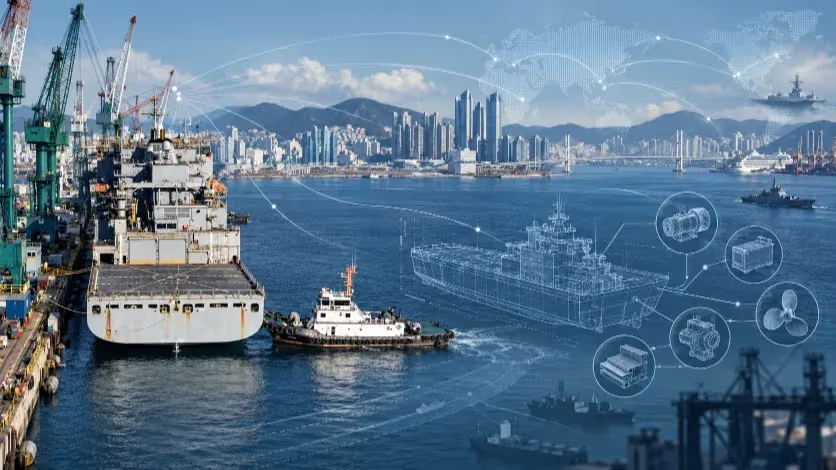 NewsSep 20, 2026
What It Takes for U.S. Navy Repair Work to Become a Busan Industry
HJ Shipbuilding has brought U.S. Navy maintenance work to Yeongdo. Whether it...
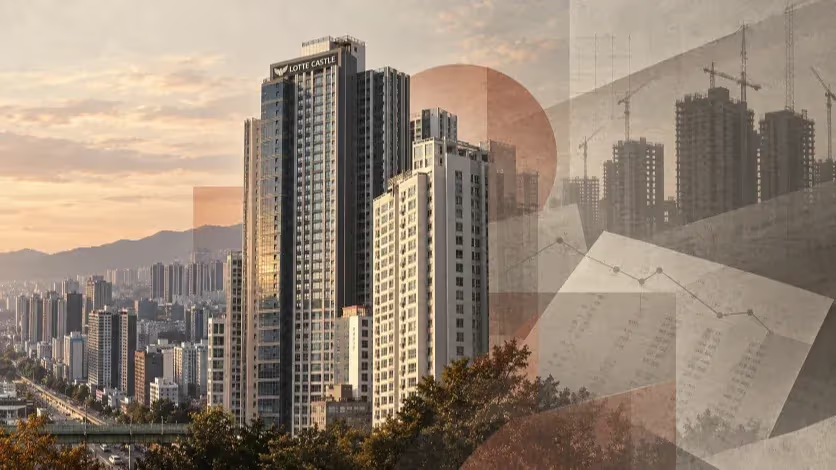 NewsSep 17, 2026
Busan’s Finished Homes, Unfinished Projects
Busan’s unsold homes sit in one monthly total, but they belong to very differ...
 NewsSep 16, 2026
Busan’s Young-Adult Migration Turns Sharply at 25–29
Busan can still draw young adults into the city, but keeping them becomes far...
More from the author
More from this byline
Stay with the same line of reporting through more work from this byline.
- NewsSep 17, 2026
Busan’s Finished Homes, Unfinished Projects
Editorial Record
Corrections, sourcing notes and newsroom disclosures remain part of the published record. View Newsroom Notes →
Reader Signal
Community readWhat did this report leave you with?
Choose the signal that best reflects your reading. Select it again to remove it.
One response per article
No response selected
A moderated conversation about the reporting.
One-level replies and newsroom moderation keep the conversation anchored to this article.
Discussion Status
Open
Please sign in to join the discussion.
Newsletter
Weekly reporting and context from Busan and Korea.