Busan mayoral race tests conservative dominance in South Korea
Jeon Jae-soo’s polling strength has made Busan’s mayoral race unexpectedly competitive, forcing incumbent Park Heong-joon to defend conservative continuity in Busan.

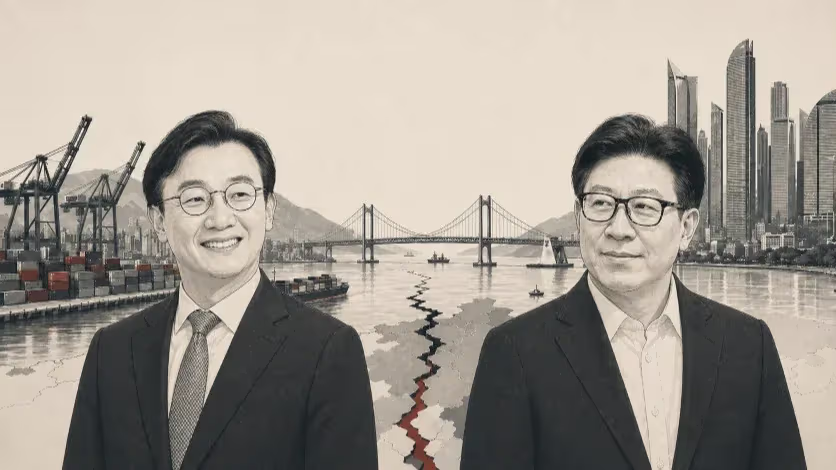
Four years after Park Heong-joon won Busan with 66.36 percent of the vote, the city is no longer behaving like a safe conservative possession. Conservatives won 17 of Busan’s 18 National Assembly seats in 2024, leaving Jeon Jae-soo as the Democratic Party’s lone surviving lawmaker in the city. By that map, Park should have entered this year’s mayoral race as an incumbent defending a settled advantage. Instead, he is trying to recover ground in a contest that has exposed how much of Busan’s old political certainty now depends on performance, not inheritance.
Jeon has led several recent surveys, giving Democrats their most serious opening in Busan since the party’s brief breakthrough in the late 2010s. Park has responded by moving fully into campaign mode after registering as a preliminary candidate, a legal step that suspends an incumbent mayor’s duties while allowing him to campaign. The race remains far from settled, and later polling suggests conservative voters may be returning to Park as the matchup hardens. But the fact that an incumbent with Park’s 2022 mandate must now fight to reassemble the conservative coalition is itself the central fact of the election.
Busan remains structurally conservative. It is South Korea’s second-largest city and the anchor of the southeastern political belt that has long supplied conservative parties with one of their most reliable urban bases outside Daegu. Yet the current race suggests that conservative identity alone may no longer be enough to settle a mayoral election. Voters who still lean right nationally are being asked to judge whether Park’s promise of continuity has produced visible change, and whether Jeon’s alternative — a maritime-capital strategy built around HMM, a maritime court, Arctic shipping routes and port-linked institutions — can be executed by a mayor rather than merely promised through Seoul.
That is the useful distinction. The race does not show that Busan has become a liberal city; it shows that Busan has become a more conditional conservative city. Park is asking voters to trust a long development cycle built around the global-hub-city agenda, while Jeon is asking them to treat the election as a chance to shift more economic authority toward the port city itself. Both arguments begin with Busan’s future, but both are being tested against the city’s present: aging neighborhoods, youth outmigration, uneven western development, old downtown decline and a growing impatience with slogans that do not translate into daily life.
Polls Show an Opening, Not a Realignment
Recent polling has given Democrats a rare opening in Busan, but it has not produced evidence of a durable realignment. Jeon has led often enough to force Park into a competitive campaign, while later surveys showing a narrower gap suggest that conservative voters may be consolidating as the election becomes a formal two-way choice. The data point to a race in which the challenger opened a serious lead before the contest fully hardened, and the incumbent is now testing whether Busan’s conservative habits can be reactivated.
That distinction matters because not all numbers are measuring the same thing. Some surveys ask about candidate suitability, others about voting preference. Some were conducted before both major parties had finalized their candidates, while others came after the matchup became clearer. Live telephone interviews and automated response surveys can produce different electorates, and a poll showing Democratic strength across the broader Busan-Ulsan-South Gyeongsang region cannot be read as the same thing as a Busan mayoral ballot test.
The safest reading is therefore narrower and more useful: Jeon has made the race real, while Park has made it unstable. Jeon’s lead gives him viability in a city where Democratic candidates often begin by having to prove they can compete at all. But a visible lead also exposes him to the familiar conservative warning that Busan could be pulled into a national Democratic project rather than choosing a city-specific alternative. If the race becomes a final-stage test of partisan comfort, some of that support could soften.
For Park, the narrowing gap offers a route back without requiring full recovery of the national conservative brand. His campaign needs to convince enough voters that the mayoralty is a separate question — one about continuity, institutional access and the risk of changing leadership while major city projects remain unfinished. In a structurally conservative city, that argument still has room to grow. But the same polling also shows the limit of his position: an incumbent with Park’s 2022 mandate should not have to rebuild permission from the ground up.
What the polls reveal, then, is not a simple Democratic surge. They show voters temporarily separating three things that once moved together in Busan: conservative identity, trust in local leadership and confidence in the city’s direction. Jeon’s task is to keep that separation open long enough to turn dissatisfaction into a governing mandate. Park’s task is to close it by rejoining party loyalty, mayoral experience and development continuity into one conservative choice.
Jeon Tries to Turn a Western Base Into a Citywide Case
Jeon’s strongest argument does not begin with the Democratic Party. It begins with geography. Most Democratic candidates in Busan have had to borrow strength from national mood, presidential approval or conservative disarray. Jeon has something more durable and more limited at the same time: a local base. He survived the 2024 parliamentary election in Buk District when Democrats were nearly erased from Busan, a result that did not make the city Democratic but did make him unusual.
His campaign now tests whether that exception can be expanded. The path starts in western Busan and the Nakdong River belt, a different political landscape from the image of Busan built around Haeundae apartments, eastern conservative districts and polished development slogans. The west contains industrial corridors, logistics land, new residential districts, older working-class neighborhoods and voters whose attachment to conservative politics can be less automatic than in the east.
For Jeon, western Busan is more than a home district. It is the proof of concept for his campaign. If he cannot turn local familiarity there into wide margins, he has little chance of winning the city. If he can, he forces Park to defend not only the conservative base in eastern Busan but also the middle ground in districts where development promises have accumulated for years without always producing daily confidence.
That is why Jeon’s policy language is built around Busan’s port identity. He is not campaigning mainly on cultural progressivism or national anti-conservative sentiment. His argument is economic and spatial: Busan should not remain a city that handles cargo while strategic decisions, corporate headquarters, legal institutions and financial authority stay elsewhere. His promise to make Busan South Korea’s maritime capital links HMM’s possible relocation, a maritime court, Arctic shipping strategy and port-related institutions into one claim — that the city should control more of the high-value functions attached to its own port economy.
The strength of the argument is its coherence. HMM, maritime law, port logistics, shipping routes and public institutions all point in the same direction. Jeon is offering voters a city model in which Busan’s maritime identity becomes an economic system rather than a slogan. For a city often described as South Korea’s gateway to the world, the argument has force because it asks why so much of the gateway’s command structure still sits outside Busan.
But coherence is not control. HMM is not a municipal agency. A maritime court cannot be created by mayoral order. Arctic shipping strategy depends on national planning, international conditions, shipping companies and infrastructure decisions that extend far beyond City Hall. The relocation of public agencies or maritime institutions requires legislation, budgets and bureaucratic bargaining. Jeon’s platform is strongest as a national-local strategy; it is weakest where voters ask what a Busan mayor can execute directly.
That execution gap is the risk in his campaign. The same national alignment that gives his maritime agenda credibility can also make it vulnerable to Park’s attack. Conservatives can argue that Jeon is promising what only Seoul can deliver, or that Busan would become dependent on a Democratic central government rather than protected by an experienced local executive. In a city that still leans conservative, that warning cannot be dismissed.
Jeon’s answer has to be local credibility. His years in western Busan must become more than a biography; they must become evidence that he understands the city’s uneven development. The argument is not that all of Busan looks like Buk District, but that the city’s future cannot be read only from its eastern skyline. His candidacy becomes more than a polling story only if he can connect western infrastructure frustration, old downtown commercial anxiety and the broader sense that Busan’s economic role has too often been described from outside the city.
A district base can make a candidate credible; it cannot by itself make him mayor. To win, Jeon must move from being the Democrat who survived in Busan to being the Busan candidate who can govern beyond Democratic voters. That means convincing moderates, younger families, port-linked workers, old downtown merchants and some conservative-leaning voters that his maritime-capital agenda is not a campaign phrase but an executable plan. The west gives him the opening; the rest of the city will decide whether it gives him permission.
Park’s Continuity Message Meets a Demand for Evidence
Park’s campaign rests on a more institutional claim: Busan has already entered a long development cycle, and replacing the mayor now would risk slowing projects that depend on legislation, central-government negotiation, investment commitments and administrative continuity. It is the natural argument of an incumbent, but in this race it is also a defensive one. Park is not simply asking conservatives to hold Busan. He is asking voters to accept that the city’s current trajectory is far enough along to deserve more time.
The phrase that holds his campaign together is the “global hub city.” In Park’s telling, Busan’s future does not rest on one industry or one district but on logistics, finance, advanced industries, tourism, culture, international exchange and metropolitan infrastructure. The city should be more than a port, more than a second city and more than a regional administrative center. It should become a platform city — a place where capital, cargo, people and institutions move through Northeast Asia.
That ambition gives Park scale. It lets him speak about Busan as a city competing not only with Seoul but with Osaka, Fukuoka, Shanghai, Singapore and other Asian nodes of trade and urban power. It also allows him to connect scattered projects into a single governing story: airport-linked development, port redevelopment, financial district ambitions, tourism infrastructure, cultural branding and logistics policy can all be placed under the same frame.
Yet the breadth of that frame is also its weakness. “Global hub city” is large enough to include almost everything, which makes it useful as a governing slogan but vulnerable as an election argument. Voters do not experience a global hub in the abstract. They experience commuting times, wages, housing costs, hospital access, school options, storefront vacancies and whether their children believe they can build a life in the city. Park’s task is to prove that the phrase has entered daily life, not only official planning language.
The Global Hub City Special Act sits at the center of that tension. For Park, the legislation is not a side issue but the institutional backbone of his future-tense argument: the claim that Busan needs special legal status and state-level support to compete as a global city. If passed with meaningful powers and resources, the law could give Park’s development frame a more concrete structure. But it remains a legislative question, dependent on the National Assembly, partisan negotiation and the willingness of lawmakers outside Busan to accept exceptional treatment for the city.
That creates a vulnerability Jeon can exploit. If Park’s central promise requires parliamentary cooperation, the mayor’s office alone cannot deliver it. If the bill is weakened, delayed or rewritten, the global-hub argument risks looking less like a guarantee than an aspiration. Park’s answer is experience: large city projects are never completed by mayoral will alone, and precisely because they require legislation, budgets and coordination, Busan needs a mayor who already knows the administrative terrain.
This is Park’s strongest ground. He does not need every voter to feel enthusiasm. He needs enough voters to decide that the cost of changing course is higher than the frustration of staying with him. In a conservative city, caution can be a political asset. Older voters, business communities and district-level conservative networks may not love every part of Park’s record, but they may still see continuity as safer than experimentation.
The danger is that safety is not the same as renewal. If the race becomes a judgment on competence, Park can recover. If it becomes a judgment on whether Busan’s existing development model has produced enough visible return, he is exposed. The longer he speaks in the language of global positioning, the more Jeon can pull the argument back to headquarters, courts, maritime institutions and the distribution of economic authority. Park speaks of making Busan bigger. Jeon speaks of moving power to Busan. Those are related promises, but they are not the same.
Park’s campaign therefore has to do more than defend his record. It has to localize his ambition. The global hub city must be translated district by district: what it means for western Busan beyond logistics land, for old downtown beyond redevelopment renderings, for eastern Busan beyond property values and tourism, for Gangseo beyond future maps and construction fences. Park remains formidable because incumbency matters, conservative consolidation matters and Busan’s old political habits have not disappeared. But he is no longer running in a city where those habits can carry the argument alone.
The Election Turns on Busan’s Uneven Political Map
Busan is often treated in national politics as a single conservative city, but the mayoral race will be decided by how different versions of Busan respond to the same two candidates. Western Busan does not read the election the same way as Haeundae or Suyeong. The old downtown districts do not carry the same anxieties as Gangseo’s new residential zones. A voter in Buk District may hear Jeon’s maritime-capital argument through the language of neglected infrastructure and western expansion, while a voter in eastern Busan may hear Park’s global-hub message through stability, property, tourism and administrative continuity.
Neither campaign can win by speaking only to its natural base. Jeon cannot win with Democratic voters alone. Park cannot rely only on inherited conservative loyalty. Each needs to cross into a Busan that is less comfortable for them.
Western Busan is where Jeon’s path is most visible. Buk, Gangseo, Saha and Sasang are not identical districts, but together they form the part of the city where industrial land, logistics corridors, working-class neighborhoods, new housing and uneven public infrastructure overlap. For many western voters, the issue is not whether Busan has development projects, but whether those projects have distributed benefits evenly enough to be felt outside the city’s eastern districts.
Park cannot concede this ground because his global-hub argument depends heavily on the west — on logistics, transport, airport-linked development and new industrial capacity. If western Busan sees those projects as Park’s unfinished work, he can defend the area. If it sees them as promises without enough daily return, Jeon can widen the map.
The old downtown districts pose a different problem. Jung, Dong, Seo, Yeongdo and parts of Busanjin carry Busan’s historical identity as a port city, but also its most visible signs of decline. Empty storefronts, aging streets, tourism-dependent commerce, redevelopment fatigue and demographic aging make abstract development language harder to sell. Park has to show that redevelopment and global-city branding have made old Busan feel renewed rather than merely re-described; Jeon has to show that maritime-capital rhetoric can speak to merchants, elderly residents and small property owners who want commercial life, transport and care infrastructure more than another strategic slogan.
Eastern Busan remains Park’s defensive base. Haeundae, Suyeong, Dongnae and Geumjeong give him the possibility of recovery if conservative voters consolidate around him, and they supply a vocabulary of stability built around asset values, education, tourism, urban services and administrative continuity. But even eastern Busan cannot be treated as politically automatic. Voters may remain conservative while still judging the mayor’s record, and Park’s path to victory likely requires not just winning these districts but winning them by enough to offset Jeon’s strength elsewhere.
Gangseo is the city’s future tense: maps, construction, logistics, airport development, new towns and family households meeting before a settled civic identity has fully formed. The politics there are not the politics of nostalgia. Residents are more likely to ask whether development is arriving with schools, hospitals, transit, jobs and usable public space. A campaign that speaks only of global logistics or maritime strategy without addressing daily infrastructure risks sounding distant.
This internal geography complicates the race because Busan contains old conservative habit, new residential uncertainty, port-city nostalgia, industrial transition, logistics ambition and neighborhood-level fatigue at the same time. The same voter can want conservative stability and still want a different economic strategy. The same district can favor continuity while demanding proof that continuity has delivered.
The winner will not be the candidate who claims Busan as a whole. The winner will be the candidate who assembles enough of its parts. Western Busan must be made to believe it is not an afterthought. Old downtown must be offered more than symbolic revival. Eastern Busan must be persuaded that continuity still carries value. Gangseo must be convinced that the city’s future is not only being built around it, but for it.
That is the map beneath the polls. Busan is still conservative in structure, but it is politically uneven in experience. The mayoral race will turn on whether Park can make that unevenness feel manageable, or whether Jeon can make it feel like the reason for change.
Beneath the Vote Is a Question of Urban Viability
Beneath the polling, campaign slogans and district-by-district arithmetic, the Busan race is being shaped by a harder question: whether the city still feels viable to the people expected to build their lives there.
That question is not the same as whether Busan is growing on paper, hosting events, attracting projects or appearing in national development plans. Cities can accumulate plans and still lose confidence. They can build infrastructure and still watch young people leave. They can describe themselves as global while residents continue to ask why the best jobs, headquarters, courts, ministries and decision-making networks remain elsewhere.
This is where the mayoral race becomes larger than Park or Jeon. Both candidates are selling versions of urban confidence. Park’s version is cumulative: Busan is already moving through a long development cycle and should not change direction. Jeon’s version is corrective: Busan has handled the physical work of a port city without receiving enough of the institutional power that should come with it. The campaigns differ, but both are responding to the same unease.
Busan’s problem is not that it lacks identity. It has too many identities that do not yet add up to a stable economic answer. It is South Korea’s second-largest city, a port city, a tourism city, a logistics city, a film city, a former industrial city, a retirement city, a gateway city and a city still asked to compete with Seoul for people, capital and authority. The question is which of those identities can produce durable work for the next generation.
For older conservative voters, viability may mean stable administration, asset protection, familiar leadership and the belief that large projects should be completed before political control changes. For younger voters, it may mean whether staying in Busan requires accepting fewer career options than moving to the capital region. For merchants in old downtown districts, it may mean whether redevelopment and tourism can revive daily commerce rather than only raise expectations. For families in new western districts, it may mean whether schools, transport, hospitals and jobs arrive at the same speed as apartment blocks and logistics plans.
That is why abstract city branding carries political risk. “Global hub city” and “maritime capital” are not weak phrases in themselves; they are attempts to answer real structural problems. But voters will test them against ordinary evidence. Does a global hub reduce the need to leave for Seoul? Does a maritime capital bring headquarters, legal services and finance to Busan, or only cargo volume? Does either vision improve the daily map between home, work, school and care?
The viability question also explains why Busan can remain conservative and still become competitive. Political identity does not disappear simply because voters are dissatisfied. Many Busan voters may still distrust the Democratic Party nationally, prefer conservative economic language or view Park as the safer administrator. But dissatisfaction can weaken automatic consent. It can make voters ask for proof before loyalty and turn a safe city into a conditional one.
For Jeon, this is the opening. He can argue that Busan’s long-term problem is not lack of ambition but lack of authority: too much economic command remains concentrated in Seoul, while Busan is left to manage the infrastructure of national trade without controlling enough of its higher-value institutions. His maritime-capital agenda is strongest when it names that imbalance directly.
For Park, the same question can still work in his favor. He can argue that viability is built through continuity, not disruption; that large projects require administrative patience; that Busan cannot afford to restart its strategy every election cycle; and that a mayor with existing relationships is better placed to extract support from Seoul, international partners and the private sector. His global-hub agenda is strongest when it is tied to specific delivery, not just scale.
The election may therefore turn less on which slogan voters prefer and more on which burden they find more believable. Jeon must prove that structural change can be executed from City Hall. Park must prove that continuity has produced enough visible return to deserve more time.
Both burdens are heavy because Busan’s anxiety is not theatrical. It is visible in the demographic tilt of neighborhoods, the commercial fragility of old districts, the daily pull of the capital region and the gap between the city’s international language and its local wages. It is visible whenever a young resident treats Busan as home but not as a career plan, and whenever a development map promises future value while the present remains inconvenient.
That is the deeper reason the race has become competitive. The contest is not only asking whether Busan wants a Democratic challenger or a conservative incumbent. It is asking whether Busan believes its current trajectory can still hold people, work and confidence.
If voters believe the answer is yes, Park has a path back. If they believe the answer requires a transfer of authority, institutions and economic imagination, Jeon has room to grow. If they doubt both, the race may be decided by turnout, party consolidation and which campaign better manages fear of the alternative.
Busan’s election, then, is not a clean ideological realignment. It is a stress test of urban viability. A conservative city can pass that test by staying conservative. It can also reveal change by demanding that conservatism prove itself in ways it once did not have to.
Polling note
This article refers to publicly reported opinion polls conducted by Research & Research / 리서치앤리서치, Ace Research / 에이스리서치, MetaVoice / 메타보이스, Global Research / 글로벌리서치, Hankook Research / 한국리서치 and J2 Insight Lab / 제이투인사이트랩. The surveys differ by fieldwork dates, sample size, survey mode, response rate, question wording and margin of error. Candidate-suitability surveys, voting-intention surveys, hypothetical matchups and broader regional party-preference polls are not treated as identical indicators. Results within the margin of error are described as close or unsettled, not as a settled lead or a prediction of the election outcome. Full disclosures should be checked through South Korea’s National Election Survey Deliberation Commission.
Continue this reporting
Reporting on the same issue
Related coverage selected from the article's desk, topics and newsroom relationships.
 NewsOct 25, 2026
The Long Bill for Busan’s Apartment City
Busan has about 958,000 apartments even as its population declines. Elevators...
 NewsOct 23, 2026
Busan’s Twelve-Year School Account Faces a Test Beyond Access
Busan’s PENZ promises one school account for 12 years, while BeAT brings AI t...
 NewsOct 22, 2026
Busan Port’s LNG and Methanol Plan: Who Pays to Keep Fuel Ready?
Busan already supplies ships with LNG and methanol, drawing on regional and i...
More from the author
More from this byline
Stay with the same line of reporting through more work from this byline.
 NewsOct 21, 2026
What a Small Mackerel Is Worth

Reader Signal
Community readWhat did this report leave you with?
Choose the signal that best reflects your reading. Select it again to remove it.
One response per article
No response selected
A moderated conversation about the reporting.
One-level replies and newsroom moderation keep the conversation anchored to this article.
Discussion Status
Open
Please sign in to join the discussion.
Newsletter
Weekly reporting and context from Busan and Korea.