Busan Looks to Deepen Mongolia Ties — But Concrete Strategy Remains Elusive
Busan brands itself as a study-friendly city for Mongolian students, but critics argue that without deeper partnerships in infrastructure, logistics, and resource diplomacy, the relationship remains superficial.

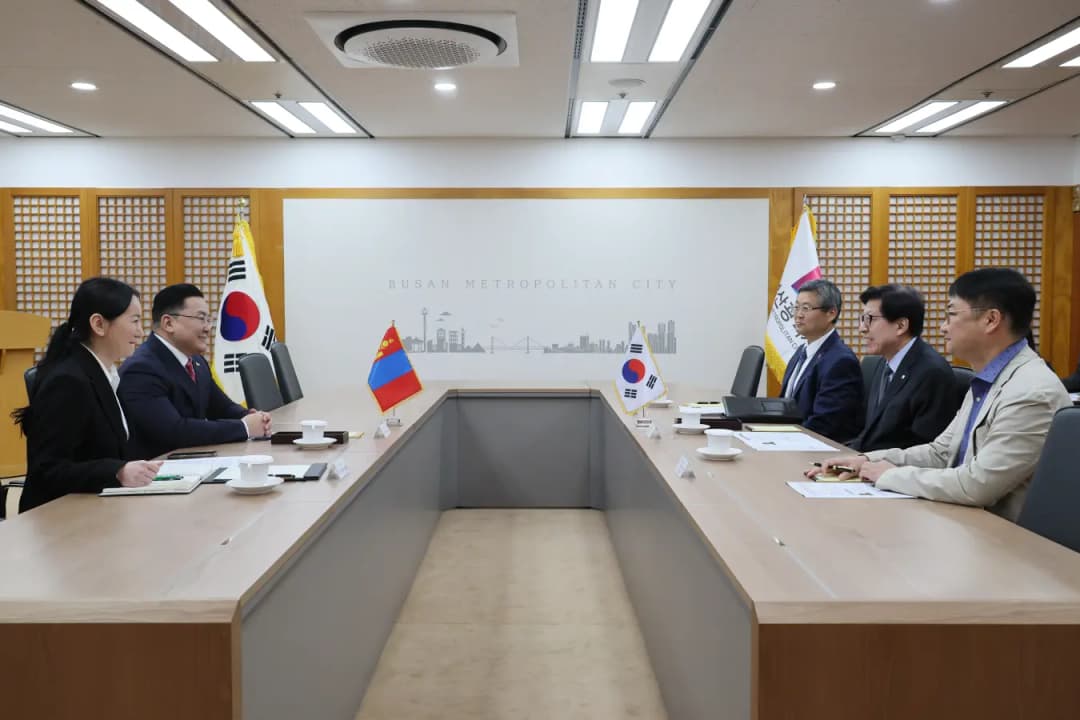
Busan, South Korea — In a quiet diplomatic gesture marking nearly three decades of sister-city ties, Busan Mayor Park Heong-joon received the newly appointed Mongolian Consul General, Tsagaan-Uvgun Jadamba, at City Hall on March 31. The meeting, held at the city's international protocol room, emphasized continued people-to-people exchange, especially in higher education, and included an invitation to Ulaanbaatar’s mayor to attend Busan’s upcoming 2025 Global City Week.
But while the occasion underscored a long-standing bond between the two cities — first formalized in 1996 — observers note that Busan’s Mongolia diplomacy remains largely symbolic, with few concrete outcomes in terms of economic cooperation, strategic alignment, or mutual development initiatives.
At a time when global cities are increasingly acting as independent diplomatic actors — shaping their own trade relationships, climate action policies, and regional influence — Busan’s limited engagement with Mongolia may signal a missed opportunity to develop more structured and strategic ties with a partner of growing geopolitical relevance.
Mongolia occupies a critical position in Northeast Asia’s shifting geopolitical landscape. Sandwiched between China and Russia, the country has long played the role of a diplomatic balancer, actively cultivating ties with “third neighbors” such as South Korea, Japan, the EU, and the United States.
Beyond its diplomatic posture, Mongolia is home to substantial reserves of strategic minerals, including copper, rare earth elements, and coal — all vital to South Korea’s clean energy transition and industrial resilience. As Korea moves to reduce its overdependence on Chinese supply chains, experts have flagged Mongolia as a logical alternative for mineral sourcing and infrastructure collaboration.
Yet, despite these advantages, Busan’s engagement with Mongolia has remained largely ceremonial, focused on education and cultural exchange. The city currently hosts around 230 Mongolian students out of more than 15,000 international students, and promotes itself as a “study-friendly” destination. In September, Busan plans to hold a study-abroad fair in Mongolia and Central Asia — another signal of its soft-power emphasis.
No major agreements on logistics, trade corridors, energy, or urban development were reported from this week’s meeting, nor have any recent bilateral memorandums been announced.
As Korea’s second-largest city and leading maritime hub, Busan is well-positioned to play a greater role in Eurasian diplomacy. It sits at the terminus of potential overland trade corridors via Mongolia and China and boasts one of the busiest container ports in the world. The city has also hosted multiple global events — including APEC in 2005 and the annual Busan Global City Week — aimed at raising its diplomatic profile.
However, critics argue that Busan’s external strategy has not kept pace with its potential. Unlike other regional capitals such as Incheon or Daegu, which have recently launched targeted economic partnerships in Central Asia and ASEAN countries, Busan’s international outreach has remained largely narrative-driven — focused on branding, not bilateral infrastructure.
“If Busan wants to become more than a logistics city, it must move from symbolic diplomacy to a strategy that integrates development, innovation, and regional resilience,” said a former diplomat familiar with Eurasian affairs.
Busan’s sister-city ties with Ulaanbaatar remain one of its oldest international relationships. Yet the absence of deeper, institutionalized collaboration risks leaving that relationship behind in a rapidly shifting regional order.
Mongolia’s strategic value — in resources, location, and diplomacy — is growing. And Busan, with its infrastructure, population, and global aspirations, has the capacity to act on that opportunity. But doing so will require a clearer vision, cross-sectoral partnerships, and a commitment to long-term diplomacy beyond the optics of educational fairs and ceremonial visits.
As Busan prepares to host cities from around the world at the 2025 Global City Week in October, its own global strategy may be put to the test. Whether its engagement with Mongolia evolves beyond symbolism may be one of the clearest indicators of whether Korea’s leading port city is ready to become a leading diplomatic city as well.
Continue this reporting
Reporting on the same issue
Related coverage selected from the article's desk, topics and newsroom relationships.
 NewsOct 16, 2026
What Is Still Worth Going to See?
Busan’s biennale faces questions of artistic judgment and institutional care....
 NewsOct 14, 2026
What Became of Busan’s University Streets?
From 2015 to 2023, registered businesses grew near Pusan National University...
 NewsOct 12, 2026
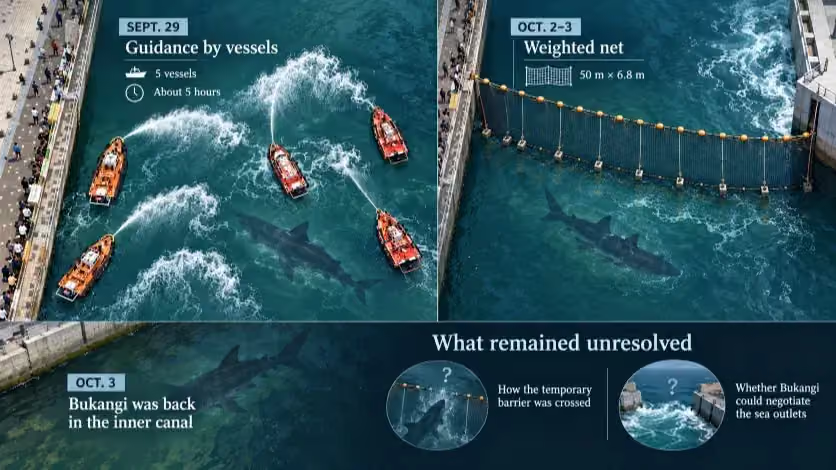
Bukangi, the Shark That Stayed in Busan’s North Port
A rescue net guided Bukangi toward the sea, but the dusky shark returned to B...
More from the author
More from this byline
Stay with the same line of reporting through more work from this byline.
 NewsOct 9, 2026
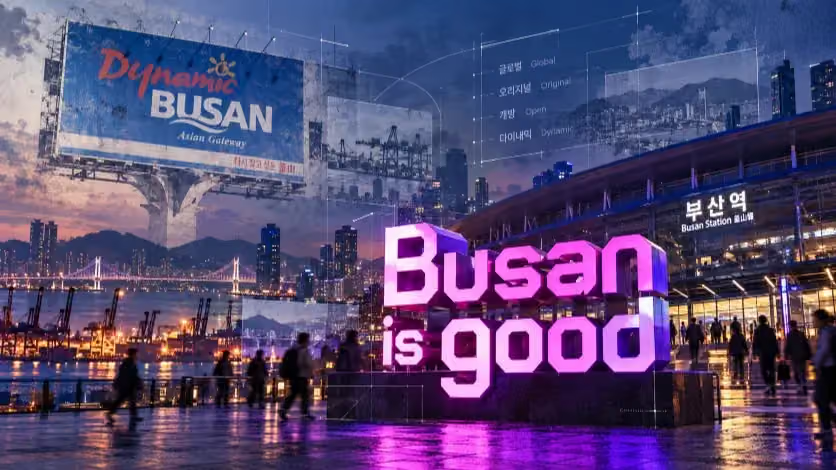
Why “Busan Is Good” Falls Short as a City Brand
 NewsSep 18, 2026
The Other AI Race Is for the Freedom to Change Course
Reader Signal
Community readWhat did this report leave you with?
Choose the signal that best reflects your reading. Select it again to remove it.
One response per article
No response selected
A moderated conversation about the reporting.
One-level replies and newsroom moderation keep the conversation anchored to this article.
Discussion Status
Open
Please sign in to join the discussion.
Newsletter
Weekly reporting and context from Busan and Korea.