Busan is building, but not breathing
Despite renewed public investment in transit infrastructure, Busan continues to face mounting housing oversupply and demographic stagnation.

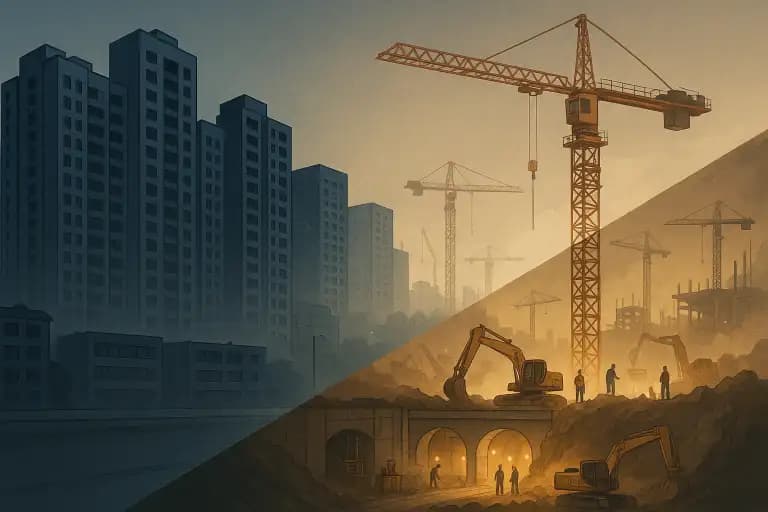
Busan, South Korea — Two long-delayed subway lines in Busan are back on the agenda. With the latest round of government spending approved in July, the Hadan–Sasang and Yangsan lines have secured construction funding and are now scheduled for completion by 2026. For a city that has seen major infrastructure plans stall repeatedly in recent years, the news signals renewed momentum—at least in terms of public works.
The broader picture is harder to read as progress. While tracks are being laid, homes across the city remain empty. As of May, Busan reported more than 5,400 unsold housing units—2,596 of them already completed. It was the third month in a row that so-called “post-construction unsold inventory” reached a record high. The contradiction is not just statistical. It captures the city's deeper dislocation: movement in policy, but not in people.
The 2025 supplementary budget delivers capital and timelines. What it does not resolve is the underlying imbalance. Busan’s infrastructure is expanding. But for now, the city’s core remains stalled.
The funding in question comes from South Korea’s second supplementary budget for 2025, approved by the National Assembly on July 4. Of the KRW 1.8754 trillion in additional spending, a portion is earmarked for long-deferred infrastructure projects, including two light rail extensions in Busan. Together, the Hadan–Sasang and Yangsan lines will receive KRW 22 billion in new allocations.
The Hadan–Sasang Line was originally slated for completion in 2021. It spans 6.9 kilometers and is designed to connect Line 1 and Line 2 in the city’s western districts, with seven stations and a dedicated depot. Delays over funding and land acquisition pushed back progress for years. With the new budget, construction is set to resume with a revised completion date of 2026.
The Yangsan Line, an 11.43-kilometer extension of Metro Line 1, serves the rapidly developing northern corridor. Like its western counterpart, it is scheduled for a 2026 opening, backed by KRW 12 billion in government funds. Both lines are part of a wider effort to expand public transport coverage to underconnected districts and absorb projected commuter demand.
Officials at the Ministry of Land, Infrastructure and Transport have framed the investment as both a mobility enhancement and a local economic measure—injecting capital into stalled construction while expanding access to peripheral areas. The budget also sets aside KRW 847.5 billion nationwide for SOC (social overhead capital), a category that includes roads, rail, and industrial access infrastructure.
The logic of the spending is straightforward: connect what has been unconnected, restart what has been idle. In isolation, the numbers reflect motion. But in the context of Busan’s broader urban dynamics, they are only one part of a more complicated equation.
While construction timelines for Busan’s rail lines are once again measurable, the city’s housing market remains suspended in place. According to Ministry of Land data, Busan recorded 5,420 unsold housing units as of May, a 15.1% increase from April. Of greater concern: 2,596 of those homes had already been completed—a category the ministry classifies as post-construction unsold inventory. It was the third consecutive month this figure reached a record high.
This is not a national trend. Across South Korea, total unsold housing fell by 1.6% in the same period. The Seoul metropolitan area saw a 3.8% decline. Busan’s numbers are not just moving in the opposite direction—they are doing so more rapidly. And within the city itself, the pain is uneven. Newer developments in fringe districts remain largely occupied on paper, while older or mid-tier sites in the urban core continue to see buyer withdrawal.
What makes these figures more troubling is their durability. A year ago, post-completion inventory in Busan hovered around 1,500 units. The shift to a persistent level above 2,000 began earlier this year and has not reversed. For developers, this is no longer a temporary slowdown—it is a structural warning.
Public response has followed. The same budget that supports subway construction also includes KRW 250 billion for a conditional housing buyback program. Under the scheme, public agencies will purchase unsold units before completion, with developers granted the right to repurchase the homes after market conditions stabilize. The measure is designed to offer liquidity without locking the state into long-term property holdings. But it has drawn muted responses from the building sector. Several regional developers have pointed to price gaps: what the government offers and what the units cost are rarely aligned.
A few unsold towers do not sink a city. But when they begin to accumulate month after month—especially after completion—the issue shifts from real estate to confidence. The supply is there. The infrastructure, increasingly, is too. What remains missing is movement.
Busan’s current condition is not the result of sudden decline or poor planning in isolation. It is the product of a city developed unevenly over time—functionally, geographically, and economically. Infrastructure has been extended. Housing has been added. But the connective tissue of urban life—jobs, services, continuity—has not kept pace.
In districts like Myeongji and Eco Delta City, large-scale developments have filled with younger households, many of them first-time buyers or movers from elsewhere in the region. The units are sold. The streets are new. But the economy around them is still forming. There are few offices, few mid-sized employers, limited public services. For many, these neighborhoods function as dormitories for lives lived elsewhere.
The imbalance is just as visible in the opposite direction. In Busan’s older urban core—Jung-gu, Seo-gu, and parts of Saha-gu—infrastructure exists but population does not. Young families have left. Employment centers have moved. Entire streetscapes feel static: serviced by transit but emptied of purpose.
This duality—of new areas without structure and old areas without residents—reflects a deeper strategic dislocation. Busan has added housing supply without aligning it to labor markets or institutional centers. It has expanded transit corridors without rebuilding the functions they are meant to connect.
Meanwhile, industrial reliance persists. Busan’s economy remains weighted toward logistics, port services, and low-to-mid value manufacturing. Unlike Seoul, it has not developed a diversified ecosystem of knowledge-based employment. The absence is not only economic—it is demographic. Young adults with portable skills often leave, and they do not return.
The result is a city that builds with ambition but absorbs with difficulty. Construction moves forward. But the urban system it belongs to remains fragmented.
To its credit, the central government has not ignored the signals. Alongside infrastructure allocations, the 2025 supplementary budget commits KRW 250 billion to a housing stabilization scheme focused on unsold inventory. Through a repurchase guarantee model, public agencies will acquire housing units before completion, with developers allowed to reclaim them within a set window once conditions improve.
The intention is liquidity, not ownership. The government does not want to become a landlord of distressed towers. It wants to buy time—for developers, for local markets, and for demand to recover. But even as the mechanism expands, its limitations are becoming clear.
In many cases, the buyback prices offered fall well below development costs, particularly in projects where construction and land expenses were locked in during the market's peak. Some developers decline the offer outright. Others accept, knowing the financial haircut is preferable to default. Either way, the program does not restore demand—it only mitigates consequences.
At the same time, these interventions are deployed uniformly across geographies, even though the sources of oversupply are highly localized. A high-rise in a satellite town with no transit access and weak service infrastructure carries a different risk profile than a delayed mid-rise in a transitional downtown zone. Treating them equally narrows the effectiveness of public action.
The deeper issue, though, may not be technical. It is conceptual. The state has mechanisms for moving money, accelerating permits, and backstopping risk. But it lacks, at least in Busan’s case, a coherent answer to the question: What kind of city is being supported here?
Without a sharper spatial and economic vision, policy risks becoming reactive—well-funded but misaligned, mobile but imprecise. The budget has delivered motion. But the direction is still unclear.
The cranes are moving again. Construction sites hum with activity. Subway lines long paused are, at last, progressing toward completion. On the surface, Busan is building.
But in the neighborhoods beyond the rail yards, the motion is harder to find. Empty units stack quietly above quiet streets. Older districts thin out. Newer ones struggle to take root. The machinery of infrastructure is moving faster than the social and economic systems it is meant to serve.
What emerges is not just a city out of sync, but a planning logic drifting without anchor. The lines are drawn. The money is committed. But the answer to what it is all meant to connect—to whom, for what kind of life—remains elusive.
Cities do not grow by movement alone. They grow when the movement has meaning.
Continue this reporting
Reporting on the same issue
Related coverage selected from the article's desk, topics and newsroom relationships.
 NewsSep 20, 2026
What It Takes for U.S. Navy Repair Work to Become a Busan Industry
HJ Shipbuilding has brought U.S. Navy maintenance work to Yeongdo. Whether it...
 NewsSep 17, 2026
Busan’s Finished Homes, Unfinished Projects
Busan’s unsold homes sit in one monthly total, but they belong to very differ...
 NewsSep 16, 2026
Busan’s Young-Adult Migration Turns Sharply at 25–29
Busan can still draw young adults into the city, but keeping them becomes far...
More from the author
More from this byline
Stay with the same line of reporting through more work from this byline.
 NewsSep 24, 2026
Taiwan’s AI Boom Is Surging, but Wealth Follows a Different Map
Editorial Record
Corrections, sourcing notes and newsroom disclosures remain part of the published record. View Newsroom Notes →
Reader Signal
Community readWhat did this report leave you with?
Choose the signal that best reflects your reading. Select it again to remove it.
One response per article
No response selected
A moderated conversation about the reporting.
One-level replies and newsroom moderation keep the conversation anchored to this article.
Discussion Status
Open
Please sign in to join the discussion.
Newsletter
Weekly reporting and context from Busan and Korea.