Busan Hosts 2025 Architecture Workshop Focused on Bujeon Station
Participants at the 2025 Busan Architecture Workshop will explore transit-oriented development and urban connectivity in the Bujeon Station area.

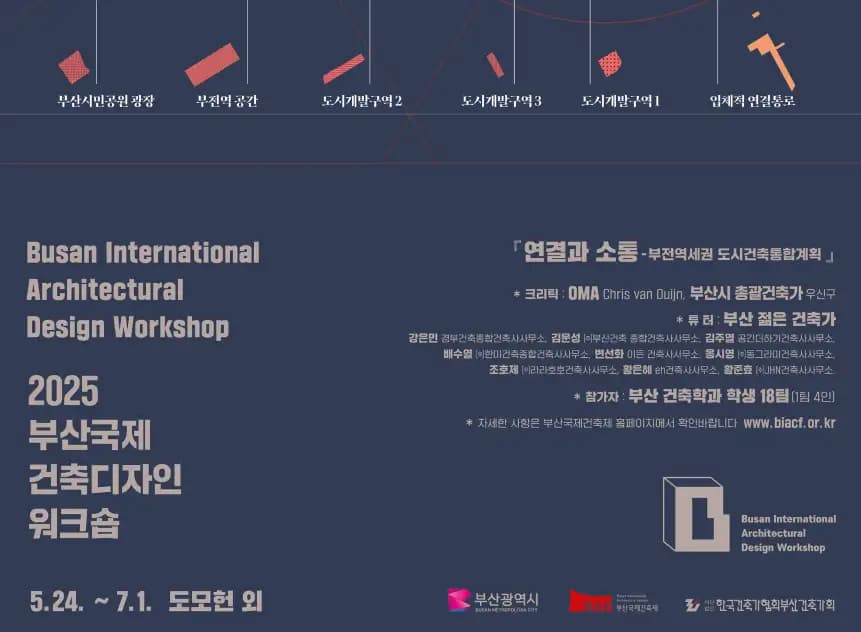
BUSAN, South Korea — As cities globally adopt integrated approaches to urban development, Busan is focusing on one of its most important transit districts: Bujeon Station. From June 30 to July 1, 2025, architecture students and young professionals will come together in the 2025 Busan International Architecture Design Workshop. The workshop is a two-day event hosted by Busan Metropolitan City and the Busan International Architecture Festival (BIAF). It will take place at Domoheon, gathering 72 students and 9 emerging architects, who will work in 18 teams to develop new urban plans under the theme, “Connection and Communication – Urban-Architectural Masterplan for the Bujeon Station Area.”
Bujeon Station holds a strategic location in the city, acting as a major transfer point in the transportation network while being adjacent to Busan Citizens Park, redevelopment zones, and planned pedestrian corridors. This workshop provides an opportunity for participants to rethink how such transportation hubs can function as inclusive, accessible, and human-scale environments. With transit-oriented development (TOD) increasingly seen as an important urban planning strategy, the design proposals will aim to address connectivity, public space, and land-use adaptability, while also promoting sustainability and mixed-use development in high-density urban settings.
The Busan International Architecture Design Workshop has been a prominent feature of the Busan International Architecture Festival since its inception in 2003. Initially conceived as a platform for architecture students to engage with real urban challenges in Busan, it has grown over the years to become an important event that brings together local and international participants, including architects, urban designers, and critics. The workshop’s historical focus has covered various urban issues, from the adaptive reuse of industrial sites to integrating nature into the urban fabric, such as projects in Yeongdo, North Port, and Mt. Hwangnyeong. Although the proposals from the workshop are speculative, they have contributed to broader urban discussions and sometimes influenced public debates on architecture and planning in Busan.
This year’s workshop will be supported by Chris van Duijn, partner at the Office for Metropolitan Architecture (OMA), one of the world’s leading architecture firms, known for projects such as the CCTV Headquarters in Beijing and the Prada Foundation in Milan. Van Duijn’s involvement brings an international perspective to the event, as his expertise in large-scale urban projects will be instrumental in providing valuable critique and guidance to the participating teams. The workshop structure will involve group-based design work, site analysis, and feedback sessions, which mirror contemporary trends in architectural education that emphasize collaborative, iterative processes in real-world settings.
At the conclusion of the workshop, the results will be exhibited at BEXCO during the Busan International Architecture Festival, running from September 17 to 21, 2025. The exhibition will be open to the public and will allow city residents, urban planners, and design professionals to explore the speculative urban designs that emerged from the event. This exhibition is part of a broader set of urban initiatives, including the International Busan Design Award (IBDA) and the Big 2025 Public Space Design Competition, which collectively aim to strengthen Busan’s position as a leader in urban sustainability and innovation.
Although the proposals produced at the workshop will not directly result in official development plans, the event functions as a conceptual platform for exploring new urban ideas and testing them in a structured, academic environment. By focusing on key urban spaces like Bujeon Station, the workshop encourages participants to think critically about the challenges and opportunities of urban connectivity, particularly in high-density areas. The workshop also reflects current global trends in urban design, where integration between transportation, public space, and mixed-use development is increasingly seen as essential to building sustainable cities.
This workshop, by engaging emerging architects and providing them with a space to test ideas, helps shape a future where urban environments are more inclusive, interconnected, and responsive to the needs of modern cities.
Continue this reporting
Reporting on the same issue
Related coverage selected from the article's desk, topics and newsroom relationships.
 NewsOct 25, 2026
The Long Bill for Busan’s Apartment City
Busan has about 958,000 apartments even as its population declines. Elevators...
 NewsOct 23, 2026
Busan’s Twelve-Year School Account Faces a Test Beyond Access
Busan’s PENZ promises one school account for 12 years, while BeAT brings AI t...
 NewsOct 22, 2026
Busan Port’s LNG and Methanol Plan: Who Pays to Keep Fuel Ready?
Busan already supplies ships with LNG and methanol, drawing on regional and i...
More from the author
More from this byline
Stay with the same line of reporting through more work from this byline.
 NewsApr 23, 2026
Gaza photo exhibition opens at Busan’s Arise Art Space
 NewsNov 10, 2025
Busan Fireworks Festival Marks 20 Years With Expanded Show
Reader Signal
Community readWhat did this report leave you with?
Choose the signal that best reflects your reading. Select it again to remove it.
One response per article
No response selected
A moderated conversation about the reporting.
One-level replies and newsroom moderation keep the conversation anchored to this article.
Discussion Status
Open
Please sign in to join the discussion.
Newsletter
Weekly reporting and context from Busan and Korea.