Busan Film Festival at 30: Global Prestige, Local Void
Three decades of growth made BIFF Asia’s top film festival. But Busan remains a host city without lasting industry roots, as decisions and jobs stay in Seoul.

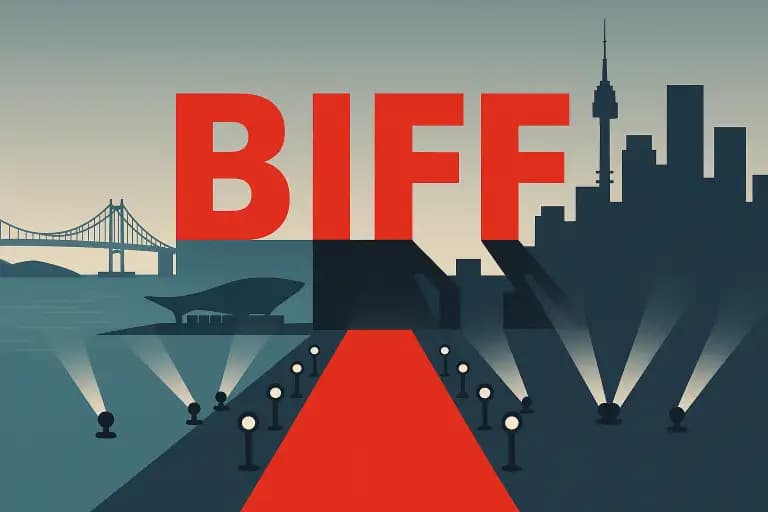
Busan, South Korea — The Busan International Film Festival (BIFF) enters its 30th year. Since its launch in 1996, the festival has been hailed as Korea’s most successful cultural export after K-pop, credited with putting Asian cinema on the global map and bringing tens of thousands of visitors to the southern port city each October. The numbers tell part of the story: from 170 films in its inaugural year to more than 300 at its peak; from a handful of foreign journalists to over a thousand accredited press today. The growth is indisputable.
Yet the question of legacy remains unresolved. Three decades of prestige have not turned Busan into a film capital. The organizational decisions are still made in Seoul, where programmers, distributors, and sponsors operate. Most of the festival’s professional staff are recruited in the capital. Press briefings take place in Seoul to secure national coverage. Sponsorship contracts are signed in boardrooms hundreds of kilometers north of the festival grounds.
Busan, meanwhile, provides the stages, the architecture, and the civic enthusiasm. The Busan Cinema Center — a landmark built at a cost of more than 160 billion won — stands as a symbol of ambition. Local universities train film students, many of whom volunteer during the festival. But once the screens go dark, those same students and professionals often leave for Seoul to find work.
BIFF at 30 therefore carries a paradox. It is a globally respected festival, but its host city has yet to acquire the industry, infrastructure, or talent pipeline that might justify the title of “film city.” The anniversary is less a celebration than an opportunity to ask why a festival of this scale has left behind so little beyond the two weeks when the world is watching.
How BIFF Began and What It Promised
When BIFF began in 1996, the ambition was direct: to make Busan more than a film location. The festival was promoted as proof that Korea’s cultural life did not have to revolve around Seoul.
The context mattered. Korean cinema was starting to attract international attention. The government had begun treating film as an industry, not just an art. Busan officials saw an opening: if the city could host a major festival, it might also pull in production houses, investors, and talent.
But from the first year, the festival leaned on Seoul. The founding director, Kim Dong-ho, came from the Ministry of Culture in the capital. Programming relied on Seoul-based critics and curators. Sponsorships were signed by companies headquartered in the capital. The idea of decentralization was there in speeches, but the machinery remained tied to Seoul.
Still, the early years gave Busan a new cultural identity. Audiences filled theaters; international guests arrived; headlines called BIFF the rising festival of Asia. What it did not yet prove was whether Busan could move from hosting an event to building an industry. That tension was present from the beginning, and it never went away.
Although the festival’s headquarters are located in Busan, the center of gravity has always tilted north. BIFF runs a permanent office in Seoul, a few minutes from the city’s media clusters. That office handles industry relations and press coordination. The programmers who decide which films are invited mostly live in the capital. So do many of the publicists and consultants who manage the festival’s image abroad.
The imbalance shows up every year. In the weeks before the festival, the main press conference takes place in Seoul. National newspapers and broadcasters attend because it is logistically easier. Sponsorship contracts are signed with banks, media firms, and conglomerates headquartered in the capital. The deals are made there, not on the ground in Busan.
Even staffing reflects the divide. During the festival, Busan supplies thousands of student volunteers and temporary workers. They run ticket counters, handle translation, and guide foreign guests. But the year-round positions with influence—the programmers, marketers, and dealmakers—are overwhelmingly based in Seoul.
The effect is that Busan carries the visible weight of the event—venues, logistics, and local pride—while Seoul controls the professional machinery that sustains it. The festival belongs to Busan in name, but its operating system runs through the capital.
Why Seoul Still Holds the Keys
The festival runs on three main sources: Busan City, the Korean Film Council, and private sponsors. City Hall spends a significant part of its cultural budget on BIFF every year. KOFIC adds subsidies. Then the large corporations step in—banks, telecom firms, media groups—all of them headquartered in Seoul. The contracts are signed there. The marketing money returns there.
In Busan, the economic lift is visible but short-lived. Hotels at Haeundae are sold out. Restaurants stay open past midnight. Taxi drivers report their best earnings of the year. City-commissioned reports claim the festival generates hundreds of billions of won in spending. But the effect ends when the screens go dark. By November, the city is back to normal levels of demand. The permanent jobs do not appear.
The most visible investment has been the Busan Cinema Center. Built in 2011 for more than 160 billion won, it was meant to anchor a permanent film culture. The architecture is bold: a massive cantilevered roof, a state-of-the-art theater, an outdoor plaza that can hold thousands. Yet the numbers tell another story. The center runs deficits almost every year. To keep the doors open, subsidies are required. Off-season programming—concerts, occasional screenings—never fills the gap.
The pattern is consistent. Busan spends on buildings and logistics. The capital secures the contracts and the profit.
Busan has tried to pull more of the festival’s weight into the city. The most visible step came in 2013, when the Korean Film Council (KOFIC) moved its headquarters from Seoul to Busan. The relocation was meant to signal decentralization. On paper, it did. In practice, much of the agency’s influence still flowed through Seoul. Senior staff stayed connected to networks in the capital. Key funding decisions continued to be made there.
Education was another strategy. The Asian Film Academy, launched in 2005, brought young directors and producers to Busan for short-term workshops during the festival. A decade later, the city opened the Busan Asian Film School, designed to run year-round training for future producers. Both programs gave Busan visibility. But graduates rarely stayed. The jobs, the investors, the distribution companies—all remained in Seoul.
There were also community initiatives. “Community BIFF,” started in 2011, allowed residents to help program and host screenings across neighborhoods. Outdoor shows under the name “BIFF Everywhere” spread the event beyond Haeundae. These efforts built goodwill and gave the festival a civic base. What they did not build was an industry.
Across these attempts, the pattern is clear. Each initiative added symbols of localization: a relocated agency, a school, a neighborhood program. None created a durable production or distribution pipeline. The festival grew in profile. Busan did not grow in capacity.
The Cycle of Training and Exodus
The problem is not a lack of effort. It is structure. Busan can host, but it cannot hold.
Film students graduate from local universities each year. Many work at BIFF as volunteers, translators, or temporary staff. By winter, most are gone. They move to Seoul, where production houses, post-production studios, and streaming platforms are based. Busan offers a classroom and a stage, but not a career.
Independent filmmakers face the same wall. Shooting in Busan is easy; the city offers incentives and scenery. But financing and distribution are controlled in the capital. A film produced in Busan must still secure Seoul investors and Seoul screens to reach an audience.
Employment is another weak link. The festival creates thousands of short-term roles—ushers, drivers, assistants. Those jobs vanish after two weeks. The stable positions, with real decision-making power, stay in Seoul.
The result is a cycle. Each year, Busan invests in training, infrastructure, and logistics. Each year, the trained talent, the money, and the contracts flow north. Thirty years on, the city remains a host, not a hub.
What Other Festivals Got Right
International film festivals rarely transform their host cities into industry capitals. Cannes is not the seat of France’s film production; that role belongs to Paris. Yet Cannes never aimed to replace Paris. Instead, it positioned itself as a neutral stage where global producers, distributors, and journalists converge each May. The city benefits from tourism, branding, and prestige, while the machinery of French cinema remains in the capital.
Sundance in Utah follows a similar model. Hollywood dominates American production, but Sundance carved out a role as a discovery platform for independent voices. Park City does not hold year-round authority over cinema, yet the festival adds value by connecting creators with buyers and audiences.
Locarno in Switzerland sustains its relevance in the same way. Its identity is artistic programming and intimacy, not industrial clout. Zurich holds the infrastructure; Locarno holds a distinctive niche.
What separates these cases from Busan is clarity. These festivals accepted their roles as showcases and maximized them. They did not attempt to redirect the entire industry. Busan, by contrast, has aspired to be both a stage and a headquarters. The result is an identity caught between ambition and reality: celebrated internationally, but unable to secure the infrastructure that would root it in its host city.
How Korea’s Cultural Map Narrows
Over the past two decades, South Korea has achieved an extraordinary expansion of cultural exports. K-pop idols fill stadiums in Latin America, Korean dramas dominate streaming platforms from Jakarta to Johannesburg, and directors who began their careers at Busan now win awards at Cannes and the Oscars. Yet the geography of this success is strikingly one-sided. For most global audiences, Korea is not a mosaic of regions but a single city—Seoul.
This is not a matter of perception alone. The cultural infrastructure is overwhelmingly concentrated in the capital. Talent agencies, broadcasters, streaming platforms, music labels, and advertising firms are all headquartered there. Even when content is set elsewhere—say, a drama shot in Jeju or a film located in Busan—the contracts, financing, and distribution pipelines pass through Seoul.
What looks like a nationwide cultural wave abroad is, inside the country, the gravitational dominance of one metropolitan hub. The paradox of Hallyu is that it appears to project Korean diversity to the world, but in practice it has narrowed the domestic field, marginalizing the very regional voices that once gave the culture its breadth.
The Risks of a Cultural Monoculture
History suggests that cultural vitality depends on variety. Renaissance Italy thrived not because one city monopolized culture but because multiple city-states—Florence, Venice, Milan, Rome—competed and collaborated, producing different schools of art, thought, and patronage. When power and wealth later consolidated, the diversity that fueled innovation began to wane.
South Korea is moving in the opposite direction. Instead of multiple centers with distinct cultural identities, virtually every industry is concentrated in Seoul. Publishing, television, film distribution, streaming platforms—all cluster in the capital. Other cities stage events, but they rarely hold the long-term infrastructure that could sustain independent voices.
The risk is structural fragility. A monoculture may appear efficient, but it weakens resilience. Without competing centers, there is little incentive for experimentation. Innovation becomes standardized. In cultural terms, the nation risks becoming synonymous with a single city, while regional traditions and creative ecosystems fade into obscurity.
Busan’s case is a microcosm of this trend. The city hosts Asia’s most visible film festival, yet the mechanics of Korean cinema remain anchored in Seoul. Thirty years of global prestige have not produced a second pole of cultural power.
The Collapse of Regional Broadcasting
Regional broadcasting once played a crucial role in Korea’s cultural landscape. In the 1980s and 1990s, local affiliates of MBC, KBS, and SBS produced dramas, documentaries, and cultural programs rooted in their own communities. Stations like Busan MBC or KNN gave regional artists visibility and allowed citizens to see their own stories reflected on screen.
That ecosystem has largely collapsed. Advertising revenue declined, competition from Seoul-based cable and digital platforms intensified, and regional stations turned into relay points for content produced in the capital. Original productions dwindled, cultural programming was cut, and investigative reporting outside the capital grew scarce.
The result is a narrowing of the country’s cultural conversation. When nearly all narratives are generated in Seoul, other perspectives are pushed to the margins. Festivals like BIFF may create temporary windows of visibility, but they lack the sustained amplification that local broadcasters once provided.
For Busan, the absence is especially damaging. The city hosts an event of international stature, but its media infrastructure is too weak to define the narrative on its own terms. Coverage of the festival is dominated by Seoul outlets, framing BIFF as part of the national cultural brand rather than as an expression of local identity. Without regional media to reinforce its role year-round, Busan struggles to establish itself as more than a temporary stage.
The Missing Generation: Youth Who Leave
Perhaps the most consequential loss is generational. Each autumn, thousands of students from Busan’s universities volunteer at BIFF. They staff the ticket counters, interpret for foreign guests, and help manage screenings. Their energy is vital to the festival. But when it ends, many of them leave—headed to Seoul, where jobs, networks, and investors await.
This exodus is not anecdotal; it is structural. Cultural industries depend on continuity: apprentices becoming mentors, small studios maturing into larger firms, local stories accumulating into traditions. When young talent departs en masse, those linkages never take root. Busan gains temporary enthusiasm but loses the possibility of long-term stewardship.
The pattern repeats each year. Local universities train students in film and media. The festival offers them experience. Then the career paths lead elsewhere. The absence of stable jobs and industry infrastructure ensures that the city’s cultural pipeline remains broken.
The cost is more than economic. What disappears is cultural memory and identity. A community without a next generation to inherit and adapt traditions risks hollowing out. Busan presents itself as a “film city,” but without young people staying to build careers, it is left with spectacle rather than continuity—a festival that dazzles for two weeks but cannot sustain its own future.
Can Busan Become More Than a Stage?
Busan has resources that no other Korean city can claim. Its history as a wartime capital and trading port left a layered cultural memory of migration, survival, and exchange. Its geography—mountains pressing against the sea, dense neighborhoods spilling into markets—offers a visual landscape that filmmakers and artists repeatedly return to. These are not incidental qualities. They form the basis of a potential identity distinct from Seoul.
Yet these assets remain underdeveloped. The Busan Cinema Center is architecturally impressive but financially dependent. The relocation of the Korean Film Council was symbolic but hollow, with decisions still routed through Seoul. Training programs and film schools have produced graduates, but few stay to work locally. The city has not defined a field in which it can lead. Independent cinema, maritime narratives, or Asian co-productions could serve as anchors, but without clear focus the investments disperse into gestures rather than building blocks.
If Busan is to become more than a stage, it must concentrate on what only it can offer. That means designing policies and infrastructure around its geography, history, and cultural memory rather than imitating Seoul’s centralized model. A city that tries to be a smaller version of the capital will always remain peripheral. A city that develops its own voice can attract attention on its own terms.
The lesson of the past thirty years is that incremental change has not worked. Buildings were erected, agencies relocated, schools established, yet the structure of the industry did not shift. Money, authority, and talent still orbit the capital. If Busan wants a different outcome, it must attempt strategies that go beyond symbolism.
One path is specialization. Busan could invest in making itself indispensable to Asian independent cinema, concentrating on post-production facilities or year-round residencies for emerging filmmakers. Another is education: creating an international academy where young directors and producers live and work in the city, tied not just to a festival cycle but to a sustained professional community. Policy authority could also be redistributed, with parts of national funding and decision-making bodies given real autonomy in Busan rather than nominal addresses.
These approaches carry risk. They require sustained resources, institutional patience, and acceptance that results may take decades, not years. But the alternative is already visible: a world-class festival hosted by a city without lasting cultural infrastructure. In that scenario, Busan remains a venue but never a voice.
The thirtieth anniversary offers less a celebration than a moment of clarity. Busan can continue providing the backdrop for a festival run by networks elsewhere, or it can attempt to build the foundations of its own cultural identity. The decision will determine whether the city becomes a participant in Korea’s cultural future or remains a temporary stage for it.
Continue this reporting
Reporting on the same issue
Related coverage selected from the article's desk, topics and newsroom relationships.
 NewsOct 16, 2026
What Is Still Worth Going to See?
Busan’s biennale faces questions of artistic judgment and institutional care....
 NewsOct 14, 2026
What Became of Busan’s University Streets?
From 2015 to 2023, registered businesses grew near Pusan National University...
 NewsOct 12, 2026
Bukangi, the Shark That Stayed in Busan’s North Port
A rescue net guided Bukangi toward the sea, but the dusky shark returned to B...
More from the author
More from this byline
Stay with the same line of reporting through more work from this byline.
- NewsOct 14, 2026
What Became of Busan’s University Streets?
 NewsSep 28, 2026
Why Some Commercial Space in Busan Is Hard to Reuse
Reader Signal
Community readWhat did this report leave you with?
Choose the signal that best reflects your reading. Select it again to remove it.
One response per article
No response selected
A moderated conversation about the reporting.
One-level replies and newsroom moderation keep the conversation anchored to this article.
Discussion Status
Open
Please sign in to join the discussion.
Newsletter
Weekly reporting and context from Busan and Korea.