Busan Eyes Maritime Revival via Arctic Trade
The Northern Sea Route is giving Busan a rare second chance—to reinvent itself as a global maritime and financial hub amid shifting Arctic trade dynamics.

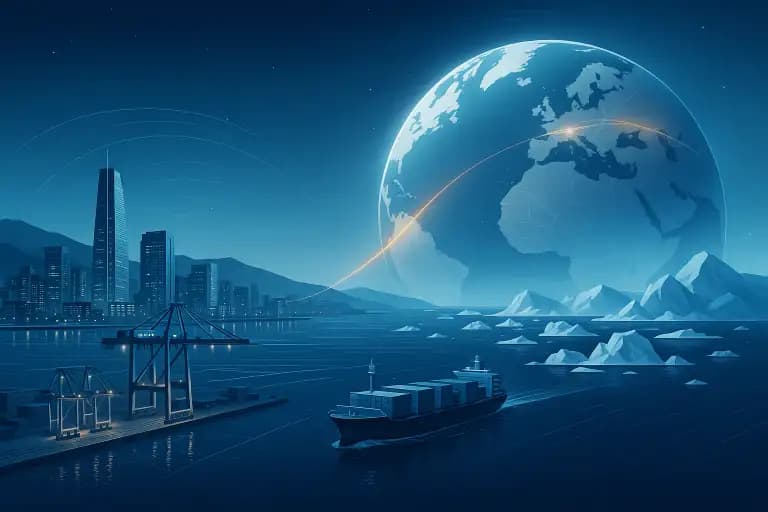
Busan, South Korea – As Arctic ice melts faster than ever, a new maritime frontier is quietly opening. The Northern Sea Route (NSR), once the domain of icebreakers and military vessels, is becoming a strategic corridor for commercial shipping. With its promise to cut Asia–Europe transit times by up to 40%, the NSR is drawing attention from global powers and major shipping lines alike.
For South Korea’s Busan, the implications are profound. Long known as a regional shipping hub, the city now finds itself positioned at the edge of a logistical revolution. Experts say Busan could emerge as Asia’s primary Arctic gateway—a role that could revive its aging industrial base, attract global shipping firms, and transform the city’s fortunes.
But can a port city battling population decline and rising regional competition reinvent itself for the Arctic era? Busan may be about to find out.
The Arctic Opportunity
Once considered too remote and ice-choked for commerce, the Arctic is fast becoming a new frontier in global shipping. Climate change has made the Northern Sea Route (NSR)—a corridor along Russia’s Arctic coast—more navigable during summer months, drawing the attention of shipping giants, energy companies, and national governments alike.
With transit times between Asia and Europe potentially cut by up to two weeks, and rising instability in traditional chokepoints like the Suez Canal and the South China Sea, the NSR is no longer a niche curiosity. It is becoming a strategic alternative in an increasingly fragmented global logistics map.
For Busan, the opportunity lies in its unique geography. Located at the southeastern tip of the Korean Peninsula, the port city is well positioned to serve as the gateway between East Asia and the Arctic Ocean. Ships departing from Korea, Japan, or China en route to Europe via the NSR must pass near Busan, giving the city a chance to evolve from a stopover point into a critical transshipment hub.
But the NSR isn’t just about faster shipping. It’s a geopolitical chessboard. Russia, which controls most of the Arctic coastline, views the route as a national asset. China, branding itself a “near-Arctic state,” is investing heavily in Arctic infrastructure and the so-called Ice Silk Road. The United States and its allies are monitoring these developments with growing concern, citing military and environmental implications.
Caught between these competing interests, Busan faces a delicate balancing act. If it aligns too closely with any one camp, it risks alienating others. If it remains passive, it risks being sidelined. The city’s challenge is to position itself as a neutral, value-adding platform—a place where Arctic commerce meets open trade, green technology, and global logistics innovation.
Economic Potential for Busan
Beneath the geopolitics and shifting sea ice lies a more pragmatic question for Busan: What’s in it for the city? As the Arctic thaws, the port city is staring at a new lane of opportunity—one that could revive old industries, attract global investment, and breathe life into a city struggling with economic fatigue.
At the top of the list is logistics. As vessels reroute through the NSR, Busan could position itself as a transshipment and maintenance hub for Arctic-bound shipping. With its established infrastructure, deep-water berths, and regional connectivity, Busan already ranks among the busiest ports in the world. The difference now is that it could become a first port of call on one of the most strategically important routes of the 21st century.
But the Arctic doesn’t just carry containers—it carries energy. The route is expected to be a major channel for LNG shipments from Russia’s Yamal Peninsula to Asia. If Busan can build the bunkering and LNG-handling infrastructure to support that trade, the city stands to capture a significant share of this high-value sector.
Then there’s shipbuilding, a sector long embedded in Busan’s industrial DNA but recently battered by global competition. The emergence of the Arctic offers a new product niche: ice-class tankers, LNG carriers, and potentially nuclear-powered vessels. With neighboring Ulsan and Geoje also in the mix, the Busan region could become a global production center for next-generation Arctic vessels.
The opportunities extend to technology and services. Navigation in polar waters requires cutting-edge systems for ice monitoring, weather forecasting, and autonomous routing—areas where Korea’s strengths in IT and engineering can shine. From Arctic-ready digital twins to smart port optimization, Busan can export software as much as steel.
From Port City to Maritime Financial Hub
For decades, Busan has been known as a port that moves goods. But in the emerging Arctic era, it could become a city that also moves capital.
As global shipping patterns evolve, so too does the financial ecosystem behind them. Ship financing, maritime insurance, fuel hedging, and carbon credit trading are no longer niche services—they’re essential components of modern maritime commerce. And for Busan, the chance to evolve into an Asian maritime financial hub may be just as transformative as any new shipping lane.
The city already has a foundation. The Busan International Financial Center (BIFC) is home to Korea’s key maritime finance institutions, including the Korea Ocean Business Corporation (KOBC), and plays host to insurance firms, investment arms, and logistics banks. But with the right incentives, Busan could attract P&I (protection and indemnity) clubs, global marine reinsurers, and shipping investment funds that today operate mainly out of Singapore, London, and Oslo.
The Arctic accelerates this potential. With its heightened risk profile—extreme weather, ice navigation, and geopolitical uncertainty—the NSR requires specialized financial services. These include Arctic-rated asset financing, environmental liability underwriting, and ESG-focused shipping bonds. If Busan can offer these, it becomes not just a port of passage, but a place where Arctic business is financed, insured, and launched.
This financial evolution would have ripple effects. Global shipping firms looking to establish Arctic logistics chains may seek to base regional HQs in Busan—not just because of proximity, but because they can access capital, legal support, data intelligence, and human talent in one place.
What Busan Must Do
Opportunities don’t become outcomes on their own. For Busan to transition from a busy Asian port to a strategic Arctic hub, it will need more than deepwater docks and global headlines. What’s required now is a coherent, future-facing blueprint—one that weaves together infrastructure, policy, talent, and diplomacy into a citywide transformation plan.
The first priority is infrastructure. Busan’s existing port facilities are modern, but not yet optimized for Arctic-class shipping. Handling LNG from the Yamal Peninsula, servicing ice-class tankers, or offering cold-weather repair capabilities will require dedicated investments. So too will smart port technology that can support autonomous or remotely piloted vessels, increasingly seen as essential for Arctic operations.
Second, the city needs to double down on human capital and maritime innovation. Busan’s universities and research institutions—like Korea Maritime & Ocean University—can lead in areas such as Arctic logistics, ship design for extreme conditions, and climate-adaptive port engineering. Specialized training programs, including bilingual Arctic navigation courses or joint R&D with Nordic countries, could position Busan as a talent magnet in polar maritime affairs.
Diplomacy also matters. While Busan is not a national government, it can play a role in track-two Arctic engagement: hosting Arctic logistics forums, building city-to-city links with ports like Murmansk or Tromsø, and inviting participation from Arctic Council observer states. In a world where cities are becoming actors in global policy, Busan’s voice in Arctic conversations could elevate its brand far beyond Korea’s borders.
Finally, the city needs a story—a new identity that frames Busan as more than a shipping port. This means urban branding, international media campaigns, and integrated development zones that present Busan not only as efficient, but as forward-looking, green, and globally networked. A city that helps drive Arctic-era trade, finance, and innovation must look and feel the part.
Busan’s Second Horizon
Not every city gets a second chance. But Busan, long overshadowed by Seoul and challenged by industrial decline, now finds itself at the edge of a rare global inflection point. The melting Arctic, once a climate warning, now carries with it economic, geopolitical, and technological opportunity—and Busan is uniquely positioned to meet it.
If the 20th century made Busan into Korea’s maritime workhorse, the 21st could turn it into a strategic, sustainable, and internationally relevant maritime capital. This transformation won't happen by default. It will require clear leadership, bold investment, cross-border cooperation, and a willingness to redefine what it means to be a port city in an era of climate disruption and digital globalization.
But the momentum is building. With the Northern Sea Route gaining global attention, and with Busan already serving as a logistical gateway for Northeast Asia, the pieces are in place. Whether it becomes a bridge between continents or a footnote in Arctic history depends on the choices it makes now.
Continue this reporting
Reporting on the same issue
Related coverage selected from the article's desk, topics and newsroom relationships.
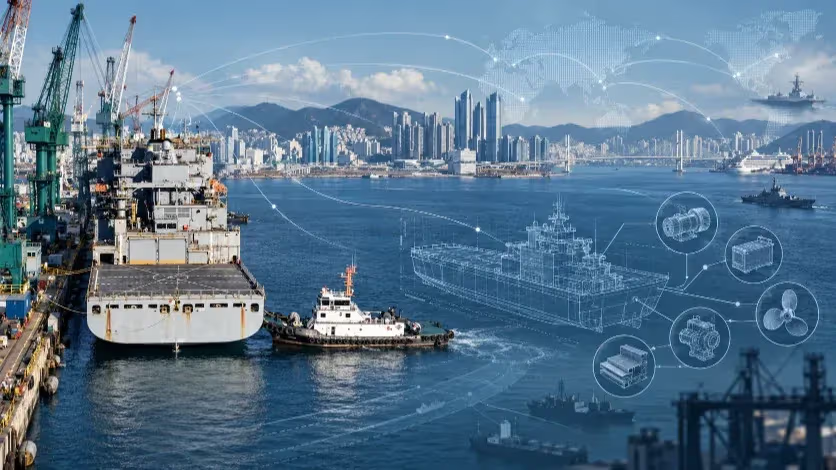 NewsSep 20, 2026
What It Takes for U.S. Navy Repair Work to Become a Busan Industry
HJ Shipbuilding has brought U.S. Navy maintenance work to Yeongdo. Whether it...
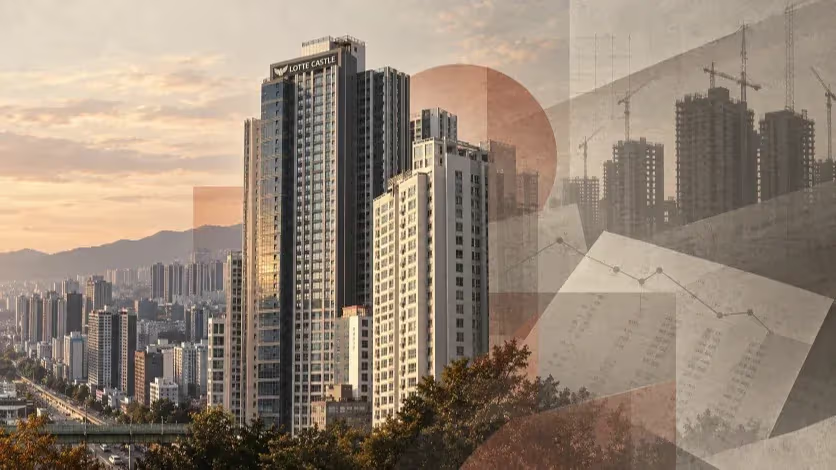 NewsSep 17, 2026
Busan’s Finished Homes, Unfinished Projects
Busan’s unsold homes sit in one monthly total, but they belong to very differ...
 NewsSep 16, 2026
Busan’s Young-Adult Migration Turns Sharply at 25–29
Busan can still draw young adults into the city, but keeping them becomes far...
More from the author
More from this byline
Stay with the same line of reporting through more work from this byline.
 NewsSep 24, 2026
Taiwan’s AI Boom Is Surging, but Wealth Follows a Different Map
Editorial Record
Corrections, sourcing notes and newsroom disclosures remain part of the published record. View Newsroom Notes →
Reader Signal
Community readWhat did this report leave you with?
Choose the signal that best reflects your reading. Select it again to remove it.
One response per article
No response selected
A moderated conversation about the reporting.
One-level replies and newsroom moderation keep the conversation anchored to this article.
Discussion Status
Open
Please sign in to join the discussion.
Newsletter
Weekly reporting and context from Busan and Korea.