Busan Chosen for National Urban Renewal in Beomil, Beomcheon, and Sinpyeong
In a second consecutive year of full selection, Busan has secured national funding to restore aging, low-income neighborhoods not by rebuilding them from scratch, but by reinforcing what remains.

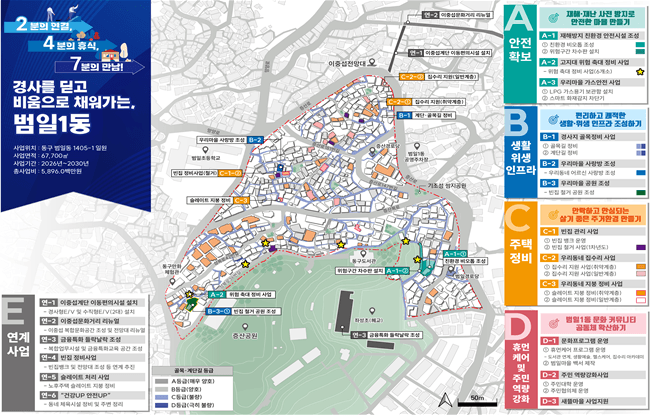
Busan, South Korea —Busan has secured ₩9.3 billion in national funding to implement targeted urban regeneration initiatives across three of its historically underserved neighborhoods—Beomil 1-dong, Beomcheon 2-dong, and Sinpyeong 1-dong—under South Korea’s 2026 Saetteul Village Project. The city’s selection for three project sites marks the second consecutive year it has achieved the maximum allowable designation, positioning Busan as a leading actor in Korea’s evolving approach to spatial equity.
Unlike conventional redevelopment schemes that prioritize demolition and land revalorization, the Saetteul model is predicated on retention, rehabilitation, and resident-led stability. Designed to serve areas with significant infrastructure deficits, aging populations, and fragmented civic amenities, the program directs public investment toward baseline improvements: slope reinforcement, drainage upgrades, derelict housing removal, pedestrian pathway design, and communal infrastructure such as local halls and gardens.
The selected neighborhoods—formed through layers of historical displacement including wartime resettlement and disaster-induced relocation—are illustrative of the policy’s reoriented logic. These are not blank-slate territories for speculative development, but densely embedded urban communities whose material decline is symptomatic of structural marginalization. Rather than attempting transformation through clearance, the project frames stabilization as a form of justice.
Busan’s 2026 deployment will run through 2030, with a combined local and national investment of ₩13.3 billion (approximately USD 10.2 million). Project scopes vary by site. Beomil 1-dong will see stabilization of its hillside terrain, upgraded alleyways, and remediation of dangerous retaining walls. In Beomcheon 2-dong, new community spaces will be developed alongside aging creekbank infrastructure. Sinpyeong 1-dong will undergo façade and path improvements within a post-relocation zone originally developed for typhoon evacuees and demolition-displaced families.
Importantly, Busan’s approach appears calibrated not only to meet the formal requirements of national subsidy programs, but to align with broader trends in decentralized governance and micro-scale spatial intervention. The emphasis on minimal displacement, infrastructure durability, and low-cost public space improvements situates the city’s work within a growing global discourse around urban regeneration without gentrification.
While 199 neighborhoods nationwide have been designated under the Saetteul framework since its inception in 2015, few municipalities have shown the same strategic continuity as Busan, which has now implemented 26 such projects. This consistency reflects an operational model in which regeneration is normalized not as spectacle, but as an iterative, bureaucratically routinized form of urban stewardship.
However, the model is not without challenges. The five-year funding horizon raises concerns about the long-term maintenance of civic assets, particularly in communities with limited fiscal and organizational capacity. Furthermore, the absence of binding post-project governance frameworks means that many initiatives rely on unformalized local engagement or the discretionary support of district offices—factors that can result in uneven programmatic outcomes.
Still, Busan’s latest designations suggest a replicable framework for urban repair in contexts where population decline, physical degradation, and institutional disconnection converge. The city’s implementation underscores that spatial justice need not be capital-intensive to be effective, nor must it rely on displacement to be transformative.
By embedding regeneration within the vernacular grain of the neighborhood—its topography, its informal architecture, its social memory—the Saetteul Village Project offers a low-visibility but high-impact policy mechanism. And in a period when public-sector budgets are tightening and megaprojects are losing legitimacy, Busan’s m
Continue this reporting
Reporting on the same issue
Related coverage selected from the article's desk, topics and newsroom relationships.
 NewsOct 16, 2026
What Is Still Worth Going to See?
Busan’s biennale faces questions of artistic judgment and institutional care....
 NewsOct 14, 2026
What Became of Busan’s University Streets?
From 2015 to 2023, registered businesses grew near Pusan National University...
 NewsOct 12, 2026
Bukangi, the Shark That Stayed in Busan’s North Port
A rescue net guided Bukangi toward the sea, but the dusky shark returned to B...
More from the author
More from this byline
Stay with the same line of reporting through more work from this byline.
- NewsOct 14, 2026
What Became of Busan’s University Streets?
 NewsSep 28, 2026
Why Some Commercial Space in Busan Is Hard to Reuse
Reader Signal
Community readWhat did this report leave you with?
Choose the signal that best reflects your reading. Select it again to remove it.
One response per article
No response selected
A moderated conversation about the reporting.
One-level replies and newsroom moderation keep the conversation anchored to this article.
Discussion Status
Open
Please sign in to join the discussion.
Newsletter
Weekly reporting and context from Busan and Korea.