Busan Balanced Development: Why Gangseo Is Growing While Sasang and Saha Grow Older
Busan’s western development has not produced one shared future. As Gangseo-gu grows through new housing and Eco Delta City move-ins, older districts such as Sasang-gu and Saha-gu face faster aging, environmental exposure, and unfinished regeneration east of the Nakdonggang River.

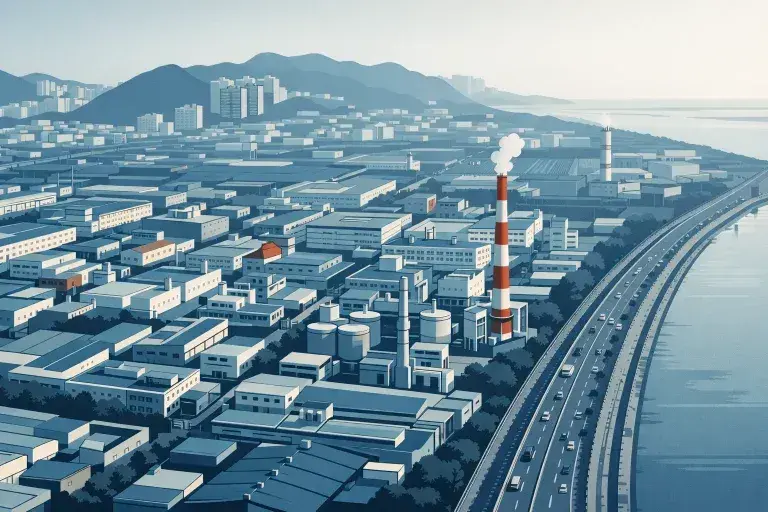
As Gangseo-gu absorbs younger households and new housing demand, Busan’s older industrial belt east of the Nakdonggang River remains caught in the slower, harder work of regeneration.
On Busan’s western edge, the city now speaks in two different development languages. West of the Nakdonggang River, in Gangseo-gu, the language is expansion: new housing, new industrial land, new logistics capacity, new rail promises, new growth. East of the river, in Sasang-gu, Saha-gu, and Buk-gu, the language changes. There, Busan Metropolitan City speaks of restructuring, rehabilitation, environmental improvement, and the modernization of aging industrial land pressed against older residential neighborhoods. The city presents both as part of one western future. They do not read like the same future. Busan’s own Gangdong Living Area Plan defines Buk-gu, Sasang-gu, and Saha-gu as the first priority zone for balanced development and describes the area as an old core of industrialization now facing aging neighborhoods, aging industrial land, and the need for blue-green infrastructure.
That contrast matters more because Busan is shrinking, not growing. The city has publicly identified low birth rates, youth outflow, and rapid aging as structural pressures. Official statistics show that residents aged 65 and older accounted for 25.3 percent of Busan’s population as of early 2026. In a growing city, a new district can expand without immediately forcing the question of what is being emptied elsewhere. In a declining city, that question cannot be avoided.
The harder question, then, is not whether Busan has invested in the west. It has. The harder question is what kind of western development it has produced. Busan has made “balanced development” one of its signature governing ideas and has formally positioned the Gangdong Living Area Plan as a first step toward correcting the city’s long-running east-west imbalance. But the city’s own planning architecture reveals a deeper problem. Western Busan is no longer one policy field moving at one speed. Gangseo-gu is being shaped through expansion and new supply. The older belt east of the Nakdonggang River is being managed through the slower politics of regeneration. One side is being built forward. The other is still being untangled.
Growth in a Shrinking City Is Not Neutral
The demographic split is already sharp enough to challenge the comfort of the slogan. Based on the February 2026 district-level dataset compiled from Busan statistics, Gangseo-gu recorded year-on-year population growth of 6.36 percent. It had 27,819 residents aged 0 to 14 and 23,200 aged 65 and older. In Sasang-gu, the 0-to-14 population stood at 13,666 against 52,200 seniors. In Saha-gu, 23,075 children stood against 77,200 seniors. Gangseo-gu, in other words, remains one of the few places in Busan where the youth base still roughly matches or exceeds the senior population, while older western districts carry much heavier aging burdens. Busan’s citywide age structure makes that contrast even starker, with seniors already accounting for 25.3 percent of the total population as of early 2026.
These are not marginal differences. They point to different demographic clocks operating inside the same broad region. They also suggest that what Busan calls western development may be reinforcing a division inside the west itself: a newer district still capable of demographic reproduction, and older districts increasingly carrying the weight of aging without the same pipeline of replacement households.
That split is not just a matter of image. In Gangseo-gu, the pull of growth is already being anchored by actual residential supply and move-ins. Busan’s own materials on the Gangseo Line describe a corridor linking Daejeo Station, Eco Delta City, and Myeongji Ocean City, reflecting a western growth strategy built not only around industry and logistics but also around new residential concentration and future mobility. In other words, Gangseo-gu is not simply benefiting from a vague development narrative. Places such as Eco Delta City are already giving younger households and family formation a concrete destination inside a shrinking metropolis.
This is where the phrase “balanced development” begins to strain. If a shrinking city channels major new housing supply, future-oriented investment, and its clearest growth narrative into one western district, the result is not automatically balance across the wider west. It may instead produce selective stabilization in one place and accelerated thinning in another. Gangseo-gu is not simply growing while the rest shrink. It is functioning, increasingly, as a demographic absorber inside a city losing people overall.
East of the Nakdonggang River, Repair Never Finished
The older western belt was never an easy landscape to remake. Sasang-gu and Saha-gu are not blank development sites, and they were never structured like cleanly planned mixed-use districts. They were shaped over decades as production landscapes, where factories, truck routes, waterways, low-rise residential areas, and transport infrastructure accumulated side by side. Busan’s Gangdong planning language effectively acknowledges as much. The area is described as a zone where mountains, rivers, sea, housing, and industrial land overlap, and where one of the city’s central policy tasks is the structural upgrading of aging industrial districts. That description reads like a development vision. It is also, more plainly, a map of why change is slow.
Sasang-gu illustrates the problem well. It is not simply an industrial district awaiting renewal. It is an old industrial-urban fabric in which manufacturing land and everyday neighborhood life have long existed in close contact. That makes modernization more expensive, more politically complex, and more spatially difficult than greenfield development elsewhere. When a city builds on relatively open land, it decides what goes where. When it regenerates an old industrial belt, it must negotiate with what is already there: fragmented land ownership, operating factories, legacy roads, aging housing stock, logistics traffic, environmental burdens, and local resistance to disruptive change.
That is why Sasang-gu has remained a symbol of promised modernization for years while still moving through revisions, coordination, and phased implementation rather than clean transformation. Busan’s Sasang regeneration district has undergone multiple plan changes since designation, including another approved revision in January 2026. At the same time, major Sasang-gu projects remain on multi-year timelines stretching well into the late 2020s. This is not a district that has been remade. It is a district still being negotiated.
Delay Has Costs
In Saha-gu, the cost of delay is not simply visual blight or industrial inefficiency. It is measurable exposure. A 2024 peer-reviewed study around the Sinpyeong-Jangnim Industrial Complex monitored heavy metals and volatile organic compounds in PM2.5 across five densely populated residential areas near the complex from December 2022 through December 2023. The study found that arsenic and benzene exceeded carcinogenic-risk thresholds across the broader area and called for more systematic mitigation measures to protect nearby residents. It also noted that the complex, established in 1990 and operating for more than three decades with roughly 600 businesses, has been one of Busan’s frequent sources of pollution complaints and a priority zone for environmental-health assessment.
That is a different order of problem from the one implied by branding language such as “smart valley.” The issue is not merely that the industrial base is old. It is that old industry and dense residential life remain packed into the same landscape. Regeneration in such a place cannot be reduced to façade improvement, a new slogan, or even a set of industrial-support programs. It requires reducing the friction between land uses that were never properly separated in the first place.
The same pattern appears in research around Sasang-gu. Studies on industrial-air exposure there have found higher particulate and hazardous-metal burdens in industrial areas than in nearby residential areas, reinforcing the point that the older western belt is not simply lagging in image or convenience. In these districts, delayed regeneration is not just a matter of postponed investment. It has public-health consequences.
What Balanced Development Has Actually Delivered
None of this means Busan has done nothing. The city has not ignored western decline. It formally launched the Gangdong Living Area planning process, continued revising and advancing Sasang-gu’s regeneration district, pushed ahead with the Hadan-Noksan Line, and secured a preliminary-feasibility track for the Gangseo Line. It has also used corporate roundtables in western industrial areas to feed local demands into support measures, including financing adjustments and export support. Those are real actions. They represent movement.
But they do not yet amount to a reordered western Busan. Most of the city’s achievements so far fall into three categories: agenda-setting, procedural advancement, and partial response. Agenda-setting matters because cities often fail by refusing to name their spatial problems at all. Procedural advancement matters because large urban projects do not move without years of review, revision, and financing adjustment. Partial response matters because local industrial districts are not transformed in one act. Yet none of that is the same as structural change.
Structural change would mean something harder to miss. It would mean that the older western belt east of the Nakdonggang River no longer carried such an imbalanced age structure. It would mean that industrial-residential friction had been materially reduced rather than documented again. It would mean that the city’s planning answer to western imbalance had moved out of prolonged preparation and into visible neighborhood-scale reordering. By that standard, Busan’s western agenda remains incomplete. The city has opened the file. It has not closed the gap.
The weakness is especially clear in the timing. Busan publicly described the Gangdong Living Area Plan as a first move toward east-west rebalancing, but even in late 2025 the city was still saying the plan would be finalized in the first half of 2026 after hearings and related procedures. As of early 2026, it had still not reached finalization and remained in a pre-final stage involving internal review, expert consultation, and subsequent public procedures. One of the city’s main strategic answers to western imbalance has therefore spent years in preparation while demographic and spatial pressures in the older western belt continued to accumulate.
The June Test
That is what makes the coming local election more than a routine campaign moment. According to South Korea’s National Election Commission, the next Nationwide Simultaneous Local Elections are scheduled for June 3, 2026. In Busan, the easy version of the western-development argument will be to promise more: more rail, more housing, more industrial investment, more western growth. The harder version is to explain what kind of west is actually being built, for whom, and at what spatial cost.
The real political test should not be whether candidates can speak fluently about western Busan. Most will. It should be whether they can describe the difference between building up Gangseo-gu and repairing the older belt east of the Nakdonggang River, and whether they are willing to admit that the two tasks are not interchangeable. One is expansion. The other is regeneration under constraint. One works on land that can still be planned forward. The other works through inherited congestion: old factories, aging housing, broken age structures, environmental exposure, fragmented land use, and the long afterlife of industrial urbanization.
That distinction matters politically because “western development” can be made to sound more complete than it is. Gangseo-gu’s gains are real, and they are increasingly rooted in actual housing supply and move-ins rather than abstract development promises alone. But they do not automatically count as recovery for Sasang-gu or Saha-gu. A new growth district across the river does not by itself solve what remains packed into the older landscape east of it. If anything, the demographic evidence suggests that western growth may be redistributing future households inside the city faster than regeneration is restoring the older districts they leave behind. That is not a failure of ambition. It is a failure of equivalence: treating expansion in one part of the west as if it carried the same meaning as repair in another.
Busan has succeeded in turning western imbalance into a formal planning and political agenda. That is not nothing. But its own plans, projects, and demographic patterns point to a more uncomfortable reality. Western Busan is not being remade evenly. Gangseo-gu is emerging as a zone of reception — for new housing, new growth, and younger households. The older belt east of the Nakdonggang River remains a zone of correction, where aging industry, aging neighborhoods, environmental risk, and demographic thinning are still being managed more than resolved.
In that sense, Busan’s problem is no longer simply whether the west has been neglected. It is whether growth in one western district is being mistaken for balance across the west as a whole. In a shrinking city, growth does not automatically heal decline. Sometimes it reorganizes it. Sometimes it pulls younger families toward the newest frontier while leaving older districts with a heavier burden of age, exposure, and delay. That appears to be the direction in which western Busan is moving now.
The city still has time to prove otherwise. But the burden of proof should now run in only one direction. Anyone invoking balanced development in Busan should have to show not merely where the plans and projects are, but whether the older western belt is becoming less unequal, less exposed, and less demographically fragile than it was before. Until that is visible, the phrase will remain politically useful and analytically incomplete.
Continue this reporting
Reporting on the same issue
Related coverage selected from the article's desk, topics and newsroom relationships.
 NewsOct 25, 2026
The Long Bill for Busan’s Apartment City
Busan has about 958,000 apartments even as its population declines. Elevators...
 NewsOct 23, 2026
Busan’s Twelve-Year School Account Faces a Test Beyond Access
Busan’s PENZ promises one school account for 12 years, while BeAT brings AI t...
 NewsOct 22, 2026
Busan Port’s LNG and Methanol Plan: Who Pays to Keep Fuel Ready?
Busan already supplies ships with LNG and methanol, drawing on regional and i...
More from the author
More from this byline
Stay with the same line of reporting through more work from this byline.
 NewsOct 21, 2026
What a Small Mackerel Is Worth
Reader Signal
Community readWhat did this report leave you with?
Choose the signal that best reflects your reading. Select it again to remove it.
One response per article
No response selected
A moderated conversation about the reporting.
One-level replies and newsroom moderation keep the conversation anchored to this article.
Discussion Status
Open
Please sign in to join the discussion.
Newsletter
Weekly reporting and context from Busan and Korea.