Busan and Jeju Forge Alliance for "15-Minute City" Model
Busan, South Korea - Busan Metropolitan City and Jeju Special Self-Governing Province have entered into a formal partnership aimed at advancing the "15-minute city" concept—a progressive urban model prioritizing accessibility and sustainability. The agreement was signed on November 20, 2024, during a ceremony at Busan City Hall, with Mayor Park Heong-joon of Busan and Governor Oh Young-hoon of Jeju in attendance. The initiative seeks to establish a framework for shared policies, cooperative pro

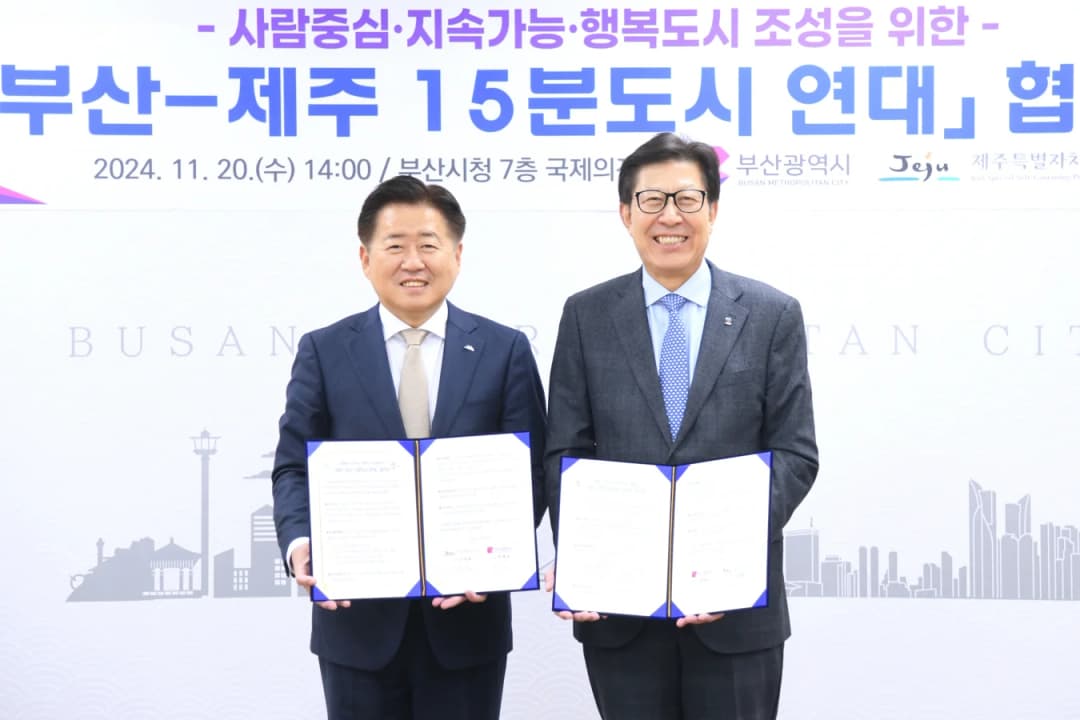
Busan, South Korea - Busan Metropolitan City and Jeju Special Self-Governing Province have entered into a formal partnership aimed at advancing the "15-minute city" concept—a progressive urban model prioritizing accessibility and sustainability. The agreement was signed on November 20, 2024, during a ceremony at Busan City Hall, with Mayor Park Heong-joon of Busan and Governor Oh Young-hoon of Jeju in attendance.
The initiative seeks to establish a framework for shared policies, cooperative projects, and expanded networks, reinforcing the two regions’ commitment to creating sustainable, people-focused urban environments.
The "15-minute city" concept is a global urban planning philosophy that aims to reduce travel distances by ensuring residents can access essential services—such as workplaces, schools, healthcare, and leisure activities—within a 15-minute walk or bike ride. Popularized in cities like Paris and Melbourne, the model is celebrated for its potential to enhance urban livability, reduce carbon emissions, and foster stronger local communities.
The partnership between Busan and Jeju revolves around a shared commitment to advancing the "15-minute city" concept, with a clear roadmap for collaboration. Central to the agreement is the exchange of ideas and strategies, as both cities aim to share their experiences and philosophies in implementing the model. By fostering an open dialogue, the cities hope to refine and adapt the principles to suit their unique urban landscapes while drawing inspiration from global best practices.
Moreover, the agreement underscores a concerted effort to elevate the "15-minute city" concept to a national level. By aligning local policies with broader governmental goals and engaging with international stakeholders, Busan and Jeju aim to position South Korea as a leader in sustainable urban development. This focus on networking reflects the broader ambition of creating a global community of innovators committed to accessible, people-centered cities.
Another pillar of the partnership is the expansion of collaboration between the public and private sectors. Through forums, conferences, and other interactive platforms, the agreement seeks to bring together policymakers, businesses, and community leaders. This inclusive approach is expected to generate fresh ideas, build trust, and create a robust support system for the successful implementation of the "15-minute city" model.
Both Busan and Jeju have already made significant headway in their pursuit of "15-minute city" ideals, showcasing a commitment to translating vision into action.
Busan’s journey began with the unveiling of its "15-minute city vision and strategy" in 2022. The city has since rolled out several pioneering projects, including the "Happy Challenge" initiative in the Dangam-Gaegeum areas. Additionally, the city has introduced key anchor facilities, such as the Deullak Nallak children’s complex. This multifunctional space has become a cornerstone of Busan’s urban strategy, blending recreation, education, and social engagement to create a hub that resonates with the principles of the "15-minute city."
Meanwhile, Jeju has been advancing its commitment to the "15-minute city" concept through a comprehensive approach to urban planning. Following the completion of its foundational plan in May 2024, the province has launched a series of initiatives across four designated pilot zones: Jeju City (Aewol-eup: Samdo 1 and 2, Ido 1, Ildo 1), and Seogwipo City (Pyoseon-myeon: Cheonji, Jungbang, Jungang, and Songsan neighborhoods). These areas were selected based on resident feedback and an analysis of access to essential services, ensuring that the projects address real community needs.
Key aspects of Jeju’s plan include improving pedestrian access, installing smart bus stops, and transforming existing public spaces such as libraries, youth centers, and health facilities into hubs of community engagement. A flagship initiative, the "Closer Neighborhoods" project, aims to enhance access to administrative services for residents in remote areas like Aewol-eup, where the distance to local government offices has long been a challenge. This project will streamline services such as disaster relief applications and agricultural subsidies, significantly reducing the need for residents to make lengthy trips.
In addition, Jeju has prioritized upgrading walking and cycling environments, with plans to enhance pedestrian safety on key routes like Goseong 1-gil and Hangmong-ro. These efforts, combined with a focus on integrating current and future service demands into urban redesign, reflect Jeju's vision of a people-centered urban model that balances modern convenience with environmental sustainability.
Together, the progress made by Busan and Jeju underscores their shared determination to lead the charge in creating sustainable, human-focused cities. Their commitment to practical, community-driven implementation sets the stage for transformative change in how urban areas are planned and experienced.
The collaboration between Busan and Jeju has the potential to generate ripple effects across South Korea, establishing the "15-minute city" as a national standard for urban planning. As this partnership progresses, it may also draw international attention, positioning the two regions as leaders in innovative, sustainable urban development.
With a two-year timeline set for initial implementation, the agreement includes mechanisms for regular review and adaptation, ensuring that both cities can maintain momentum and respond effectively to emerging challenges. This commitment to sustained growth and innovation signals an exciting future for urban development in South Korea.
Continue this reporting
Reporting on the same issue
Related coverage selected from the article's desk, topics and newsroom relationships.
 NewsOct 14, 2026
What Became of Busan’s University Streets?
From 2015 to 2023, registered businesses grew near Pusan National University...
 NewsOct 12, 2026
Bukangi, the Shark That Stayed in Busan’s North Port
A rescue net guided Bukangi toward the sea, but the dusky shark returned to B...
 NewsOct 6, 2026
Busan’s Water System Is Entering a Harder Era of Renewal
Busan spent decades building a water system that can absorb major failures. N...
More from the author
More from this byline
Stay with the same line of reporting through more work from this byline.
 NewsOct 9, 2026
Why “Busan Is Good” Falls Short as a City Brand
 NewsSep 18, 2026
The Other AI Race Is for the Freedom to Change Course
Reader Signal
Community readWhat did this report leave you with?
Choose the signal that best reflects your reading. Select it again to remove it.
One response per article
No response selected
A moderated conversation about the reporting.
One-level replies and newsroom moderation keep the conversation anchored to this article.
Discussion Status
Open
Please sign in to join the discussion.
Newsletter
Weekly reporting and context from Busan and Korea.