Busan AI Data Centers Bring Big Investment, but Jobs Remain Harder to Prove
From Microsoft’s existing Busan-area operations to future projects in Eco Delta City and Myeongji–Noksan, Busan is becoming a serious host for AI infrastructure — but not yet a proven engine of high-quality job growth.

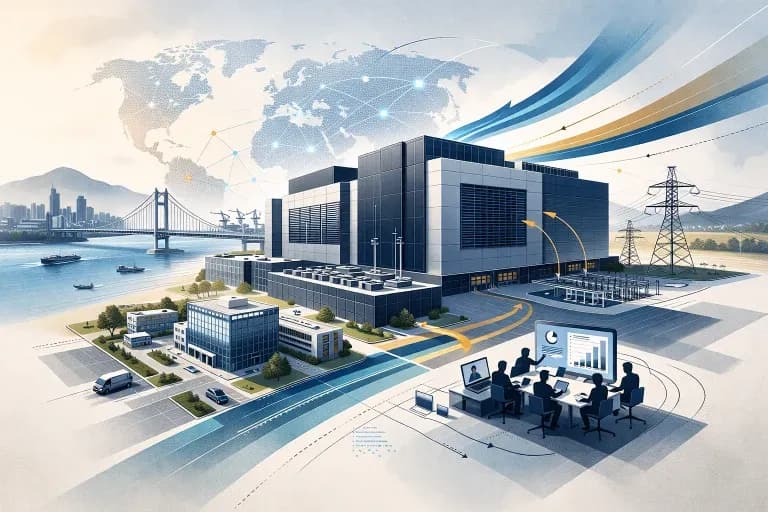
Busan is no longer merely pitching itself as a destination for the infrastructure of artificial intelligence. It is already hosting that infrastructure, expanding it, and planning for more. Microsoft unveiled a newly completed datacenter in Busan in September 2024, larger than the facility it completed in 2020, while the city has also pursued additional AI-focused cloud datacenter expansion and promoted new cluster sites for future investment.
That shift matters because Busan’s datacenter strategy is being presented as part of a larger industrial transition. City officials have framed projects such as Eco Delta City’s Opportunity Development Zone as a platform for future industries including datacenters, mobility, and robotics, with KRW 5.3615 trillion in planned investment and 965 planned jobs across 14 companies. The city’s pitch is straightforward: Busan has the land, infrastructure, and power conditions to become a major regional base for AI-era digital infrastructure.
But the economic meaning of that strategy is less straightforward. The most concrete operational benchmark currently available points to a much narrower labor footprint than the investment headlines suggest. Microsoft says its datacenters in the greater Busan area employed about 50 people as of 2025, while a new facility typically requires around 350 construction roles during the build phase. In other words, the sector clearly creates jobs, but the available evidence suggests that its labor intensity is concentrated in construction and that its steady-state operational workforce is relatively lean.
That gap sits at the center of Busan’s datacenter story. The city is clearly succeeding in attracting capital-intensive digital infrastructure. What remains much harder to prove is whether that success is translating into broad growth in permanent, high-quality local employment. Busan’s challenge, in that sense, is not simply whether it can host the AI economy. It is whether hosting it will deliver the kind of labor-market gains that justify the public resources, land, and policy support being assembled in its name.
The jobs question
If Busan’s datacenter strategy is to be judged as an industrial policy, the first test is not the size of the investment announcements but the nature of the jobs they produce. And on that point, the available evidence points to a narrower labor story than the city’s capital commitments might imply.
That is partly because “jobs” in the datacenter economy can mean several different things at once. Busan’s Eco Delta City Opportunity Development Zone announcement cites 965 planned jobs across 14 companies tied to KRW 5.3615 trillion in planned investment. A separate 2025 AI datacenter project in Myeongji–Noksan was presented with 300 direct jobs, alongside an estimated 7,570 jobs in broader employment effects. Those figures are not inherently inconsistent. They describe different categories of impact. But they are easily consumed in public debate as if they all referred to the same kind of local labor-market gain.
The clearest benchmark for realized operations employment in Busan remains Microsoft’s own figure. In a Korea datacenter fact sheet published in 2025, the company said its facilities in the greater Busan area employed approximately 50 people as of that year. The same document says that building a new facility typically requires around 350 construction roles, underscoring a defining characteristic of the sector: labor demand is much heavier during construction than in steady-state operations.
That distinction matters. Construction jobs are real, and they can be economically important, especially for local contractors and suppliers. But they are temporary by nature. Operational jobs are the more meaningful indicator of whether a city is gaining a durable employment base from a project once the cranes leave and the servers begin running. On the evidence currently available, Busan has clearly gained some permanent datacenter work, but not yet on a scale that would justify describing the sector as a broad-based local jobs engine.
The workforce profile emerging around the sector also points to a specialized rather than expansive employment model. Microsoft’s Busan Datacenter Academy, launched with the city and local universities, is training a relatively small cohort for site-level roles. In December 2025, Busan said six trainees would begin three-month on-site internships at the Microsoft datacenter in Busan in January 2026. That is evidence of a real talent pipeline, but also of a narrow one—built around operational readiness, field training, and datacenter-specific technical work rather than mass hiring.
Taken together, the available numbers suggest that Busan’s datacenter economy should be understood through a layered labor structure. At the top are large investment announcements tied to future projects. Beneath them are estimates of direct jobs and multiplier effects, which measure different kinds of impact. At the most concrete level are realized operations jobs, which in Busan’s best-documented case remain modest in scale. The question is not whether datacenters create employment at all. They do. The question is whether they create enough permanent, high-quality employment to support the broader policy narrative that has grown around them.
That gap—between capital scale and demonstrated labor scale—is where the rest of Busan’s datacenter story begins.
The real policy logic
If datacenters do not obviously function as a broad jobs engine, why is Busan pursuing them so aggressively? The answer lies in how the city appears to understand its place in the AI economy. Busan is not competing primarily as a labor-rich industrial base. It is competing as a host platform: a city that can assemble land, infrastructure, administrative coordination, and above all the energy conditions required by capital-intensive digital facilities.
That logic is visible most clearly in Busan’s own official language. In announcing the Eco Delta City Opportunity Development Zone in February 2026, the city said the area had been highly evaluated for its “excellent large-scale power supply conditions” as well as its smart-city infrastructure and the concentration of related functions. The same release said 14 companies plan KRW 5.3615 trillion in investment and 965 jobs in the zone, centered on datacenters, mobility, and robotics. Taken together, those details suggest that Busan is not merely attracting isolated projects. It is trying to build an integrated environment in which AI-era infrastructure can be sited, powered, and expanded with relatively low friction.
Power is central to that strategy. Internal city planning materials presented to the Busan council in 2025 said the cluster was being supported by a plan for an occupant-company shared receiving substation, making possible 500 MW-scale electricity supply. That is not an ordinary industrial estate detail. It is evidence that Busan’s datacenter policy is being built around the physical requirements of high-load computing infrastructure. In practice, the city is not just offering land. It is helping create the grid-ready conditions that such facilities need in order to operate at scale.
The global context helps explain why that matters. The International Energy Agency projects that global electricity demand from datacenters will rise to around 945 TWh by 2030, more than double current levels, with AI as the main driver of the increase. That means the competition to host datacenters is increasingly a competition over power availability, permitting, and infrastructure readiness rather than labor alone. Busan’s strategy fits that global pattern. Its value proposition is not simply that it wants future industry. It is that it can offer the physical and administrative capacity to host the power-intensive backbone of that industry.
The policy package does not stop at land and electricity. Korea’s Opportunity Development Zone regime gives qualifying firms substantial tax advantages, including a 100% exemption of income or corporate tax for the first five years and a 50% reduction for the following two years, according to national investment guidance and legal summaries. Property-tax and acquisition-tax relief can also apply under qualifying conditions. In other words, Busan’s datacenter strategy is not simply the product of private market demand. It is a publicly structured bargain in which the city and state reduce friction and cost for capital-intensive projects in the hope of securing long-term economic value.
This is where the policy critique becomes sharper. Busan may have strong reasons to want a foothold in AI infrastructure. A city that fails to attract major digital infrastructure risks being left out of an increasingly important layer of the future economy. But that strategic logic is not the same as a labor-market logic. If the city’s real competitive strength is its ability to provide power-ready industrial sites and policy support, then datacenter development may be succeeding as a hosting strategy even if it remains much less convincing as a high-quality jobs strategy.
That distinction matters because it changes how the policy should be judged. The success of a hosting strategy cannot be measured by investment announcements alone. It has to be measured against what the public is actually putting on the table: land, infrastructure planning, electricity-system capacity, and tax-favored policy space. Once the story is understood in those terms, the next question is unavoidable: what kind of value is Busan capturing in return?
The distributed economy of AI
The case for Busan’s datacenter strategy becomes more complicated once the question shifts from investment and infrastructure to value. Datacenters do leave an economic footprint where they are built. They require construction, site operations, maintenance, utilities coordination, and technical staff to keep facilities running. But those are not the only layers of value in the AI economy, and they may not be the most important ones.
Microsoft’s own materials offer a useful starting point. The company says its datacenters in the greater Busan area employed about 50 people as of 2025, and describes local roles in terms of campus management, IT operations, mechanical and electrical engineers, security contractors, building maintenance, and critical-environment work. Those are meaningful jobs. They are skilled, site-specific, and essential to keeping complex infrastructure online. But they also describe a relatively narrow operational workforce centered on uptime, facilities, and systems support. They do not, on their own, demonstrate that Busan is capturing a broad share of the higher-value layers often associated with the AI economy, such as large software teams, platform control, advanced product development, or major concentrations of digital decision-making.
That distinction matters because it changes what “success” looks like. A city can host advanced digital infrastructure without necessarily becoming a major center of digital value creation. In Busan’s case, the evidence so far suggests that the city is clearly securing the physical layer of the sector: land development, construction activity, operational staffing, and the infrastructure needed to support high-load computing facilities. What remains far less clear is whether it is securing the higher-value layer: a dense ecosystem of engineering employment, software development, supplier specialization, and strategic control that would anchor a broader regional transformation.
The city’s own workforce initiatives support that reading. Busan’s Datacenter Academy, launched with Microsoft and local universities, is designed to train people for datacenter operations and related technical roles. That is a legitimate and potentially valuable workforce strategy. But it also reinforces the article’s larger point: the skills pipeline currently visible around Busan’s datacenter push appears tailored to site-level technical operations, not to a large-scale expansion of the wider AI command economy. If that remains the case, then Busan may be building competence in hosting the infrastructure of AI without necessarily building a broad employment base in the most lucrative layers of that industry.
The environmental side of the story points in the same direction. In 2025, K-water said its agreement with Microsoft was Korea’s first official partnership tied to water use associated with the company’s Seoul and Busan datacenter operations, and that its first project was expected to restore about 340,000 tons of water annually. That does not tell us the precise cooling method, withdrawal profile, or water burden of each individual Busan site. But it does establish something important: water is not incidental to the datacenter economy. It is material enough to require formal mitigation efforts tied directly to operations. In practical terms, that means Busan’s role in this sector includes not just hosting buildings and jobs, but also absorbing part of the infrastructure and environmental burden that comes with keeping compute online.
None of this means Busan is “getting nothing.” That would be inaccurate. The city is getting investment, physical development, some permanent operations work, and a stronger foothold in the infrastructure backbone of the AI economy. The harder question is whether those gains are proportionate to what Busan is contributing: industrial land, power-system capacity, policy support, and public legitimacy for a model of growth whose most scalable returns may not all remain local. Put differently, Busan appears to be becoming an increasingly important place where the AI economy is housed and powered. It is still much less certain whether it is becoming an equally important place where the AI economy is owned, directed, and widely worked in.
That is the deeper policy question behind the city’s datacenter push. It is not whether Busan can attract the infrastructure of the future. It clearly can. The question is whether hosting that infrastructure will be enough to generate the kind of durable, high-value regional development that city leaders imply when they present datacenters as a pillar of Busan’s industrial future.
The Real Test of Busan’s AI Strategy
Busan has clearly moved beyond simply courting the infrastructure of artificial intelligence. It already hosts major datacenter operations, is pursuing additional expansion, and is organizing policy-backed industrial sites around the needs of high-load digital infrastructure. On those terms, the city’s strategy is real, coherent, and increasingly visible. The investment case is no longer speculative.
But the reporting points to a narrower achievement than the language of industrial transformation may suggest. Datacenters in Busan are generating construction activity, operational roles, and large capital commitments. What they have not yet clearly demonstrated is broad, durable growth in the kind of high-quality local employment that a city like Busan most urgently needs. The contrast between large-scale planned investment and far smaller realized operational staffing is not incidental. It is the central fact of the story.
That distinction matters because Busan’s strategy appears to be working first and foremost as a hosting model. The city is offering the conditions that AI infrastructure requires: land, power readiness, administrative coordination, and policy incentives. What remains much less certain is whether those conditions are also drawing the layers of the digital economy that create deeper local value — headquarters functions, research capacity, product development, partner ecosystems, and the thicker labor markets that sustain high-skilled urban growth. A datacenter can anchor such an ecosystem, but it does not automatically become one.
That does not make Busan’s strategy irrational. In an economy increasingly shaped by AI, there are good reasons for a regional city to secure a place in the physical backbone of computing. But hosting infrastructure is not the same as converting it into local economic power. If datacenters are to be defended as a pillar of Busan’s industrial future, they should be judged not by announced capital alone, but by what remains after construction ends: permanent jobs, technical depth, local procurement, public cost, and the share of long-term value that stays in the city.
For Busan, then, the real question is no longer whether it can attract the infrastructure of the future. It is whether the city can use that infrastructure to bring in the firms, functions, and talent that make digital growth economically transformative — or whether, in the AI era, it will remain more important as a place where the future is housed and powered than as a place where that future is broadly worked in and economically owned.
Continue this reporting
Reporting on the same issue
Related coverage selected from the article's desk, topics and newsroom relationships.
 NewsOct 27, 2026
Where Busan’s New Density Meets the Old City
Busan’s Beomil and Munhyeon districts are gaining homes and financial offices...
 NewsOct 25, 2026
The Long Bill for Busan’s Apartment City
Busan has about 958,000 apartments even as its population declines. Elevators...
 NewsOct 23, 2026
Busan’s Twelve-Year School Account Faces a Test Beyond Access
Busan’s PENZ promises one school account for 12 years, while BeAT brings AI t...
More from the author
More from this byline
Stay with the same line of reporting through more work from this byline.
 NewsOct 26, 2026
What It Took to Feed Busan
 NewsOct 21, 2026
What a Small Mackerel Is Worth
Reader Signal
Community readWhat did this report leave you with?
Choose the signal that best reflects your reading. Select it again to remove it.
One response per article
No response selected
A moderated conversation about the reporting.
One-level replies and newsroom moderation keep the conversation anchored to this article.
Discussion Status
Open
Please sign in to join the discussion.
Newsletter
Weekly reporting and context from Busan and Korea.