Busan, Ulsan, and South Gyeongsang Forge Ahead with Ambitious Economic Alliance
In a landmark move signaling a new era of regional cooperation and prosperity, the cities of Busan, Ulsan, and South Gyeongsang Province have collectively ushered in the second phase of their economic alliance. On March 11th, 2024, at Ulsan City Hall, the trilateral partnership convened for the 2nd Busan-Ulsan-South Gyeongsang Policy Consultation Meeting. This assembly, attended by key regional leaders, including Mayor Park Heong-joon of Busan, Mayor Kim Doo-gyeom of Ulsan, and Governor Park Wan


In a landmark move signaling a new era of regional cooperation and prosperity, the cities of Busan, Ulsan, and South Gyeongsang Province have collectively ushered in the second phase of their economic alliance. On March 11th, 2024, at Ulsan City Hall, the trilateral partnership convened for the 2nd Busan-Ulsan-South Gyeongsang Policy Consultation Meeting. This assembly, attended by key regional leaders, including Mayor Park Heong-joon of Busan, Mayor Kim Doo-gyeom of Ulsan, and Governor Park Wan-su of South Gyeongsang, marked a decisive step toward the implementation of the "2024 Metropolitan Region Development Plan."
The meeting, a crucible of strategic planning and collaborative endeavor, was a platform for discussing and announcing major cooperative projects that promise to redefine the contours of regional development. The projects span three critical sectors: the promotion of future growth industries, the construction of super-regional infrastructure, and the collaborative advancement of talent cultivation and tourism initiatives.
Central to the discussions was the shared recognition of the transformative potential of future growth industries. The regional leaders pledged to jointly propel the development of eco-friendly mobility solutions across automotive, shipbuilding, and aviation sectors. By harnessing the synergies of collaborative research and development, these initiatives aim to position the region as a pioneering hub for next-generation mobility technologies.
The construction of an expansive super-regional infrastructure emerged as another cornerstone of the cooperative agenda. Aiming to forge a one-hour living sphere that seamlessly connects Busan, Ulsan, and South Gyeongsang, the leaders underscored the critical role of enhanced transportation networks. Projects such as the expansion of metropolitan railway systems and the establishment of a comprehensive logistics platform were highlighted as essential for facilitating regional integration and economic dynamism.
In addressing the dual challenges of talent cultivation and tourism development, the trilateral partnership is setting the stage for a comprehensive approach to regional growth. By building a cooperative framework for nurturing local talent and reducing brain drain, alongside a joint strategy to elevate regional tourism, the alliance is poised to attract both human capital and visitors. The integration of educational initiatives and the promotion of a unified regional tourism brand are envisioned as key drivers of socio-economic revitalization.
Mayor Park Heong-joon articulated the collective ambition of the partnership, stating, "Through our super-regional cooperation, we are committed to building a single economic zone that grows together. Our aim is to create a robust alternative to the capital region, ensuring that the citizens of Busan, Ulsan, and South Gyeongsang Province have access to superior employment, education, and environmental conditions."
As the proposed projects begin to take shape, they herald a promising future for the region—a future characterized by sustainable development, economic resilience, and an enhanced quality of life for its residents. With this ambitious agenda, Busan, Ulsan, and South Gyeongsang are not only forging a path toward mutual prosperity but also setting a benchmark for regional cooperation nationwide.
Continue this reporting
Reporting on the same issue
Related coverage selected from the article's desk, topics and newsroom relationships.
 NewsOct 16, 2026
What Is Still Worth Going to See?
Busan’s biennale faces questions of artistic judgment and institutional care....
 NewsOct 14, 2026
What Became of Busan’s University Streets?
From 2015 to 2023, registered businesses grew near Pusan National University...
 NewsOct 12, 2026
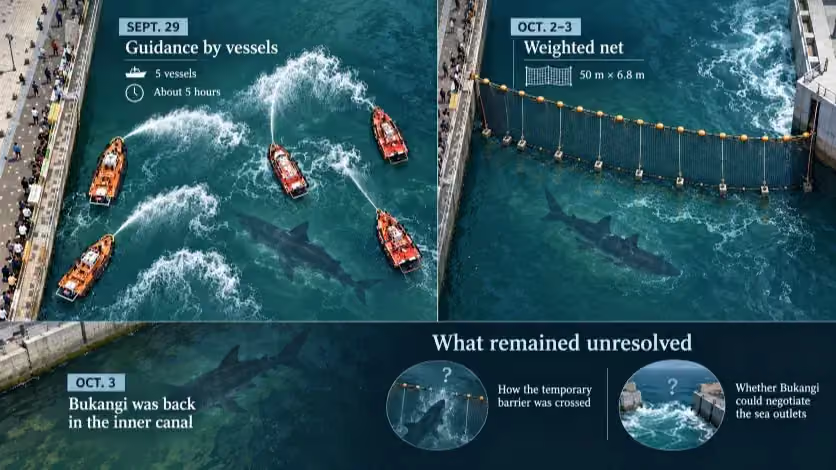
Bukangi, the Shark That Stayed in Busan’s North Port
A rescue net guided Bukangi toward the sea, but the dusky shark returned to B...
More from the author
More from this byline
Stay with the same line of reporting through more work from this byline.
 NewsOct 9, 2026
Why “Busan Is Good” Falls Short as a City Brand
 NewsSep 18, 2026
The Other AI Race Is for the Freedom to Change Course
Reader Signal
Community readWhat did this report leave you with?
Choose the signal that best reflects your reading. Select it again to remove it.
One response per article
No response selected
A moderated conversation about the reporting.
One-level replies and newsroom moderation keep the conversation anchored to this article.
Discussion Status
Open
Please sign in to join the discussion.
Newsletter
Weekly reporting and context from Busan and Korea.