BOF 2025: Can a K-Pop Festival Redefine Busan’s Global Image?
As Busan prepares to host the 2025 One Asia Festival, the city is betting on music and spectacle to reinvent its post-industrial identity and stake its claim as a global cultural hub.

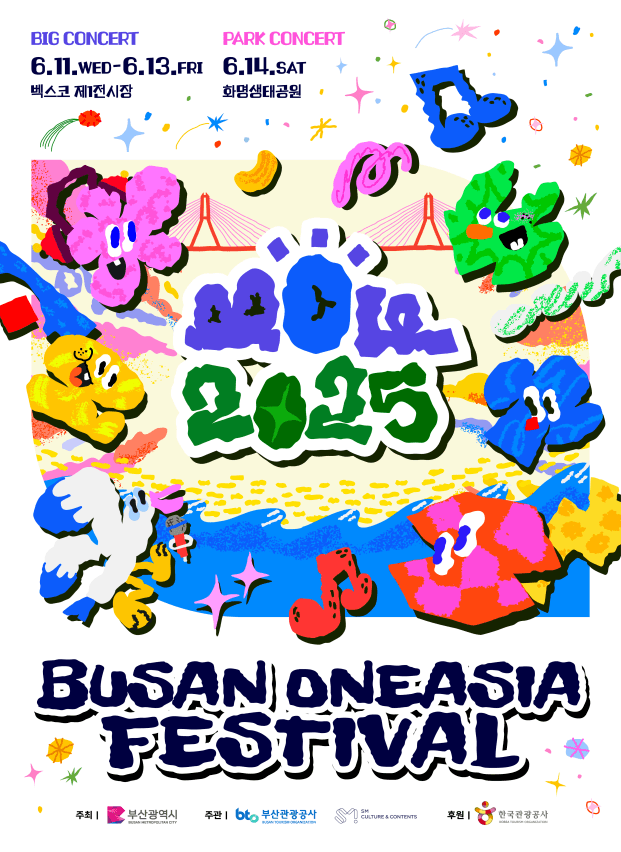
Busan, South Korea — As the sun prepares to shine over Busan this June, the city is once again tuning up for the return of its flagship cultural event: the 2025 Busan One Asia Festival (BOF). With a star-studded K-pop lineup and fresh programming innovations, the festival aims to capture not just headlines and hearts, but something deeper — a renewed global identity for South Korea’s southern coastal metropolis. But as the lights go up at BEXCO and performances spill into the city’s parks and plazas, an enduring question lingers: can one festival genuinely transform the future of a city?
Busan has long stood at the crossroads of identity. Once the heartbeat of Korea’s heavy industry and maritime trade, it grew as a logistical powerhouse in the postwar era, home to shipbuilders, steel plants, and busy port terminals. Yet in recent decades, that industrial legacy has begun to fade, replaced by an aging population, stalled urban development, and a persistent struggle to define itself beyond Seoul’s shadow. Despite being the country’s second most populous city, Busan often feels peripheral in matters of culture, governance, and national imagination.
The Busan One Asia Festival was born out of this search for reinvention. Launched in 2016, BOF was envisioned as a vehicle for soft power — an annual celebration of Hallyu, or the Korean Wave, that could extend Korea’s cultural reach beyond its capital and recenter global attention on Busan. The early years saw growing interest, but the festival remained uneven in scope and purpose. It struggled to move beyond its image as a municipal K-pop showcase, often lacking the ecosystem, brand depth, and integration that defines world-class cultural events.
In 2025, BOF is attempting something bolder. Organizers have restructured the festival into a multi-day format anchored by a new "Big & Band" concert series, introducing thematic programming and elevating lesser-known artists alongside headliners like Super Junior and NCT Wish. Alongside the performances, a new initiative called “Fandom City” will feature immersive exhibitions, fashion installations, and interactive spaces for fans — a nod to the evolving demands of global pop audiences and Busan’s aspiration to become a cultural capital for youth.
This year’s edition also marks a deliberate geographic shift. For the first time, BOF will stage its “Park Concert” in Hwamyeong Ecological Park — located in the city’s northwest, far from the high-density cultural clusters of Centum City or Haeundae. This move is not just about logistics. It reflects a growing effort by city officials to decentralize cultural access, bridge intra-city cultural gaps, and ensure that the festival’s benefits extend beyond traditional tourist zones. By bringing a large-scale music event into the more residential west, the city hopes to spark momentum for broader regional revitalization and cultural inclusion.
Yet the ambitions behind BOF go well beyond fandom. For city planners, the festival is a strategic tool for place-branding, tourism development, and economic stimulation. By positioning BOF as a “spring Coachella” or “Asian SXSW,” Busan hopes to anchor itself in global circuits of cultural innovation. This year’s edition, they argue, is not just a concert — it is part of a broader portfolio that includes the upcoming Busan Opera House, the North Port redevelopment, and even a revived push for hosting World Expo 2030.
Still, the stakes are high — and so are the risks. The city has invested over 2.6 billion won (nearly $2 million) into this year’s BOF, the majority from public funds. It estimates over 90,000 attendees and anticipates spillover benefits for hospitality, dining, and retail sectors. But cultural economists and urban planners remain cautious. A festival, no matter how glittering, cannot substitute for long-term cultural infrastructure. It cannot, on its own, retain young people, reverse population decline, or spark deep-rooted innovation. BOF may put Busan on the global map for a few days — but what about the other 362?
Indeed, some local residents express skepticism. In neighborhoods beyond the festival’s footprint, from Yeongdo to Sasang, BOF still feels distant. And while the inclusion of Hwamyeong Park is a promising gesture, it remains to be seen whether such events are one-off spectacles or the beginning of a sustained strategy to rebalance Busan’s cultural geography. Critics worry that the festival risks becoming performative — more showcase than substance — unless it builds deeper bridges with Busan’s cultural workers, educators, and creative entrepreneurs.
Moreover, Busan is not alone in its ambitions. Cities across Asia are rapidly investing in cultural infrastructure — from Jakarta’s music-tech festivals to Bangkok’s creative districts — each competing for the attention of the same global, digital-native generation. Seoul continues to dominate Korea’s cultural exports, while new players like Incheon and Daegu are carving out niches of their own. For Busan to lead, it must not just host events. It must create ecosystems.
That is the challenge — and the opportunity. BOF could become more than a festival. It could anchor a year-round cultural economy, spark creative clusters, and redefine the role of cities in a post-industrial, imagination-driven era. But this would require sustained investment, not only in events but in education, space, and storytelling. It would mean seeing culture not as a weekend attraction, but as infrastructure — as vital as roads and ports in shaping a city’s destiny.
As the crowds gather this June, as lights flare and beats drop, Busan will have a chance to show not just what it can stage, but what it can become. A global cultural hub? A generational magnet? A new model for urban identity in the 21st century?
That stage is still being built. But the music has already started.
Continue this reporting
Reporting on the same issue
Related coverage selected from the article's desk, topics and newsroom relationships.
 NewsOct 14, 2026
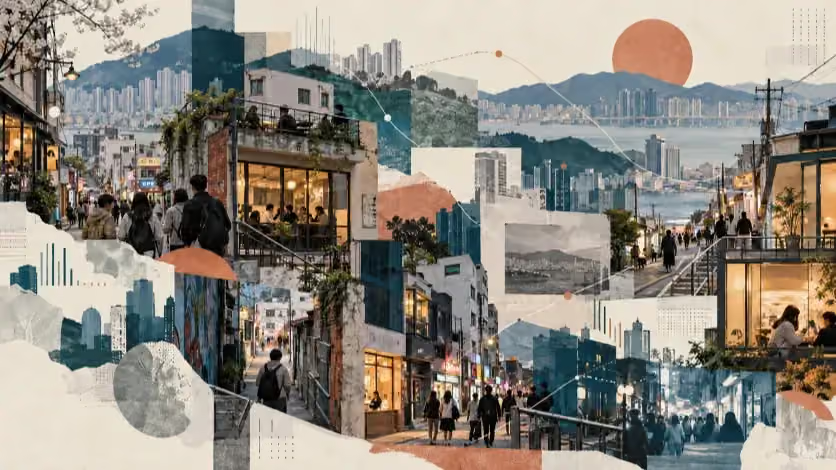
What Became of Busan’s University Streets?
From 2015 to 2023, registered businesses grew near Pusan National University...
 NewsOct 12, 2026
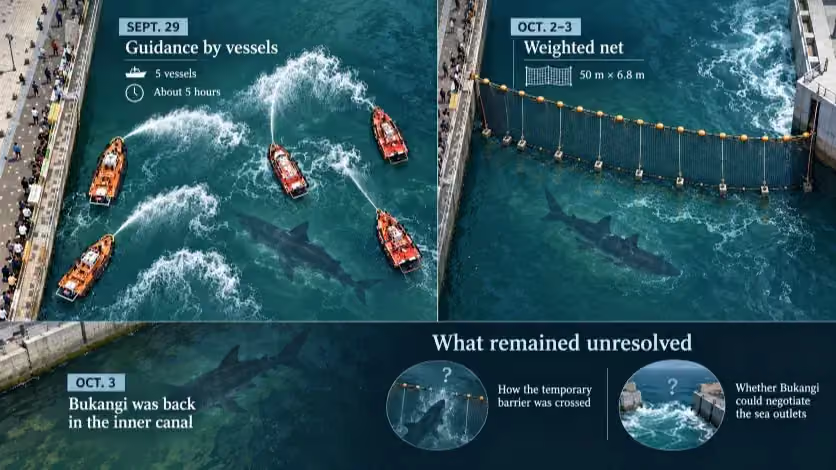
Bukangi, the Shark That Stayed in Busan’s North Port
A rescue net guided Bukangi toward the sea, but the dusky shark returned to B...
 NewsOct 6, 2026
Busan’s Water System Is Entering a Harder Era of Renewal
Busan spent decades building a water system that can absorb major failures. N...
More from the author
More from this byline
Stay with the same line of reporting through more work from this byline.
 NewsOct 9, 2026
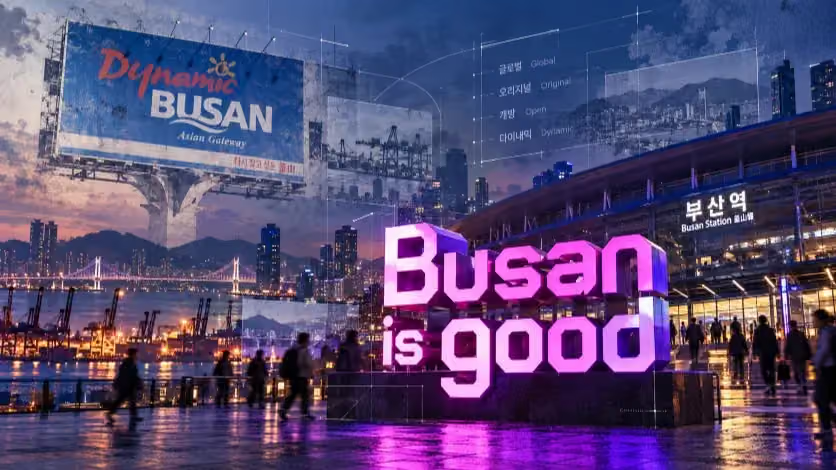
Why “Busan Is Good” Falls Short as a City Brand
 NewsSep 18, 2026
The Other AI Race Is for the Freedom to Change Course
Reader Signal
Community readWhat did this report leave you with?
Choose the signal that best reflects your reading. Select it again to remove it.
One response per article
No response selected
A moderated conversation about the reporting.
One-level replies and newsroom moderation keep the conversation anchored to this article.
Discussion Status
Open
Please sign in to join the discussion.
Newsletter
Weekly reporting and context from Busan and Korea.